
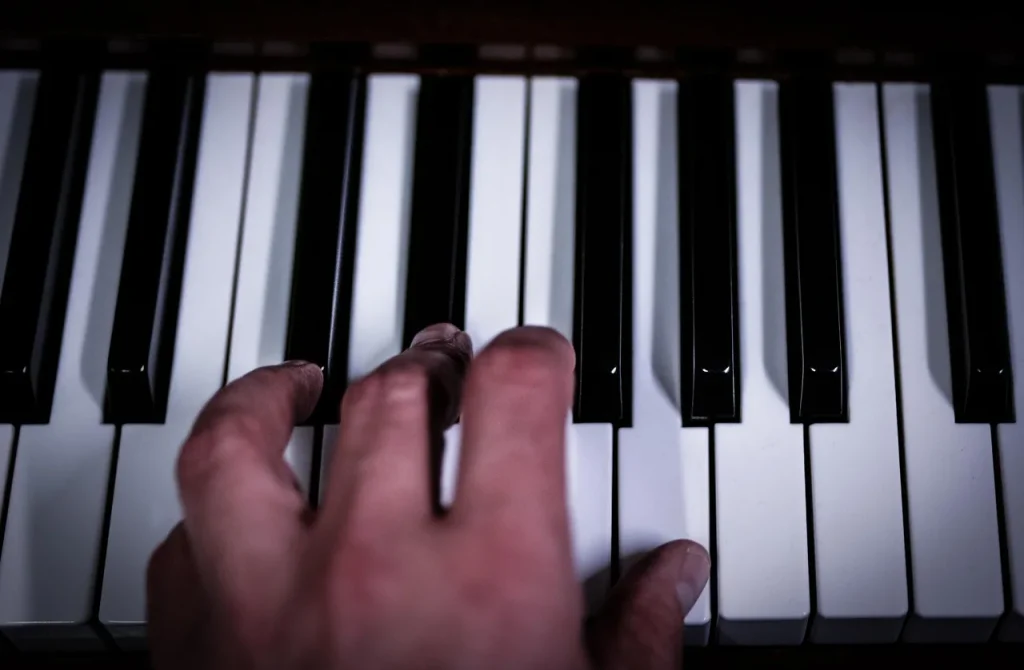
Playing great melodies on a full-size keyboard remains essential for making progress. This article offers a practical framework: why this format reproduces the range of an acoustic piano and supports learning, practice and performance.
Before buying, check the key action and feel, polyphony, sound quality, speakers and headphone experience. Consider connectivity, compatible apps and the space the piano needs. Your budget and value for money are also decisive.
Comparisons from 2025 mention affordable models such as the Donner EC3061, Alesis Recital and Recital Pro, alongside entry-level Roland and Yamaha models. In practice, a good instrument should be judged first by how comfortable it is to play, then by the technical features that help you progress in music.
Why choose an 88-key digital piano in France today?
Full-size keyboards are increasingly available in France and offer advanced key actions even at entry level.
The situation in 2025: the market offers a wide range of affordable digital pianos. Recent tests by Le Monde show that capable models are available for around €400 to €500.
Value for money: the initial cost remains well below that of a new or used acoustic piano. No annual tuning is needed, while adjustable volume and headphone use make apartment living easier.
Learning and the standard format: a full-size keyboard reproduces the range of a traditional piano. This helps avoid a difficult transition when studying at a conservatory or with a teacher.
- Realism: hammer actions, carefully sampled sounds and polyphony support the playing experience.
- Tools: companion apps, built-in lessons and recording make it easier to track progress.
- Players: beginners seek simplicity and a forgiving touch; intermediate pianists want more nuance; experienced pianists look for connectivity and recording.
| Criterion | Benefit | Suggested reference |
|---|---|---|
| Initial price | Less expensive than an acoustic piano | Roland FP-10, Yamaha P-145 |
| Maintenance | No annual tuning | Savings of €80 to €100 a year |
| Apartment use | Adjustable volume, headphones and a smaller footprint | Entry-level portable models |
88-key digital piano: the essentials to check
To choose well, focus first on key feel, action and sound quality.
Feel and action: look for a graded hammer action, such as Yamaha’s GHS or GHC, or Casio’s Tri-Sensor. These systems provide a feel closer to that of an acoustic piano, with heavier keys in the bass and lighter ones in the treble.
Types of action: the difference between a semi-weighted and a hammer action is immediately noticeable. The former is forgiving for beginners. The latter offers more dynamic control and better repetition.
Polyphony and voices
Aim for at least 96 to 128 notes of polyphony to prevent notes from dropping out when using the pedal. Some models reach 192 notes, including Yamaha’s P-125.
Look for well-sampled piano sounds and additional voices that are useful for study and performance.
Speakers and headphone playing
Built-in speakers rated at 20 to 25 W suit a living room: the Alesis Recital offers 20 W and the Donner DEP-20S offers 25 W.
For an apartment, check headphone sound quality and equalization settings.
Connectivity and apps
Check for USB-MIDI and Bluetooth, as well as compatibility with Smart Pianist or Piano Partner 2.
Apps make it easier to adjust sounds and learn; some keyboards also include lessons through Skoove or Melodics.
To examine a specific model, see this listing: FunKey DP-88 II.
Our selection of the best 88-key digital pianos of 2025
Discover the models selected in 2025 for their convincing actions, carefully designed sounds and manageable prices.
Best value for money
Roland FP-10 and Yamaha P-145 stand out. According to Le Monde, their prices are around €399 to €413.
Both offer a credible hammer action, app integration and a compact footprint. The FP-10 has 96-note polyphony; the P-145 has 64 notes.
Versatility and portability
Yamaha P-225 and P-125 suit travel and light studio use.
Their GHC and GHS actions, high polyphony of 194 and 192 notes, and improved sound engines make them suitable for the stage and for recording through apps.
Affordable options
Alesis Recital (20 W, semi-weighted, 128-note polyphony) and Recital Pro (hammer action, 20 W, 12 voices) suit beginners.
They provide access to lessons compatible with Skoove and Melodics and work well in a living room.
Pleasant surprises and alternatives
Donner (DEP-20S, EC3061 and DDP-300) offers 238 sounds, 25 W speakers, 128-note polyphony and a three-pedal unit.
NUX NPK-20 is aimed at pop and electronic music enthusiasts: it has 271 sounds, a large screen and an equalizer. Its touch is respectable, although its sounds are brighter.
| Model | Polyphony | Speakers | Strengths |
|---|---|---|---|
| Roland FP-10 | 96 | Small built-in speakers | Reliable action, app, excellent value for money |
| Yamaha P-145 | 64 | Built-in | Hammer action, Piano Partner 2, competitive price |
| Yamaha P-225 and P-125 | 194 and 192 | Improved | GHC and GHS, sound power, app compatibility |
| Alesis Recital and Recital Pro | 128 and 128 | 20 W | Accessible path for learning, included lessons, suitable for a living room |
| Donner and NUX | 128 and unspecified | 25 W and unspecified power | Large sound banks, connectivity, creative features |
Tip: for classical music, prioritize the action and the brand’s reliability. For creating music, choose a keyboard with a wide range of sounds and connectivity options.
Piano touch: graded hammer, semi-weighted or hammer action
Choosing the right keyboard action determines precision and expressiveness. Key feel influences your technique and playing comfort.
- Semi-weighted — lighter and suited to beginners and tighter budgets, as on the Alesis Recital.
- Hammer action — better repetition and dynamic response; closer to an acoustic piano.
- Graded hammer — weighting changes from bass to treble: lower keys are heavier and higher keys lighter, encouraging proper technique.
GHS, GHC, Ivory Feel and Tri-Sensor: which feel should you choose?
Yamaha’s GHS and its GHC version both have graded actions, with GHC optimized for a portable format.
Roland’s Ivory Feel G combines materials and sensors to provide grip and consistency. Casio’s Tri-Sensor uses three sensors per key to detect velocity and repeated notes precisely.
Try before you buy: check key travel, return, mechanical noise and fatigue after 30 minutes. Consider pedals too: a sustain pedal is essential, half-pedaling is useful for classical music, and a three-pedal unit suits advanced study.
To understand the technical differences, read our guide to types of keyboard action.
Sound quality, polyphony and voices: what changes the experience?
Clear sound and ample polyphony often make playing more enjoyable and precise. Aim for 96 to 128 notes for comfortable practice; 64 notes suffice for simple exercises, while 192 or more suit very dense arrangements.
Polyphony prevents notes from dropping out when you hold chords with the pedal or layer sounds. Typical figures are 64 notes for the P-145, 96 for the FP-10, 128 for Alesis and Donner, 192 for the P-125 and 194 for the P-225.
Quality also depends on the sound engine: Pure CF, SuperNATURAL and Tri-Sensor contribute to resonance, sustain and tone. A few well-sampled piano sounds are better than a huge bank of uneven quality.
A variety of voices helps with composition: concert piano, electric piano, strings or organ. For example, the P-225 offers 24 voices; the NUX NPK-20 has 271 sounds for pop music creation.
“Test with pieces you know and long notes held with the sustain pedal to assess sustain and harmonic consistency.”
Finally, always connect touch and sound: a responsive action reveals the nuances and richness of the samples more effectively. To compare specific models and consult detailed guides, read our practical guide to choosing your instrument.
Speakers, headphones and apartment use
For apartment playing, the balance between built-in amplification and headphone listening is essential.

Useful power: built-in speakers rated at 20 to 25 W are enough for a living room. Models such as the Alesis Recital (2 × 20 W) or Donner DEP-20S (25 W) reproduce bass and midrange reasonably well without turning up the volume and disturbing neighbors.
Headphones and late-night practice: working with headphones helps refine articulation and note accuracy. If available, look for a stereo headphone optimizer to improve the sense of space.
Amplification and placement
Alternate between headphones and speakers to protect your hearing and check how the sound projects naturally. For rehearsals or small venues, external amplification is still needed: check for stereo line outputs or a USB audio/MIDI connection.
Place the instrument on a stable stand, away from resonant walls, and adjust equalization to improve clarity and dynamic response.
| Setting | Solution | Note |
|---|---|---|
| Living room or apartment | 20 to 25 W speakers | Good sound without disturbing others |
| Late-night practice | Wired headphones and an optimizer | Keeps things quiet for others while protecting your hearing |
| Stage or rehearsal | External amplifier and line outputs | Check the USB audio/MIDI connection |
Learning features: metronome, lessons and modes
Built-in learning features turn daily practice into a structured and enjoyable process.
Key features for progress include a built-in metronome, recording, simple accompaniments and song libraries. These tools provide a clear framework for working on rhythm, accuracy and note memory.
Practical study modes
Split mode divides the keyboard between bass and melody, helping you coordinate your hands. Layer mode combines two voices to enrich the sound.
Lesson mode lets you isolate passages and repeat them slowly. Recording helps you take stock: listen back, make corrections and note your progress.
Included lessons and apps
Some models include lessons: the Alesis Recital and Recital Pro offer a metronome, lessons, Split and Layer modes, recording, 60 Melodics lessons and three months of Skoove Premium access.
The Yamaha P-225 offers a metronome and recording, along with Smart Pianist and Rec’n’Share. The Roland FP-10 uses Piano Partner 2 for settings and content.
- Recommended routine: warm up with a metronome, spend 15 minutes on technique and 20 minutes on pieces, then finish with a recording.
- Alternate between Split and Layer modes to develop hand independence and musicality.
- Use apps to track progress and adjust sounds to your level.
“A variety of features makes study more enjoyable and encourages consistency, a decisive factor in progress.”
Connectivity and technology: USB, MIDI, Bluetooth and apps
Choosing the right ports and protocols ensures smooth integration with your devices.
USB-MIDI connects a keyboard to a computer or tablet for composing, recording and controlling music production software. Audio outputs, whether jack or line outputs, connect to an amplifier or interface. Remember to check for a sustain-pedal input to expand your playing options.
Bluetooth makes apps easier to use and sometimes enables MIDI transmission. Check the version and compatibility: some models offer Bluetooth audio, while others support only Bluetooth MIDI.
Apps offer quick settings, Split and Layer modes, recording and sharing. For example, the Alesis Recital and Recital Pro offer USB-MIDI and a headphone output; the Donner DEP-20S includes an MP3 player and LCD screen; the Yamaha P-225 supports Smart Pianist and Rec’n’Share; and the Roland FP-10 supports Piano Partner 2 and, depending on the version, Bluetooth. For more on the FP-10, see the official page.
| Feature | Use | Note |
|---|---|---|
| USB-MIDI | Recording and music production software | Low latency with stable drivers |
| Line and headphone outputs | Amplification and late-night practice | Allow for adapters for mobile devices |
| Bluetooth | Apps and audio transmission | Check the version and range |
| Screen and buttons | Quick navigation | Saves time during rehearsal |
Allow for USB Type-B cables, smartphone adapters and headphones with a suitable impedance to achieve a balanced sound.
Footprint, weight and furniture-style models
Your available space often determines whether you choose a portable model or a more stable furniture-style version.
Comparing formats: portable keyboards are convenient for travel and rehearsals. They generally weigh between 7 and 13 kg: the Alesis Recital weighs about 7.71 kg and the Yamaha P-225 about 13 kg. Heavier furniture-style versions provide greater stability and a full pedal unit.
Dimensions and posture: a full-size keyboard is about 132 cm long. Leave clear space in front of it and use a bench at the right height to protect your posture and playing technique.
Stability while playing: a furniture-style stand reduces vibrations and helps you control nuances. Roland, Yamaha and Kawai offer dedicated stands for greater rigidity.
- Portable models: light, compatible with X stands and easy to move.
- Furniture-style versions: more attractive and stable, often supplied with a pedal unit.
- Effect on price: a furniture-style stand or accessory bundle raises the cost but improves ergonomics and playing comfort.
Tip: choose a portable model if you move it often; choose a furniture-style version if you want a fixed setup and comfortable daily practice.
Budget and value for money: from entry level to premium
A good purchase starts by defining three ranges: entry level, midrange and premium. For serious beginner study, budget around €400 to €500; according to Le Monde, models such as the FP-10 and P-145 offer an excellent starting point.
Entry level: models sufficient for beginners, with a decent action and acceptable polyphony. Prioritize a reliable keyboard over a large sound bank.
Midrange: more polyphony, better samples and useful connectivity for a home studio. Portable models such as the P-125 and P-225 fall into this range.

Premium: a feel close to an acoustic piano and professional features, as on the Casio PX-860 and Roland RD-300NX. The initial cost remains below that of a new upright piano, at around €3,500, and avoids annual tuning, estimated at €80 to €100.
- Start with a portable model; you can later move to a furniture-style version.
- Invest in a set with a stand, bench, headphones and pedal for greater comfort.
- Choose established brands to make resale easier and reduce the overall cost.
“A €400 to €500 keyboard lets you make progress without sacrificing essential quality.”
Quick comparison by type of use
Comparing models by intended use helps you find the best value for money quickly.
Beginners and returning players
To get started, choose simple, reliable models. Le Monde recommends the FP-10 and P-145 for their convincing actions and attractive prices.
Tip: look for polyphony of at least 96 notes and a companion app to guide learning.
Intermediate pianists, home studio and stage
Intermediate pianists will benefit from the versatility and ample polyphony of the P-125 and P-225. With its Tri-Sensor action, the Casio PX-160 offers greater expressiveness for developed playing.
For a home studio, prioritize a stable USB-MIDI connection and line outputs to reduce latency and make the most of carefully designed sounds.
- Tight budgets: Alesis Recital and Recital Pro — included lessons and progress at a manageable price.
- Small stages: prioritize portability, a sturdy chassis and line outputs; external amplification is recommended.
- Pop and electronic music: the NUX NPK-20 offers varied sounds and a built-in equalizer; check whether it meets your needs if you are following a classical course of study.
“Choose according to your level and intended use: a good model today remains a lasting investment in practice and creativity.”
A closer look at leading models from tests and guides
Here is a brief, focused overview of the models most often mentioned in 2025.

Roland FP-10
Advantage: the best value for money according to Le Monde.
Its hammer action is impressive at this price, its response is consistent, and its 96-note polyphony is sufficient for serious study.
Integration with Piano Partner 2 and Bluetooth makes settings and learning easier.
Yamaha P-145, P-225 and P-125
P-145: compact GHC action, 64-note polyphony and samples inspired by the CFIIIS — a dependable beginner choice.
P-225: increased polyphony of 194 notes and 24 voices, ideal for versatility and small stages.
P-125: improved speakers and a Pure CF sound engine, with 192-note polyphony for a wide repertoire.
Alesis Recital and Recital Pro
Alesis emphasizes practicality: the Recital is semi-weighted and offers 20 W speakers, 128-note polyphony and access to Skoove and Melodics.
The Recital Pro offers a hammer action, 12 voices and a full range of learning features to support progress.
Casio Privia PX-160
Its Tri-Sensor Scaled Hammer action uses three sensors per key for more reliable repetition and better dynamic response.
It offers a good balance of low maintenance and playing feel for anyone seeking expressiveness on a budget.
“Test the response and control of dynamics, listen to the main voices and check how easy the basic functions are to use.”
| Model | Action | Polyphony | Strengths |
|---|---|---|---|
| Roland FP-10 | Hammer | 96 | Value for money, Piano Partner 2, Bluetooth |
| Yamaha P-145 | GHC | 64 | CFIIIS sound, compact format, reliability |
| Yamaha P-225 and P-125 | GHC and GHS | 194 and 192 | High polyphony, improved amplification, compatible apps |
| Alesis Recital and Recital Pro | Semi-weighted and hammer | 128 and 128 | Learning features, portability, 20 W speakers |
| Casio PX-160 | Tri-Sensor | About 128 | Expressive response, good balance of feel and musicality |
Brands and ranges to consider in 2025
In the 2025 market, a few brands stand out for their consistent technology and service in France. They cover most needs, from portable models to premium furniture-style pianos.
Yamaha, Roland, Casio and Alesis: market mainstays
Yamaha relies on GHS and GHC actions and its Pure CF engine for a good balance of sound and feel. Roland offers Ivory Feel G and FP and RD models designed for realism.
Casio emphasizes Tri-Sensor for repeated notes, while Alesis focuses on learning with educational features and good value for money.
Other options to watch
Among other brands, Donner stands out for its features at the price. NUX offers playful sounds and controls geared toward pop and electronic music. Glarry and Leadzm remain budget alternatives, often sold with accessories.
- Check consistency of touch, reliability and the quality of local service.
- Consider apps, official pedal units and updates.
- To compare specific models, consult an 88-key piano comparison.
“A well-established brand makes maintenance easier and extends your instrument’s service life.”
Acoustic or digital: choose according to your repertoire and living space

Choosing between an acoustic and a digital piano depends on your repertoire and daily life.
Complementary strengths: the two formats work well together. Digital models suit daily practice, quiet headphone use and small spaces. An acoustic piano retains unmatched resonance and mechanical response.
For classical music or jazz, regular playing on an acoustic piano remains strongly recommended. For pop and electronic music, a good digital piano often provides all the expressiveness needed.
Living space: in an apartment, choose an instrument with headphones and adjustable volume. In a house or studio, the acoustic piano’s soundboard has an artistic advantage.
Costs: both purchase and maintenance costs are higher for an acoustic piano. Silent systems exist, but they often cost more than a ready-to-play digital keyboard.
“Assess how often you play, your repertoire and your living space, then keep the option of playing an acoustic piano.”
| Criterion | Digital advantage | Acoustic advantage |
|---|---|---|
| Quiet playing | Headphones and adjustable volume | Costly silent systems |
| Mechanical response | Good for daily practice | Superior resonance and feel |
| Cost | Lower price and maintenance costs | Higher purchase and maintenance costs |
To compare models and options, consult our practical guide.
Quick checklist for choosing the right digital piano
Here is a concise checklist to help you decide quickly when buying. Keep these points in mind when comparing models in a store or online.
Key feel and pedals
Aim for a graded hammer action such as GHS, GHC or Tri-Sensor for a feel close to an acoustic piano. Test consistency, mechanical noise and key travel.
Choose a pedal that supports half-pedaling, or compatibility with a three-pedal unit if you study classical repertoire.
Polyphony, voices and speakers
Choose at least 96 to 128 notes of polyphony to prevent dropouts when using the sustain pedal. Listen to two or three principal piano sounds, such as concert and studio, as well as an electric piano sound to check their consistency.
Speakers rated at 20 to 25 W are enough for a living room; also test headphone sound and plan for external amplification on stage.
Connectivity and features
Check the stability of the USB-MIDI connection, the availability of line outputs and Bluetooth if needed. Smart Pianist and Piano Partner 2 make settings and learning easier.
A metronome, recording, Split and Layer modes, and built-in lessons through Skoove or Melodics simplify progress.
Ergonomics, space and budget
Consider the weight and dimensions in relation to your room, then choose a furniture-style stand for stability or an X stand for portability.
Budget tip: prioritize action, polyphony and connectivity over the total number of sounds for better value for money.
| Criterion | Recommended minimum | Why |
|---|---|---|
| Action | GHS, GHC or Tri-Sensor | Greater expressiveness |
| Polyphony | 96 to 128 notes | No note dropouts with the sustain pedal |
| Speakers | 20 to 25 W | Comfortable living room use |
| Connectivity | USB-MIDI and line outputs | Studio and stage |
“Always test in real playing conditions — with headphones, speakers and pedals — before making your choice.”
Conclusion
In summary, choose a model that combines a natural response with useful tools for learning.
On a tight budget, the FP-10 and P-145 remain strong choices. For more versatility, consider the P-225 and P-125. Alesis and Donner offer affordable options; the NUX NPK-20 appeals to players who want to explore sounds.
Remember the decisive criteria: a credible hammer action, sufficient polyphony, well-sampled sounds, a coherent audio system and modern connectivity. Test the keyboard’s response, the sustain of notes with the pedal and the controls before buying.
A good digital piano supports a pianist’s progress and makes them want to play every day. Choose an instrument suited to your living space and repertoire for a good balance between enjoyment and progress.