

Goal of this guide: help you understand the strengths and trade-offs of a compact instrument so you can choose one based on the range and features you need.
The P Series brings together keyboards designed for practice, from entry-level models to more advanced versions. It offers options for beginners and demanding musicians alike, with different key actions (GHS, GHC, GrandTouch‑S) and powerful sound engines.
Expect good sound quality and an experience close to playing an acoustic piano every day. This guide compares the P‑45 and P‑145 for beginners, the P‑225 for more features, and the P‑525 for a premium finish.
We will explain how the technologies (CFIIIS, CFX, VRM) affect the playing experience, portability and ease of use. We also cover indicative prices and useful accessories to help you budget for your setup.
Read on: the following sections will help you choose according to your skill level, expectations and available space.
Who is this Yamaha portable digital piano buying guide for?
This guide is for all musicians, from first-time buyers to professionals who need a portable instrument. It helps you make a choice based on your skill level and how you plan to use the piano.
For beginners, the P‑45 and P‑145 offer straightforward controls, a consistent key action and an easy start for regular practice.
Intermediate pianists will find features that support their progress in the P‑225: CFX sound, VRM Lite, Bluetooth and recording. Advanced pianists may prefer the P‑525 for greater expressiveness and finer adjustments.
“Where you play — at home, on stage or in a studio — matters as much as the specifications.”
- Family use: durability and versatility for different players.
- Frequent travel: prioritize weight and connectivity.
- Budget: include a stand, headphones and pedals to improve the playing experience.
| Player | Recommended model | Key advantage |
|---|---|---|
| Beginners | P‑45 | The essentials at an affordable price |
| Dedicated learners | P‑145 | GHC, CFIIIS sound |
| Intermediate players | P‑225 | CFX, Bluetooth, Smart Pianist |
| Advanced players | P‑525 | GrandTouch‑S, CFX & Bösendorfer |
Yamaha portable digital pianos: strengths and limitations
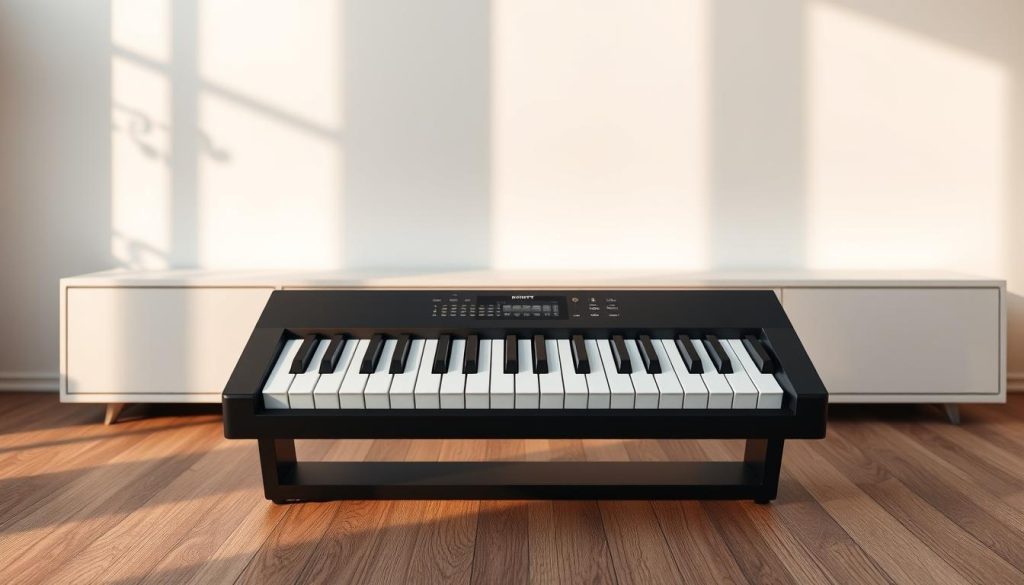
These models have one major advantage: portability. Each lightweight, compact instrument retains a full 88-key keyboard and is easy to transport and set up quickly.
Technical advances
Sound quality improves noticeably with each sound engine: the CFIIIS in the intermediate model delivers fuller bass and precise treble. CFX with VRM Lite adds harmonic richness, while full VRM in the premium model recreates the resonance of a grand piano.
Practical limitations
Most built-in amplifiers are modest (2 × 6 W or 2 × 7 W). They work well at home but have limits in large rooms or on stage. In those settings, plan for external amplification.
How skill level affects your choice
For a beginner, a forgiving key action and adequate polyphony are enough to make progress. An intermediate pianist can benefit from VRM Lite, Dual and Split modes, and Bluetooth when practising with modern tools.
An advanced musician will prioritize a more responsive key action (GrandTouch‑S), more voices and broader connectivity for recording or performing. Ultimately, the balance between keyboard, sound engine, amplification and features determines the playing experience.
Essential selection criteria: key action, sounds, polyphony and connectivity
Focus on the features that affect your playing: keyboard feel, the range of sounds, available polyphony and connectivity.
Key action and keyboard
GHS and GHC use graded hammer actions. They provide a response close to that of an acoustic instrument.
The wooden GrandTouch‑S keyboard broadens the dynamic range and improves control over delicate notes. Four sensitivity levels let you adjust the response to your technique.
Sound quality and technology
CFIIIS provides a convincing foundation. CFX with VRM Lite adds more resonance.
Full VRM models the interaction of the strings for greater authenticity. Polyphony varies: 64 voices for learning, and 192 or 256 for dense textures and extensive pedal use.
Connectivity and apps
USB audio/MIDI ports make recording and home studio integration easier. Bluetooth audio lets you play along with songs without a cable.
Smart Pianist makes it easier to adjust sounds and access practice pieces. Always try the piano through headphones and its speakers to assess its features and how well the key action, sound engine, polyphony and connectivity work together.
Yamaha P‑145: a compact GHC keyboard and CFIIIS sound for beginners
The P‑145 is a compact, modern option for anyone serious about learning piano. It has an 88-key GHC keyboard with four sensitivity levels for a balanced, progressive piano feel.
The CFIIIS sound provides convincing tones for learning and practice. Its 64-note polyphony covers most beginner pieces, even with frequent pedal use.
Portability is a strength: at 11.1 kg, its compact dimensions make it easy to transport and set up. The 2 × 7 W amplification is enough for a living room or headphone practice; for stage use, plan for additional amplification.
Useful features include USB audio/MIDI, Duo/Split modes, a metronome, reverb effects and Sound Boost. This model replaces the P‑45 while remaining easy to configure.
| Feature | Specification | Benefit |
|---|---|---|
| Keys | 88 GHC (4 sensitivity levels) | Realistic feel |
| Sound | CFIIIS | Convincing sound for practice |
| Polyphony | 64 voices | Enough for chords and pedal use |
| Amplification | 2 × 7 W | Home use and headphones |
| Weight | 11.1 kg | Good portability |
In short, this model suits beginners who want a dependable instrument without complex menus. If you progress quickly, consider moving up to the P‑225 for more resonance and advanced features. For a detailed opinion and price information, read this full guide: P‑145 review and comparison.
Yamaha P‑225: a balance of portability and concert piano realism
The P‑225 occupies the middle ground: it is even more compact than its predecessors while offering sound quality you can notice immediately.
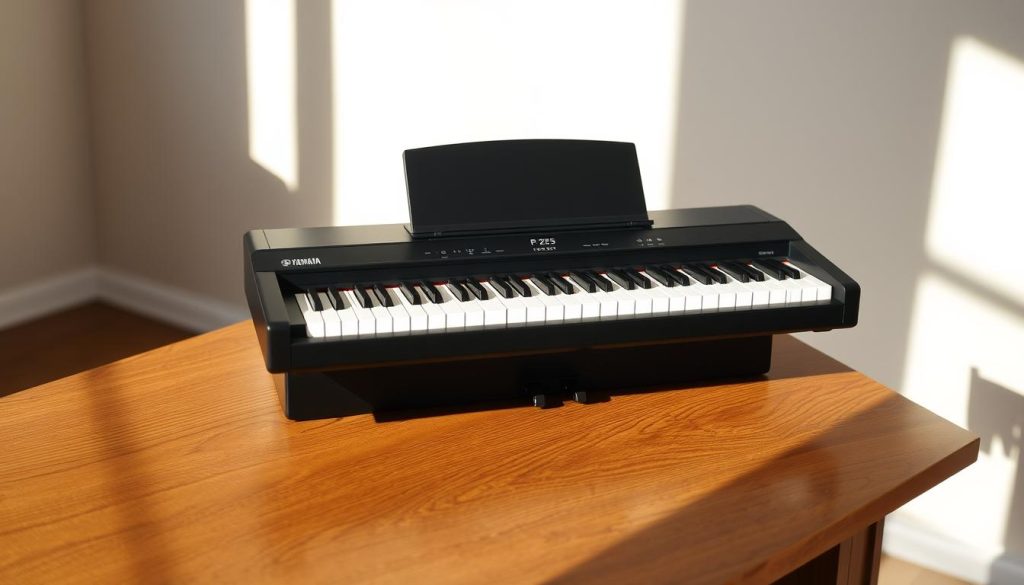
The CFX engine with VRM Lite improves resonance and depth. Treble notes become clearer and bass notes more sustained, producing a sound closer to a concert grand piano.
Strengths
With 192-note polyphony and 24 sounds, dense pieces are more comfortable to play. Dual, Split and Duo modes expand your playing options.
Modern conveniences
Bluetooth audio and Smart Pianist make it easier to play along with your playlists and adjust sounds. Two-track recording helps you practise and track your progress.
Limitations and trade-offs
The 2 × 7 W amplification is enough for home use but limited on stage. The model remains portable at approximately 11.5 kg and 1,326 × 272 × 129 mm.
- 88-key GHC keyboard (4 sensitivity levels): a consistent feel for everyday playing.
- Broad connectivity: USB audio/MIDI, headphone outputs, IAC and acoustic optimizations.
- Observed prices: approximately €499 to €555 — good value for its features and sound quality.
Yamaha P‑525: a premium portable piano for a superior experience
The P‑525 is a premium model for musicians who want the feel of a concert grand while retaining the option to transport their instrument.
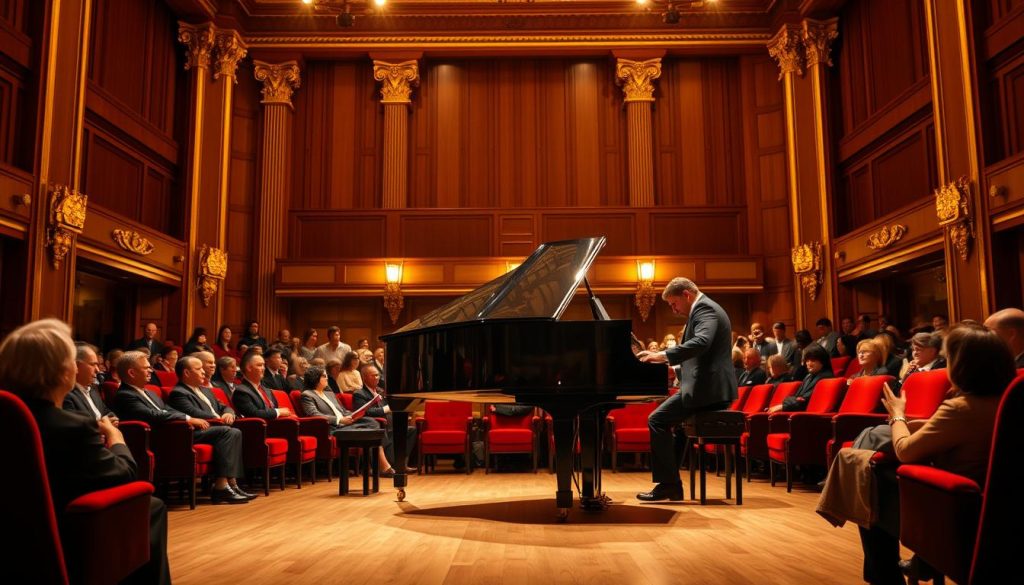
Exceptional key action: the wooden GrandTouch‑S keyboard offers fine control over tone. Precise attacks and nuanced dynamics support expressive playing.
Major advantages
- Two grand pianos: CFX and Bösendorfer Imperial deliver rich tones close to those of a grand piano.
- Full VRM and Grand Expression Modeling
- 256-note polyphony and 44 sounds (+ 18 Drum/SFX and 480 XG) cover every repertoire.
Advanced features
Sixteen-track MIDI recording, up to 80 minutes of USB audio recording, and extensive connections (USB, MIDI, AUX, Bluetooth). Its 20 W + 6 W × 2 amplification, with oval speakers and tweeters, delivers superior sound quality even at low volume.
“A benchmark for players who want a concert piano’s range of sounds without giving up portability.”
Things to consider: its size and weight (1,336 × 145 × 376 mm, 22 kg) require suitable transport arrangements. Its design and durability justify the higher price for demanding pianists.
Budget, accessories and value for money at every skill level
Setting a spending range helps you prioritize key action, sound and accessories.
Indicative prices and positioning
Observed price ranges: P‑45, approximately €298 to €321; P‑145, approximately €398 to €462; P‑225, approximately €499 to €555; P‑525, in the premium range.
Positioning: the P‑45 offers the essentials at a low price, the P‑145 a modern GHC design, the P‑225 a noticeable improvement in sound, and the P‑525 features for professional needs.
Useful accessories
- L‑200 stand (approximately €140) for a furniture-style appearance and good stability.
- SC‑KB851 carrying case for travel; alternative stands (Millenium KS‑101) to keep costs down.
- Recommended headphones: Beyerdynamic DT 770 Pro 80 Ω for precise practice without disturbing others.
- Pedal unit and an extended warranty (from 2 to 3 years at some retailers) for greater peace of mind.
“Good headphones and a suitable stand extend the instrument’s life and help you make progress.”
| Item | Price range | Effect on value for money |
|---|---|---|
| Entry-level model | €298 to €321 | Low cost, with the essentials for beginners |
| Intermediate model | €398 to €555 | Better sound and more features |
| Premium model | Higher price | Greater expressiveness and polyphony |
| Accessories | €50 to €200 | Comfort, protection and performance |
Final tip: choose the value for money that suits your skill level, and look out for bundles and extended warranties to make the most of your investment.
Conclusion
Overall, the range offers clear steps up according to your needs and budget.
For beginners, the P‑145 remains an excellent compromise. If you progress quickly, consider choosing the P‑225. Demanding pianists will find a wider range of sounds and a superior key action in the P‑525.
The resemblance to an acoustic piano comes from the CFX and CFIIIS sound engines, VRM, and GHC or GrandTouch‑S keyboards. These features improve control over dynamics and sustained notes.
Prioritize the keyboard and the quality of its sounds, check the connections (USB audio/MIDI, Bluetooth), and plan for external amplification on stage.
Try the instrument if possible, or use these criteria to choose one that will provide a consistent, lasting playing experience.