
Last updated: September 2025. This introduction aims to help you quickly narrow your choice to one or two models suited to your needs and budget in France.
A good first instrument encourages regular practice and enjoyment. Conversely, a poor-quality model can be discouraging. We explain why the feel, keyboard and sounds matter.
This article is for beginners, pianists returning to practice and musicians looking for a quiet second instrument.
The guide covers formats (portable, console and stage), essential technical criteria, connections, brands and price ranges. You will find verified recommendations and practical points for comparing models.
Method: start with your needs, set a realistic budget, rank your priorities, shortlist models, try them through headphones and their speakers, then decide. For current models and prices, see our selection on quel-piano.
Why this buying guide matters when starting or improving
Success at the keyboard often depends on the instrument: key action, sound and ease of use matter. A good instrument has consistent action and 88 keys. Without these, technique can develop poorly and progress can slow.
At home, digital pianos let you adjust the volume, play through headphones and avoid regular maintenance. Cost matters too: a credible keyboard costs around €400–€500, while a new upright piano often exceeds €3,500 and needs annual tuning.
For adults returning to piano, ease of use and instant availability encourage practice. Modern models include a metronome, recorder and useful apps, though these do not replace time at the keys.
| Benefit | Digital pianos | Acoustic pianos |
|---|---|---|
| Volume and headphones | Yes, adjustable | No (except Silent systems) |
| Starting price | €400–€500 | ≈ €3,500 (new) |
| Maintenance | Almost none | Annual tuning recommended |
This article aims to give you concrete ways to match an instrument to your level and available practice time. Comparing instruments in a store at equal volume remains the best way to assess their feel.
Buying guide: choosing a quality digital piano
A good shortlist starts with clear musical priorities. First, define how you will use the piano: classical study, accompaniment, pop or electronic music, composition or mixing. This guides your choice of sounds and key action.
Set a realistic budget that includes a stand, bench, pedal and headphones to avoid surprises at checkout. Consider future upgrades too, such as compatibility with a console stand, a three-pedal unit or mobile apps.
- Assess your current level and goals for the next 12–24 months: aiming for 88 keys and convincing action will help you progress.
- Rank the criteria: keyboard and action first, then polyphony and sounds, followed by connections and the wider ecosystem.
- Shortlist one or two models within your budget: for example, the Roland FP‑10 or Yamaha P‑145 at entry level, and the Roland FP‑30X a step above.
Before trying them, read qualified reviews and watch blind tests. Bring your headphones and some pieces to play to the store. Match the volumes, check note repetition and test how easy the functions are to use (metronome, keyboard split and recorder).
Make your final choice based on what you feel and hear, not just the specification sheet.
Acoustic, digital, hybrid and “silent” pianos: understanding the differences
Each type of instrument has clear trade-offs in feel, sound and practical requirements. This section briefly compares how they work and where they fit best.
Upright and grand acoustic pianos
An acoustic piano produces sound when felt-covered hammers strike strings stretched over a soundboard. The result is harmonic richness and resonance that other instruments cannot fully reproduce.
The upright piano remains a common choice for apartments because it takes up less space. A grand piano is longer, projects sound better and adds prestige and stage presence.
Digital pianos and how they generate sound
Electronic models reproduce sounds through multilayer sampling and/or resonance modeling. They offer weighted action and useful features: a metronome, recorder, effects, MIDI/USB and playing through headphones.
Stage pianos often have no built-in speakers and connect directly to an amplifier or sound system.
Hybrids and “Silent” systems
Hybrids combine a real mechanical action with digital sound generation. They feel close to an acoustic piano while allowing quiet playing and offering modern features.
“Silent” systems physically stop the hammers before they reach the strings and use sensors beneath the keys. Acoustic sound returns as soon as you turn off the mode. Expect to pay around $6,000–$8,000 for a high-end Silent or hybrid setup.
Quick tip: choose according to use: authenticity and expression with an acoustic, flexibility and quiet practice with a digital, or a balance of both with a hybrid.
The keyboard comes first: 88 keys and piano-like action
Keyboard feel often determines motivation and progress.
Aim for 88 keys to get the full range of an acoustic piano. This avoids repertoire limits and poor hand-position habits from the second year of study onward.
Why aim for 88 keys
Keyboards with 61 or 76 keys remain practical for stage use or small spaces. However, they soon limit a motivated student who wants to play complete pieces.
Types of action and how they feel
Weighted action that is too light feels unrealistic. Semi-weighted action (springs and weights) is acceptable. Graded hammer action replicates an acoustic piano and remains the best option for developing your playing.
Tips for trying a piano in a store
Test responsiveness with fast trills, repeated notes and control from pianissimo to fortissimo. Check consistency from bass to treble, key grip (synthetic ivory or ebony-like surfaces) and the absence of unwanted mechanical noise.
| Criterion | What to check | Examples of actions |
|---|---|---|
| Size | 88 keys for learning | Acoustic piano range |
| Action | Graded hammer resistance, repetition | Yamaha GHS/GHC, Roland PHA‑4/PHA‑50 |
| Keys | Grip, material, sensitivity | Casio Smart Scaled, ivory-like coating |
Sensitivity, dynamics and nuance: the heart of musical expression
The precision of the keys’ response often defines a player’s expressive range.
Sensitivity is the keyboard’s ability to turn playing force into changes in volume and tone. Without it, accompaniments sound flat and melodies lose their shape.
Test the velocity curve by playing scales that grow louder, then softer. Listen to how the sounds change through headphones and then through the speakers: both should respond consistently.
Some models offer sensitivity settings that adapt the response to your touch. Higher-end pianos add multiple sensors to improve repetition and subtle expression.
| Criterion | What to check | Effect on playing |
|---|---|---|
| Sensitivity | Velocity curve, consistency | Dynamic nuance |
| Consistency | Bass and treble | Tonal balance |
| Settings | Soft, standard and hard modes | Adjustment to your touch |
Tip: favor a well-calibrated keyboard over a long list of effects. For classical music and jazz, precise action remains decisive.
Sounds, sampling and polyphony: what you can actually hear
Sound quality varies greatly with polyphony and sampling quality. Polyphony indicates how many notes the instrument can play at once. With the sustain pedal, sounds quickly overlap; 64 voices are a minimum, while 96 to 128 voices provide more headroom.
Good multilayer sampling and alternate samples improve transitions between playing dynamics. More layers can make the tones sound more natural.
Useful effects include room or concert-hall reverb, subtle chorus and equalization to adjust the sound. Beware of excessive effects that hide flaws.
Practical comparisons and examples
For blind tests, match the volume: a mediocre sound through built-in speakers may become convincing through headphones. Bring your own pair to the store to judge.
Examples: the FP‑10 appeals with its responsive action and connectivity (96 voices), while the Yamaha P‑145 remains popular for its CFIIIS-derived tones (64 voices).
- Listen to several presets (bright, mellow).
- Optimize speaker placement at home to hear the bass and stereo image more clearly.
- Use the companion app to fine-tune sound settings.
Formats and uses: portable, console and stage
The keyboard’s format affects ease of use and long-term practice. Choosing the right format makes regular playing easier and avoids unnecessary expense.
Portable
A portable piano is ideal for beginners and for moving around. Light and compact, it is easy to store.
Above a certain price, it often offers 88 keys and realistic action. USB-MIDI ports and headphone outputs are common.
Compact console
Stable and elegant, it includes three pedals and fits more naturally into a living room.
It is harder to move, but offers comfort and a visible presence that encourages daily practice.
Stage
Designed for amplification, it offers professional line outputs and sturdy construction, often without built-in speakers.
It needs a speaker or amplifier, but remains a sensible choice for concerts and studios.
| Format | Use | Indicative price | Main advantage |
|---|---|---|---|
| Portable | Beginning, practice away from home | ≈ €400–€600 | Mobility, connectivity |
| Compact console | Fixed setup, living room | ≈ €800–€1,000 and up | Stability, three pedals |
| Stage | Concert, studio | Varies (depending on features) | Professional outputs, durability |
Tip: a console-style stand lets your setup grow: add one to a portable model for greater comfort without changing instruments.
Space, weight and design: planning for your home
Your available space often determines whether a stable console or a portable model makes more sense.
For 88 keys, allow about 1.50 m of wall space. Include the stand’s depth and enough room to move the bench back so installation day brings no surprises.
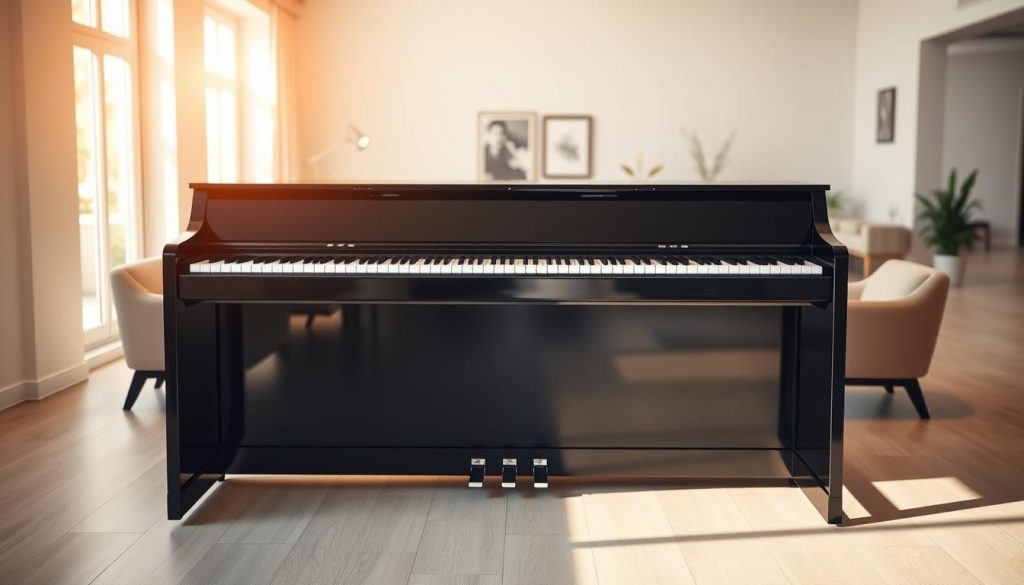
Plan for the weight: a compact console is considerably heavier than a portable model. Check access through stairs or lifts before ordering to limit delivery costs.
Consider how it will look in the room: black or wood finishes, or the appearance of a stage piano. Choose a stable position away from heat and moisture, with enough light for the music rest.
- Plan for storage: a portable model is easier to put away; a console needs a dedicated space.
- Limit sound transmission in an apartment: a rug and stable stand reduce mechanical noise.
- Arrange power, headphone and USB/MIDI cables to keep the area tidy.
Choose a compact, adjustable bench. Think about future changes: you can add a console stand later if space and price allow.
Tip: a well-positioned portable piano can match a console for presence and practicality. Consider how many pieces the setup has and how easily you can change it before choosing.
Connections and ecosystem: MIDI, USB, Bluetooth and apps
Ports and apps often determine how easily an instrument fits into a wider setup.
Many pianos offer USB-MIDI, jack outputs and Bluetooth. USB-MIDI carries data: notes, controller input and automation. It works with learning apps, music-production software and performance editing.
Bluetooth makes wireless control, and sometimes audio streaming, easier. Watch for latency: for real-time playing, use a wired connection where possible.
Headphone outputs let you practice quietly and hear the sound clearly. Check that you can reach them easily in daily use.
Companion apps (Smart Pianist, Piano Partner 2) help you change sounds and velocity curves and track progress. Line or jack outputs connect monitors or a hi-fi system for better sound reproduction.
- Check compatibility with iOS, Android and PC, along with the cables you will need.
- For learning, favor instruments with a recorder, metronome and interactive sheet music.
- In the studio, MIDI recording simplifies editing; direct audio recording lets you make demos quickly.
Advice: consider each brand’s ecosystem: updates, documentation and community support affect an instrument’s longevity and the quality of your choice.
Budget and prices in France today
Looking at the full cost helps you choose a lasting instrument instead of buying on impulse.
As a practical guide for France, expect to pay about €400–€600 for a credible entry-level model. Examples include the Roland FP‑10 at around €399 and Yamaha P‑145 at around €413.
For a midrange compact console, allow about €800–€1,000 (the YDP‑145 at around €833–€835). For a high-end portable, budget more than €1,200 (for example, the Roland FP‑90X).
Remember the accessories. A stand, bench, pedal and headphones often add €100–€250 to the total. Bundles with a stand, pedal unit and bench are often cheaper than separate purchases.
Look out for seasonal promotions: back-to-school sales, holidays and cashback offers (Yamaha: €40 on the P‑145BT, €60 on the YDP‑145 and €70 on the YDP‑165 until 31 October 2025).
| Tier | Range (€) | Examples | Advice |
|---|---|---|---|
| Entry level | 400–600 | FP‑10, P‑145 | Prioritize action and polyphony |
| Midrange | 800–1,000 | YDP‑145 | A console and three pedals help with study |
| High end | Over 1,200 | FP‑90X | Invest if you want a feel closer to an acoustic piano |
Avoid unfamiliar brands with prices that seem too good to be true: a low price can conceal poor action and a short lifespan.
The secondhand market offers opportunities, but check the keys and sensors and whether parts are available. A good branded model holds its value reasonably well and is easier to resell.
Conclusion: waiting for a reliable promotion is better than rushing. Aim for the best balance of price and usefulness for your current and future playing.
Established brands and ranges to consider
Some brands stand out for their respected sounds and keyboard actions. Before trying instruments, identify the range that fits your needs: living room, stage or intensive study.
Yamaha remains a dependable choice: Clavinova for high-end consoles, Arius (YDP‑145) for the compact segment and the P series for portables. The CLP‑825 offers grand-piano sounds appreciated in 2023–2025.
Roland stands out among compact models. The FP series (FP‑10, FP‑30X, FP‑90X) combines PHA actions with high polyphony. PHA action appeals to pianists seeking good note repetition and a natural feel.
Casio offers the Privia and Celviano ranges: highly compact models with up to 256 voices and good value for apartments and living rooms.
Other brands: Kawai (keyboards and Novus hybrids), Korg (the entry-level B2), and Thomann and Alesis as budget options. Always try two brands at the same price point.
Advice: favor established series, support in France and the resale advantages of a recognized brand.
The best digital pianos for beginners (≈ €400–€600)
For a first piano, favor proven models with realistic action and a pleasing sound. This price range includes complete, reliable keyboards for the first year of study.
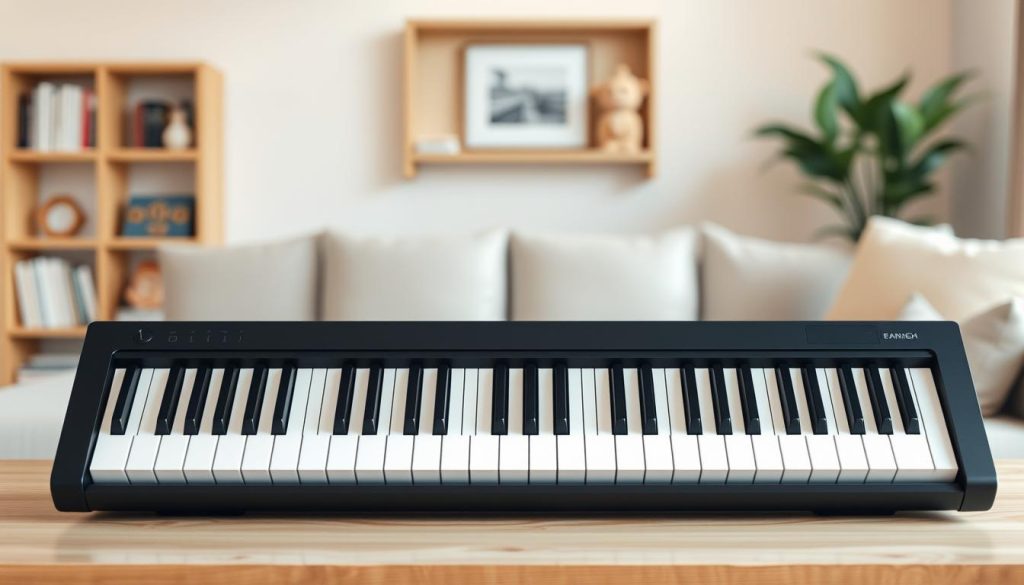
Roland FP‑10: hammer action, polyphony of up to 96 voices, Bluetooth and USB. Excellent value, ideal if you want modern connectivity and convincing action.
Yamaha P‑145: GHC action and CFIIIS-derived tones, with 64-voice polyphony. A dependable, compact and musical choice often named among the best entry-level models.
Casio CDP‑S110 / PX‑S1100: highly compact, versatile models for home use. The CDP‑S110 is a practical low-cost first piano; the PX‑S1100 offers more refinement and features.
NUX NPK‑20: more geared toward pop and electronic music, with 271 sounds and a built-in display. An enjoyable model for exploring different styles without sacrificing playing comfort.
“Always bring your headphones to the store: the FP‑10 and P‑145 often come down to a choice of feel and tone.”
- Polyphony: 64 to 96 voices are enough for study if you use the pedal moderately.
- Check bundles that include a stand and pedal to improve the overall price.
- These models accept an optional console stand and work with learning apps.
Midrange and compact console pianos for progressing players
A broader sound palette and better action often justify moving to a compact console.
Yamaha YDP‑145 Arius remains a popular model for home practice. It offers 88 GHS keys, three pedals and ample polyphony (192 voices). Its console design supports good posture and intensive practice.
Casio PX‑770 / AP‑470 stand out for their ivory- and ebony-like key surfaces and polyphony of up to 256 voices. Their carefully designed feel and sound suit Romantic repertoire.
Roland FP‑30X offers a highly regarded keyboard action and excellent value (around €599). It suits players who want to keep a portable, highly musical instrument.
Advice: listen to the stereo image, compare resonances and check Bluetooth/USB and app compatibility. These models often have better built-in speakers than entry-level instruments.
| Model | Action / keys | Polyphony | Advantage |
|---|---|---|---|
| Yamaha YDP‑145 | GHS / 88 | 192 | Console, three pedals, stability |
| Casio PX‑770 / AP‑470 | Ivory- and ebony-like coating / 88 | 256 | Refined feel and sound |
| Roland FP‑30X | Well-regarded action / 88 | 128 | Highly musical portable, good value |
High-end portables and an acoustic-like feel
High-end instruments often bring the keyboard experience closer to that of a grand piano.
Roland FP‑90X is a benchmark among portables: PHA‑50 action (a combination of composite materials and wood), acoustic-environment simulation and a very wide dynamic range. Its so-called “unlimited” polyphony for piano sounds prevents notes and resonances from cutting off, even with heavy pedal use.
Yamaha CLP‑825 is the entry point to the Clavinova console range: grand-piano tones, weighty action and a rigid cabinet. Its stereo projection and realistic three-pedal unit give it an acoustic-piano presence in the living room.
Practical comparison: the FP‑90X offers mobility and extensive customization; the CLP‑825 emphasizes home integration and an acoustic-piano feel. For an advanced pianist, fast repetition, pianissimo control and the finish of the wood and composite keys make the difference.
| Model | Action / finish | Polyphony | Recommended use |
|---|---|---|---|
| Roland FP‑90X | PHA‑50 (composite materials and wood) | Unlimited (piano) | Stage, studio, customization |
| Yamaha CLP‑825 | Weighted keys, wood finish | High (multilayer sampling) | Living room, intensive practice, acoustic presence |
Advice: try them alongside an acoustic piano to judge key rebound and harmonic richness. To compare models and prices, see our top picks and check connections, apps and modeling options before deciding.
Essential accessories for a good setup
A good setup starts with carefully chosen accessories. They protect the instrument, improve comfort and help bring out its sound every day.
Stands, benches and pedals
Favor a Z-style stand for side-to-side stability, especially if you play forcefully or use the pedal often.
Choose a sturdy, adjustable bench to maintain good posture. Check whether the included pedal meets your needs: a basic sustain pedal is enough at first, but a three-pedal unit becomes useful for advanced repertoire.
Headphones, protection and amplification
Good closed-back headphones with a neutral sound let you play late without exaggerating the bass. Avoid models with an overly colored sound.
For better sound from a portable or stage piano, a pair of studio monitors (speakers) can make a substantial difference. Allow for a padded case if you move the instrument.
Practicality and budget
- Use a stable music rest for thick books.
- Organize cables and power strips with suitable cable ties.
- Comparing accessory bundles can reduce the price by 15 to 25% against separate purchases.
Simple care: clean the keys with a soft, dry cloth. Avoid solvents and harsh products to protect the instrument.
Common buying mistakes to avoid
It is essential to recognize misleading impressions on a specification sheet. Many buyers are drawn to a long list of sounds or an attractive price without testing what really matters for years of practice.
Confusing semi-weighted keys with true piano action
Beware: semi-weighted keys are no substitute for graded hammer action.
To progress, favor an action that reproduces the graded resistance of an acoustic keyboard. Light actions limit the development of technique and expression.
Overlooking polyphony, pedals and connections
Low polyphony soon becomes a problem when using the sustain pedal. Aim for at least 96 voices if you want more headroom.
Test the pedal: its response should be gradual and, if possible, support half-pedaling.
Connections: USB-MIDI and Bluetooth compatibility make online lessons, recording and app use easier.
- Do not judge sound by volume alone in the store: match levels and compare through headphones.
- Be wary of very cheap accessory bundles with flimsy stands and pedals.
- Favor established brands for resale and after-sales service in France.
Conclusion: test action, pedal response and polyphony before secondary sounds; these factors determine whether your choice will serve you over time.
Care, longevity and resale: what to know
Caring for your instrument extends its life and makes resale easier. For a portable piano, maintenance is simple: dust it regularly, protect it from moisture and install software updates when available.
Acoustic pianos need more care. Plan for tuning about once a year (€80–€100). Strings and wood react to humidity and temperature, so periodic adjustments and checks are necessary.
Note: a Silent system or hybrid does not eliminate maintenance of the acoustic mechanism. Mechanical noises remain audible, and the acoustic parts still need care.
Protect the instrument:
- Keep it away from direct sunlight and heat sources.
- Maintain stable humidity and use a sturdy stand.
- Keep the packaging and receipts to make transport and resale easier.
Branded models tend to retain more value. Keep a record of their history (receipts and repairs). Before selling or buying secondhand, test every key and all the connections. Make sure no note is silent.
Finally, a good keyboard can last many years if its action and electronics are well maintained. Parts availability and the brand’s service network in France make out-of-warranty repairs easier.
Current deals and when to buy
Limited-time offers can sometimes make a higher-end model more affordable. Watch back-to-school and year-end periods: discounts, accessory bundles and cashback offers can significantly improve value.
Yamaha currently offers cashback valid until 31 October 2025: €40 on the P‑145BT, €60 on the YDP‑145 and €70 on the YDP‑165. Recently updated models (P‑145, CLP‑825, FP‑30X, FP‑90X) are often worth considering.
Try headphones to judge the sound
In a store, always match the volume, then test models with your own headphones. Blind tests show that sample quality is easier to hear through headphones than through speakers.
- Compare prices across several retailers in France and check their bundles.
- Consider buying after a product-range update to benefit from better software support.
- Read recent reviews and check the store’s return policy.
Final tip: if you are deciding between two models, look at finishes to find offers on black pianos and quickly compare your options: black piano comparison.
Conclusion
Start by reviewing your needs and budget to narrow your choice to one or two suitable models.
A sound approach: aim for 88 keys with graded hammer action, compare polyphony and sampling, then try the models through headphones and speakers.
For a quick shortlist, consider the FP‑10 and P‑145 at entry level; the YDP‑145, PX‑770 / AP‑470 or FP‑30X in the midrange; and the FP‑90X and CLP‑825 at the high end.
Prioritize connections and apps to support progress and easy recording. Also check each brand’s reliability for service and resale.
Ultimately, choose the instrument that makes you want to play every day. Try it in a store with your headphones and sheet music to confirm your choice.