
A clear overview of the French market: this guide brings together design, quality and budget to help you choose quickly.
Popular models: reviews highlight the Roland FP-10, Yamaha P-145 and NUX NPK-20 at the entry level, while the Casio PX-870 WE, Yamaha YDP-165 WH and Korg LP-380U WH lead the furniture-style category.
The guide moves from a quick overview to recommendations, then to technical criteria: keys, polyphony, speakers, connections and headphone practice.
Categories covered: compact models for apartments, mid-range instruments for developing players, premium models for living rooms, affordable beginner instruments and options suited to pop and electronic music.
We emphasize the importance of a three-pedal unit for serious playing and the role of the brand in long-term durability.
The recommendations draw on comparisons for different kinds of players and structured tests. Check prices and availability in France, as both may change.
Why choose a white digital piano today?
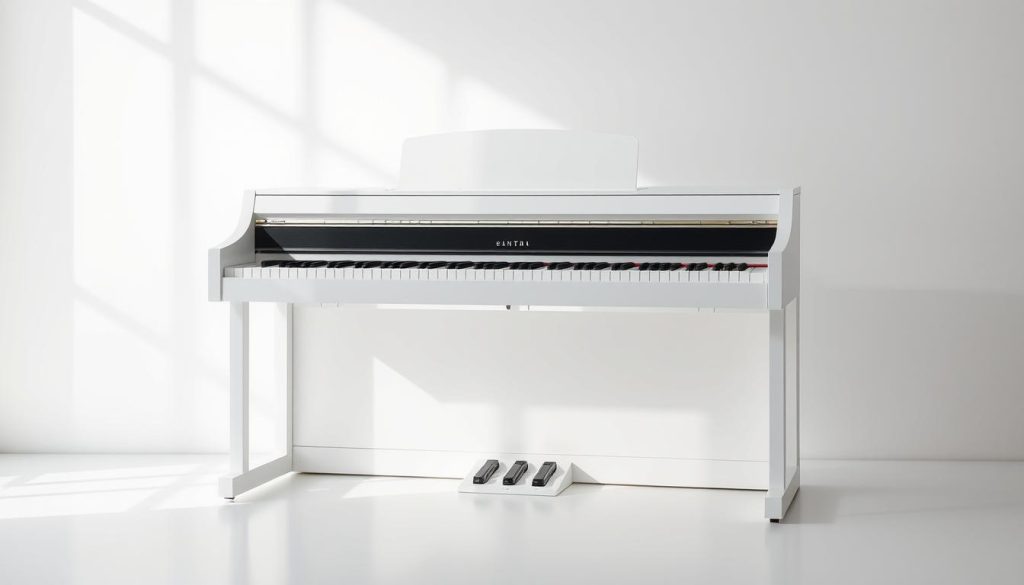
An instrument with a light finish can be practical, attractive and perfectly suited to daily playing.
Design and fit: a white model fits easily into a modern living room without compromising the musical essentials. Its finish adds a decorative touch that suits contemporary homes while remaining understated.
Practical benefits: playing at low volume or with headphones keeps an apartment peaceful. There is no annual tuning to arrange, and it takes up less space than an acoustic piano, making installation and moving easier.
Budget and performance: a good-quality instrument is available from around €400 to €500, compared with nearly €3,500 for a new acoustic upright. Current models often have 88 keys and a convincing hammer action for developing technique.
Finally, USB/MIDI compatibility and, often, Bluetooth make recording and working with modern tools easier. Established brands such as Yamaha, Kawai, Casio, Korg and Roland offer white models at every price level, so you can choose according to your ability and repertoire.
Our key recommendations at a glance
Three models stand out for their balance of design, keyboard feel and ease of use.
Best value for the living room — Casio PX-870 WE Privia: 88 keys, a three-pedal unit, 19 sounds, a sequencer and two headphone jacks. Ideal for a living room where cabinet stability and fixed pedals matter.
A reliable choice for demanding pianists — Yamaha YDP-165 WH Arius: CFX concert-grand sound, a responsive hammer-action keyboard, MIDI export over USB and 2 × 20 W amplification. Well suited to daily classical practice.
A compact, family-friendly design — Korg LP-380U WH: 30 useful sounds, two headphone outputs, USB MIDI/Audio and 2 × 22 W amplification. Its small footprint makes it easy to accommodate without giving up sound power.
Tip: prioritize the sound you actually hear, cabinet stability and connections that meet your recording needs over extra gadgets.
- Price and positioning: these models span the entry and mid-range tiers of furniture-style digital pianos.
- After-sales service and availability in France: favor established brands with a reputation for durability.
White digital piano: selection and key considerations
Before buying, check the features that affect feel, dynamics and everyday use.
88-key keyboard, hammer action and sensitivity
88 keys: this is the standard. They let you play the full repertoire without a restricted range and develop complete technique.
Hammer action: it recreates the resistance and response of an acoustic instrument. Try the touch sensitivity and velocity settings in a store.
Polyphony, sound realism and speakers
Polyphony: aim for 96 to 128 notes to avoid notes cutting off while others ring with the sustain pedal.
The sounds should remain natural. Built-in speakers suit a living room, though their limitations become apparent in large spaces.
Headphones, outputs and connections: USB, MIDI, Bluetooth
Connections: USB/MIDI lets you record and send performances to music production software. Bluetooth MIDI/Audio adds convenience on models that support it.
Look for two headphone outputs so two people can play without disturbing the household.
Sustain pedal or three-pedal unit
A single sustain pedal is enough to get started. A three-pedal unit is recommended for working on expression with sustain, soft and sostenuto pedals.
Footprint, cabinet and fit with your decor
Choose the depth and width according to the space available. Cabinet models are more stable and fit into a living room more like a piece of furniture.
- Try the keyboard in a store to make sure its feel suits you.
- Check that the cabinet is sturdy enough for family use.
| Criterion | Minimum | Recommended | Benefit |
|---|---|---|---|
| Keys | 61 to 76 | 88 | Full repertoire |
| Polyphony | 64 | 96 to 128 | No notes cut off |
| Connections | Jack socket | USB/MIDI and Bluetooth | Easy recording |
For an example of a dependable cabinet model, see the Roland HP704 furniture-style piano, which illustrates these quality criteria well.
Compact white models for apartments and small spaces
If space is limited, some compact models still deliver convincing musical performance.
Korg LP-380U WH
A compact, manageable choice: this model retains 88 keys while weighing around 37 kg.
It offers 30 sounds, reverb and chorus effects, a metronome and transposition. Two headphone outputs make learning together easier.
Its 2 × 22 W amplification and built-in speakers are sufficient for a medium-sized living room.
Connections include USB MIDI/Audio and L/R mini-jacks for connecting a recorder or sound system.
Casio PX-870 WE
Another option with a shallow cabinet: its clean design suits bright spaces.
It offers 19 sounds, a sequencer, transposition and two headphone jacks. The three-pedal unit supports expressive piano playing.
Its value for money is attractive for daily playing and study.
Tip: check the cabinet depth and try the keyboard in a store to make sure its feel suits you.
- Fit with your decor: clean lines for bright interiors.
- Uses: study, a varied repertoire and quiet headphone practice.
| Model | Sounds | Power | Headphones |
|---|---|---|---|
| Korg LP-380U WH | 30 | 2 × 22 W | 2 outputs |
| Casio PX-870 WE | 19 | Amplification suited to a living room | 2 jacks |
Balanced mid-range options for steady progress
Instruments in this category support developing skills without sacrificing sound quality or connectivity.
Kawai CN-201 W
Why we recommend it: this model combines Bluetooth MIDI/Audio with an OLED screen for easier use during practice.
It offers 25 sounds, 7 effects and a sequencer that can record up to 3 pieces. Its learning function helps organize practice sessions.
The 3.5 mm and 6.3 mm headphone jacks work with consumer and professional equipment.
Yamaha YDP-165 WH Arius
Main strength: CFX samples produce a rich, expressive sound, ideal for working on phrasing and dynamics.
The responsive hammer-action keyboard, synthetic ivory- and ebony-feel key surfaces, and MIDI export over USB make recording and tracking progress easier.
Its 2 × 20 W amplification is sufficient for attentive home use.
Practical tip: use headphones to judge the sound accurately. They often reveal more detail than the built-in speakers.
To compare other options in a similar range and find the best value for your budget, see this comprehensive comparison.
| Model | Connections | Sounds and effects | Benefit for practice |
|---|---|---|---|
| Kawai CN-201 W | Bluetooth MIDI/Audio, 3.5 and 6.3 mm headphone jacks, USB | 25 sounds, 7 effects, sequencer | OLED screen, simple recording |
| Yamaha YDP-165 WH | USB MIDI, headphone jacks, 2 × 20 W amplification | CFX samples, detailed sounds | Refined feel, expressive sound |
Space-saving premium models for the living room
For a discerning player, some premium models save space without compromising keyboard feel or sound power.
Yamaha CLP-735 WH
An introduction to the premium range: the GrandTouch-S keyboard simulates an escapement point for a feel closer to a concert grand.
Its library includes samples of the CFX and Bösendorfer Imperial pianos. It offers 38 sounds, 20 rhythm styles and more than 300 practice exercises.
The sound system uses 2 × 30 W amplification. MIDI in/out/thru and USB host/device connections support recording and professional use.
Studio benefit: 16-track recording and USB WAV export let you prepare demos without a complicated computer setup.
Yamaha CLP-745 WH
A step up: wooden keys, 50 W amplification, Bluetooth and a 128 × 64 LCD for smooth navigation.
The sound library is the same, but the more advanced controls make its features easier to access for family use or study.
Tip: try the instruments in a store to feel the difference in their keyboards and decide whether the materials and extra power justify the cost.
Suggestion: these models suit experienced pianists seeking something close to a concert-grand experience, whether practicing with headphones or recording.
| Model | Keyboard feel | Power | Connections |
|---|---|---|---|
| CLP-735 WH | GrandTouch-S with simulated escapement | 2 × 30 W | MIDI in/out/thru, USB host/device |
| CLP-745 WH | Wooden keys | 50 W | Bluetooth, USB, comprehensive connections |
Get started affordably without sacrificing keyboard feel
You can begin confidently on a modest budget by choosing a model suited to your playing and available space.
Roland FP-10: excellent value for money at the entry level thanks to its convincing hammer action. Its 96-note polyphony is useful when using the sustain pedal. Connections include Bluetooth, a mini-jack and USB. The Piano Partner 2 app supports learning. Indicative price: around €399.
Yamaha P-145: a reliable choice with an enjoyable GHC keyboard. Its 64-note polyphony and tone inspired by CFIIIS/CFX samples give it a pleasing presence. Indicative price: around €413.
Both models suit small spaces and headphone practice. In our comparison for different kinds of players, they stand out for their overall balance.
| Model | Keys | Polyphony | Strength |
|---|---|---|---|
| Roland FP-10 | 88 hammer-action keys | 96 | Bluetooth, Piano Partner 2, price around €399 |
| Yamaha P-145 | 88 keys with GHC action | 64 | CFIIIS/CFX sound, natural feel, price around €413 |
For pop, electronic music and sound exploration
When exploring different timbres is the priority, versatile and engaging instruments often make the best choice.
NUX NPK-20: this model stands out for its broad range of 271 sounds and large, intuitive screen. The built-in equalizer lets you shape the tone in real time for the room or piece.
The keyboard remains enjoyable for creative playing and informal learning. Its white finish fits well in a modern home studio.
Strengths: accessible controls, multiple voices, layered sounds and straightforward sound-creation features. Limitation: the piano sounds are fairly bright and less suited to demanding classical study.
- Recommended for: amateur composers, content creators and versatile musicians.
- Suggestion: try the piano, pad and lead synthesizer sounds to see whether they suit your needs.
- Practical tip: use good headphones to hear every detail.
| Feature | Specification | Benefit |
|---|---|---|
| Sounds | 271 | Broad range for pop and electronic music |
| Equalizer | Built in | Shapes the tone in real time |
| Indicative price | Around €549 | Good value for creative use |
Touch and tone: digital versus acoustic piano
Keyboard feel remains the deciding factor for pianists seeking expressive precision.
Response, note repetition and keyboard feel
Playing a fast passage reveals the limitations of some electronic instruments. On an acoustic piano, the complex action and hammer rebound allow notes to repeat almost instantly.
The keys offer fine control over dynamics, useful for legato, trills and quick attacks.
Premium models now simulate escapement and note repetition. Their feel approaches that of an acoustic piano without reproducing its action completely.
Resonance, fullness and the expressiveness of strings
The strings of an acoustic instrument produce rich resonance and complex harmonics. Built-in speakers do not always convey this depth.
With a well-sampled digital piano, listening through headphones or to a good recording can bring its perceived tone closer to that of an acoustic instrument.
Tip: try fast passages and extreme dynamics. Also test the una corda and sostenuto pedals to assess expressiveness.
For intensive classical study, playing an acoustic piano regularly is still recommended. Otherwise, a practical approach is to practice daily on a digital piano and refine your skills on an acoustic one.
To compare cabinet models suited to the home, read this guide to the best furniture-style piano for beginners.
| Criterion | Acoustic | Premium digital |
|---|---|---|
| Note repetition | Very fast | Good, close to acoustic |
| Resonance | Rich and natural | Sampled, limited |
| Dynamic control | Excellent | Good |
Connections and modern features worth prioritizing
How an instrument connects often determines how smoothly you can work in a home studio.
Headphone output and quiet apartment practice
Priority: a quality headphone output improves private listening.
Choose a model with two headphone outputs for lessons with a teacher or playing as a duo. This makes lessons and rehearsals easier without disturbing neighbors.
USB/MIDI, Bluetooth and audio export for recording
A reliable USB/MIDI connection remains the safest option for low-latency recording.
Bluetooth MIDI/Audio makes apps convenient, but test latency before recording performances where timing is critical.
Check whether you can export WAV audio over USB to share and archive your pieces easily.
Metronome, transposition, keyboard split, layered sounds and sequencer
These features make practice easier: the metronome helps with tempo, transposition helps when accompanying a singer, and keyboard split and sound layering expand your tonal options.
The sequencer lets you record ideas, listen back and quickly correct your playing. A clear interface with an OLED or LCD screen makes these functions accessible every day.
“Simple, reliable connections are more useful than a host of unnecessary ports.”
- Check the 3.5 mm and 6.3 mm jack inputs and outputs, along with USB host/device ports.
- Choose a useful selection of voices for your repertoire instead of sound banks you will never use.
How we selected and compared these pianos
For this comparison, we assembled a varied panel and conducted standardized trials.
Testing with different players in a controlled setting
A panel of eight player profiles — a child, student, amateur, teacher, studio musician, composer, professional and concert pianist — played each instrument during sessions in Paris.
The trials were blind, with volume standardized. Fast passages helped assess responsiveness and how long notes sustained with the pedal.
Technical criteria and analysis method
Main criteria: 88 keys, hammer action, polyphony, dimensions, stability and price.
The team assessed the realism of the sounds, sound reproduction, keyboard feel and whether notes cut off when the pedal was used.
The current French market
The French market offers many beginner options around €400 to €500, while cabinet models move upmarket with their pedal units and greater stability.
“We prioritized overall consistency over a score based on a single feature.”
| Feature tested | Observation | Effect |
|---|---|---|
| Keys | Standard 88 keys | Full repertoire |
| Polyphony | 96 to 128 notes recommended | No notes cut off |
| Cabinet stability | Integrated pedal unit | More comfortable playing |
Buying advice for France right now
If you are buying in France today, start by defining your budget and the level you want to reach. Reliable beginner models cost around €400 to €500 (Roland FP-10, Yamaha P-145). Living-room cabinet models (Casio PX-870 WE, Yamaha YDP-165 WH, Korg LP-380U WH) cost more but offer stability and integrated pedals.
Budget and value for money
Set clear price bands: entry level (around €400 to €600), mid-range (€700 to €1,500) and living-room cabinet models (over €1,500). Look for the best balance of keyboard feel, polyphony and warranty. Bundles from specialist retailers often include a stand and pedal unit; compare prices and warranties.
Available space, cabinet and stability
Measure the available depth and width before buying. A stable cabinet protects the instrument during family use and helps keep children safe.
Playing level and progress
Match your choice to your level: beginner, intermediate or advanced. Allow room to progress: a three-pedal unit and comprehensive connections will serve you longer.
Where to buy: specialist stores and online retailers
Compare offers in specialist stores and online. Check bundles, availability, return terms, and home delivery and assembly options for heavy cabinets.
Suggestion: try the keyboard in a store or request a home trial. Keep your warranty documentation and note the return terms.
| Criterion | Recommendation | Why |
|---|---|---|
| Budget | €400 to €500 / €700 to €1,500 / over €1,500 | Covers beginner, developing-player and living-room cabinet models |
| Space | Measure depth and width | Ensures a good fit and sufficient stability |
| Purchase | Specialist store or online retailer | Bundles, after-sales service, delivery |
Conclusion
The right choice combines attractive design, realistic keyboard feel and useful features for daily practice.
Categories: compact apartment models, mid-range instruments for developing players and premium options for a discerning living room. The Casio PX-870 WE, Yamaha YDP-165 WH and Korg LP-380U WH remain dependable living-room choices.
For beginners on a limited budget, the Roland FP-10 and Yamaha P-145 offer convincing keyboard feel. The NUX NPK-20 makes pop and electronic music fun to explore. At the premium end, the CLP-735/745 WH models aim for a professional experience.
Deciding criteria: 88 keys, hammer action, sufficient polyphony, a three-pedal unit, reliable connections and comfortable headphone listening. Always try the instrument to check its feel and controls.
Choose a balance of design, real-world use and a manageable budget. Thanks to current technology, these instruments can make playing at home rich and rewarding.
Final tip: compare offers in France and favor a sturdy cabinet and a reliable brand. The best choice is the piano that makes you want to play every day.