

Goal: this guide helps musicians in France find the best instrument for rehearsals, small venues, or a home studio.
Three categories stand out: portable keyboards (Roland FP-30X, Yamaha P-145, Kawai ES120, Casio PX-S1100), compact models for the living room (Yamaha YDP-S35, Casio PX-870), and console pianos that more closely resemble acoustic instruments (Yamaha CLP-825, Kawai CA-701).
Key criteria include amplification and outputs, connectivity (Bluetooth Audio/MIDI, USB, MIDI DIN), key action (PHA-4, GHC, RHC), polyphony, and performance features (split, layer, recorder).
What this guide covers: a selection of products by use and budget, plus comparisons based on 2025 specifications (voices, power, weight, and connections). Consider the total price: a stand, case, and pedal often add to the cost.
VRM, Harmonic Imaging, and GrandFeel technology enrich the tone and resonance when playing in a band. Read on for quick comparisons and connection advice.
Playing in a band in 2025: what has changed when choosing a digital piano
In 2025, instrument connectivity and key action have evolved.
Bluetooth Audio & MIDI on models such as the Kawai ES120 and Casio PX‑S1100 makes it easier to connect tablets and use backing tracks. However, Bluetooth latency can cause problems on stage: use wired outputs for the PA system.
Key actions are developing quickly. GHC, PHA‑4, RHC, and RHIII offer a more realistic feel. A responsive keyboard helps maintain rhythmic cohesion and control dynamics.
Polyphony is improving too: 192 to 256 voices help prevent notes from dropping out when sounds are layered and the sustain pedal is used heavily. Sound engines such as VRM, SuperNATURAL, and Harmonic Imaging also improve the richness and resonance of a band’s sound.
| Criterion | Impact in 2025 | Example |
|---|---|---|
| Connectivity | Bluetooth is useful in rehearsal; line outputs are essential on stage | Kawai ES120 / PX‑S1100 |
| Key action | Advanced actions improve precision and dynamics | Yamaha GHC, Roland PHA‑4 |
| Polyphony | 192 to 256 voices allow multiple sounds to be layered without notes dropping out | Roland FP‑30X, ES920 |
| Power / outputs | More powerful speakers or quality line outputs to a DI box or PA system | Korg SP‑280, CLP/CA (line outputs) |
Finally, weight and size remain crucial: slim portable models are easier to move but need a sturdy stand. Check the variants sold in France (BT/A, Audio), which may have different specifications.
Next: the following section explains the practical criteria and the best models by use and price.
Key criteria for playing in a band and rehearsing
Power and sound projection determine how well you are heard in the mix. For rehearsals with a drummer, look for speakers rated at least 2 × 20 W or a quality line output to the PA system. The Korg SP-280 illustrates the powerful built-in speaker approach. A compact 2 × 8 W model is enough in a small room if you use an amplifier or DI box.
Modern connectivity
Dual headphone outputs, USB for a digital audio workstation, and MIDI DIN remain essential. Bluetooth Audio & MIDI makes backing tracks easier to use, but watch out for latency. Always bring suitable balanced cables and a DI box.
Keys, action, and feel
PHA-4, GHS/GHC, and RHC actions provide weighted keys and progressively graded resistance, helping you keep time with the band.
Polyphony and performance features
Aim for at least 192 voices; 256 is ideal for layered sounds and sustain. Check for split, layer, recorder, and user memory functions according to your budget and where you plan to play.
| Criterion | Why it matters | Example |
|---|---|---|
| Power | Presence in the mix | Korg SP-280, CLP-825 |
| Connections | Compatibility with stage equipment and digital audio workstations | ES120, FP-30X |
| Key action | Control over dynamics | PHA-4, RHC |
Recommended portable digital pianos for rehearsals and gigs
Compact models often offer the best balance of portability, playing feel, and useful stage features.
Roland FP-30X
PHA-4 action provides a precise, responsive feel, with 256-voice polyphony. Its 2 × 11 W speakers are sufficient for personal monitoring; on stage, use the line output to the mixing desk.
Yamaha P-145 / P-225
Very compact instruments with GHC/GHS actions and CFX/CFIIIS sounds. VRM or VRM Lite adds natural resonance suited to rehearsals and home recording.
Kawai ES120
Quiet RHC action and Harmonic Imaging derived from higher-end models. Full Bluetooth Audio & MIDI connectivity and 192-voice polyphony make it an excellent instrument for lessons and band playing.
Casio Privia PX-S1100
Very slim, light, and easy to carry, it can run on batteries and has two line outputs. Its focused selection of 18 sounds is well suited to small, mobile gigs.
- Practical tip: choose a stable stand and a hard case if you move your keyboard often.
- Aim for at least 192-voice polyphony if you layer piano sounds and use sustain.
- Compare connections (MIDI DIN, USB, line outputs) with your PA system or older instruments in mind.
Compact home pianos suitable for rehearsals
Compact home models combine good looks and stability. They stay in place, fit into the room, and are always ready for rehearsals at home.
Yamaha YDP-145 / YDP-S35
The GHS action and VRM Lite resonance provide a convincing piano feel.
The main CFX sound, 192-voice polyphony, and 2 × 8 W speakers are sufficient for making demos and playing with a small group.
Casio PX-870
The three-sensor action, 256 voices, and 2 × 20 W speakers offer greater dynamics and headroom for layered sounds.
Synthetic ivory- and ebony-style key surfaces and 19 carefully crafted sounds are useful if you alternate between classical music and songs.
- Advantage of a console piano: stable sound projection and comfortable keys for regular practice.
- Limitation: it is less portable than a portable model; check for a line output to the PA system.
- Practical tip: use the built-in metronome and recorder, and test whether 192 or 256 voices are enough for your layered sounds.
This digital piano comparison can help refine your choice by product range and price.
Console pianos with an acoustic feel for playing with others at home
In a living room where musicians get together, high-end console pianos can reproduce the character of an acoustic piano remarkably well while offering digital flexibility.
Yamaha CLP-825
GrandTouch-S and VRM provide nuanced touch and rich resonance. CFX and Bösendorfer samples, along with binaural headphone sound, improve the sense of space.
Audio output, Bluetooth, and 2 × 20 W speakers are sufficient for focused rehearsals at home.
Kawai CA-701
The Grand Feel III action and long keys with synthetic ivory- and ebony-style surfaces provide fine control over tone.
Its 5-inch touchscreen, 96 sounds, and 2 × 55 W speakers let several musicians play together without an external PA system.
- Technology: VRM and Harmonic Imaging affect resonance in different ways when playing in a band.
- Features: a recorder, memories, and Bluetooth for backing tracks useful in rehearsal.
- Advice: test the key action and feel before buying; they matter greatly to how well the group plays together.
High-end stage pianos: expression and versatility
Professional keyboards combine expression, durability, and detailed controls needed on tour.
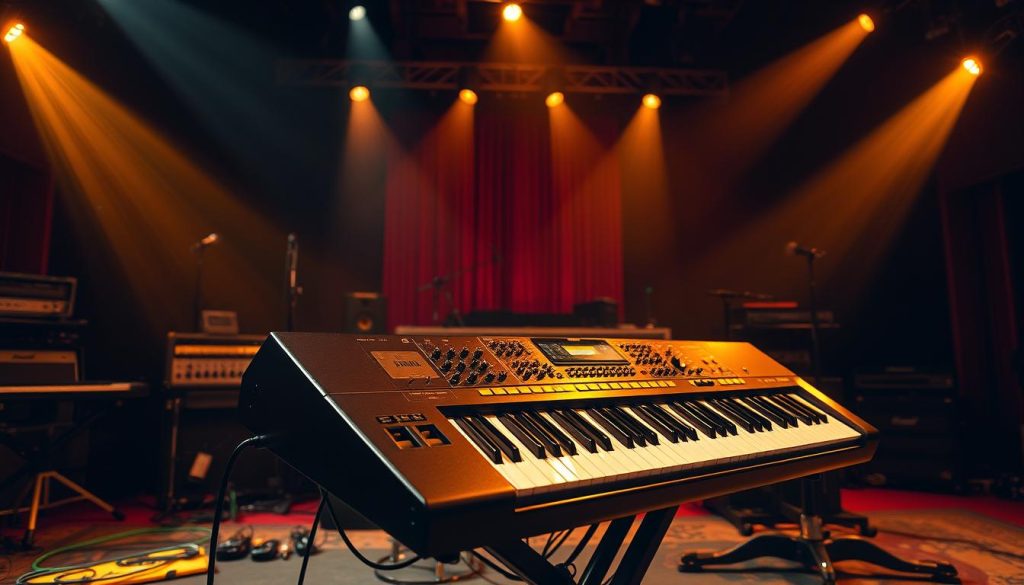
Kawai ES920: a premium portable instrument with a highly responsive RHIII action. It offers 256 voices, 38 carefully crafted sounds, and comprehensive outputs for the PA system and monitors. Equalizer settings and velocity curves let you adjust its response for each venue.
Nord Stage 4 73: a benchmark for professionals. Four dedicated sections (piano, organ, synthesizer, and effects) and premium sound libraries cover a wide range of music. Its high price and considerable weight are offset by its stage-friendly controls and reliability.
The versatility and advanced features of these models let you move smoothly from an acoustic piano solo to synthesizer pads.
| Model | Strengths | Best use |
|---|---|---|
| Kawai ES920 | RHIII, 256 voices, 38 sounds, stereo outputs, detailed controls | Realistic acoustic and electric piano sounds, indoor sessions, and monitoring |
| Nord Stage 4 73 | 4 sections, premium sounds, professional effects, stage presets | Professional touring, varied styles, multi-keyboard setups |
| Comparison | ES920: excellent key action; Nord: broad sound palette | Choose according to your needs: piano feel or maximum versatility |
Practical advice: plan your connections (stereo outputs, multiple pedals, MIDI/USB), get a sturdy flight case, and back up your presets. A sound technician and in-ear monitors help ensure consistent performances.
Effective entry-level models for starting to play in a band
An affordable, well-equipped model makes the transition easier from first rehearsals to small gigs. Start with an easy-to-use instrument that has line outputs and a quality pedal.
Korg B2
The Korg B2 offers weighted keys and 12 sounds. It is easy to get started with, although its amplification is modest.
It is ideal for starting out in a band if you plan to use the rehearsal room’s PA system.
Thomann DP-26 and SP-5600
The DP-26 offers 20 sounds, 128-voice polyphony, and a useful recorder for capturing ideas.
The SP-5600 is an arranger: its 600 sounds and 230 styles let you create backing demos quickly.
Korg SP-280
The SP-280 stands out for its built-in power: 2 × 22 W, MIDI In/Out, line outputs, and two headphone sockets.
A stand and pedal are included, making it an excellent choice if you want good value for money.
| Model | Strengths | Limitations |
|---|---|---|
| Korg B2 | Weighted keys, simplicity, 12 sounds | Modest amplification, limited features |
| Thomann DP-26 | 20 sounds, recorder, numerous outputs | 128-voice polyphony, basic sounds |
| Korg SP-5600 | Full-featured arranger, 600 sounds and 230 styles | Key action feels less like a piano |
| Korg SP-280 | 2 × 22 W, line outputs, stand and pedal included | Heavier and bulkier |
- Choose a keyboard with line outputs so it is easier to fit into the mix.
- Get a quality sustain pedal and a hard case if you transport the instrument.
- Listen to the main acoustic and electric piano sounds: these are the sounds that need to fit into the band’s mix.
Connectivity and amplification in a band: good practices
Careful amplification gives every instrument room in the mix without letting the keyboard mask the others. Follow a few simple rules to avoid distortion and maintain consistent sound quality.
Using line outputs with a mixing desk or PA system without distortion
Connect the keyboard’s line output to a DI box or mixing desk. Use short, good-quality cables where possible and a DI box for longer runs.
Setting levels: start with a moderate level on the keyboard, then adjust it at the mixing desk. Do not turn up the output to compensate for weak built-in speakers: you could overload the mixing desk’s input.
Balancing headphones during a quiet rehearsal
Dual headphone outputs (FP‑30X, SP‑280) are useful for practising together. Use a small headphone mixer to balance the instruments.
Remember to save presets and volume levels for each song to speed up transitions.
Bluetooth Audio/MIDI: when is it useful on stage?
Bluetooth MIDI is useful for controlling an app. Avoid Bluetooth Audio for essential parts: its latency can disrupt the tempo.
“On stage, use a line output connected to a DI box and reserve Bluetooth for nonessential backing tracks.”
| Situation | Tip | Example |
|---|---|---|
| Long cable run | Active DI box, balanced XLR cable | SP‑280 → DI → mixing desk |
| Quiet rehearsal | Dual headphone outputs or a headphone mixer | FP‑30X, SP‑280 |
| Essential parts on stage | Bluetooth MIDI can be used; avoid Bluetooth Audio | ES120 (Bluetooth MIDI), PX‑S1100 (Bluetooth) |
Pack TRS, XLR, and USB cables, label your lines, and disable the model’s built-in speakers in its menu to avoid duplicate sound. Finally, a quiet sustain pedal limits mechanical noise on stage.
Key action and playing comfort: getting closer to an acoustic piano
How the keys feel affects expression and precision. A well-calibrated keyboard lets you play from pianissimo to fortissimo predictably and helps the band stay in time.
Graded hammer actions: progressive resistance and escapement
Graded hammer actions provide greater resistance in the bass and lighter resistance in the treble. Simulated escapement makes quick note repetition easier and creates a feel close to that of an acoustic piano.
Synthetic ivory- and ebony-style key surfaces: control and comfort
These surfaces, found on some models (CLP, CA, PX‑870), improve grip and reduce slipping during long sessions.
Benefit: better control of dynamics and less finger fatigue.
Testing note repetition and velocity curves
Check the consistency of the velocity response and note repetition across the entire keyboard. Try several models side by side using the same headphones and settings.
“Compare PHA‑4, GHS/GHC, and RHC/RHIII: each action has its own characteristics. Choose according to your style (classical, jazz, pop).”
- Key noise: some actions are quieter, which is useful when rehearsing with headphones.
- Build quality: check that the keys feel consistent; an advanced action may justify a higher price.
- Technology: sampling and modeling turn your playing into realistic sounds.
Polyphony, sound engines, and sound libraries: preventing dropped notes
Voice management and the sound engine often determine whether a dense passage can be played without notes dropping out.
192 or 256 voices: the effect of layering and sustain
Polyphony of 192 voices (ES120, YDP-145) is sufficient for simple pieces and limited sound layering.
With several layered sounds and prolonged sustain, 256 voices (FP-30X, ES920, PX-870) significantly reduce the risk of notes being cut off.
Sampling, modeling, and resonance
Sound engines differ. VRM (Yamaha), SuperNATURAL (Roland), and Harmonic Imaging (Kawai) handle resonance and note release in different ways.
The result: a sound closer to an acoustic piano and a better response to sustain and half-pedaling.
Practical features and sound libraries
Sound libraries, particularly those on the Nord Stage 4, offer variety and ease of use. Check how quickly you can change sounds and assess the quality of the acoustic and electric piano sounds before buying.
Always test how the instrument responds to the pedal and compare several models through the same PA system.
| Feature | Impact | Example |
|---|---|---|
| Polyphony | Prevents notes dropping out when sounds are layered and sustain is used | 192 voices: sufficient / 256 voices: preferable |
| Sound engine | Realism of resonance, note release, and half-pedaling | VRM, SuperNATURAL, Harmonic Imaging |
| Sound libraries | Suitability for the setlist and speed of sound changes | Nord Stage 4, ES920 presets |
Brands to consider for band playing
Each manufacturer has a characteristic sound and set of controls that affect playing comfort. Here is a practical overview to guide your purchase by use, budget, and portability needs.
Yamaha
A versatile, established brand in France. The P-145/P-225 and YDP-145 series cover the entry-level range useful for rehearsals, while the CLP-825 offers more for home studios and small venues.
Its technology includes CFX sounds and VRM (or VRM Lite). The brand has an extensive service network.
Roland
The brand is known for its SuperNATURAL technology and PHA actions. The FP-30X remains an excellent balance for rehearsals and small gigs thanks to its key action and polyphony.
Korg
The brand emphasizes portability and built-in power. The B2 and SP-280 offer effective amplification (2 × 22 W for the SP-280) and straightforward connections, useful if you want to play without an external PA system.
Kawai
The brand is known for its key action and the realism of its SK-EX pianos. The ES120 suits regular use; the ES920 and CA-701 meet the needs of musicians who demand more from the action (RHC/RHIII) and from stage performance.
According to your budget: Yamaha and Roland offer a strong balance of quality and price, Korg emphasizes built-in power, and Kawai focuses on piano feel. Always try the model in context and check accessory availability and after-sales support.
Guide to the best digital pianos
How much should you budget for playing in a band?
Budget and intended use often determine the ideal model: your investment should reflect your musical priorities.
Small budget: up to €600
Ideal for rehearsals and home use. Choose a simple, reliable instrument with line outputs and a quality pedal.
Examples: Korg B2, Roland FP‑10, Yamaha P‑145, Kawai ES120 (around €599).
Midrange: €600 to €1,200
This range offers better key action, more polyphony, and useful features (Bluetooth, balanced outputs).
Strengths: regular travel, small gigs, and good value. Reference models: FP‑30X, ES120, PX‑S1100, SP‑280.
High-end: from €1,200
For stage and studio use: expressive playing, extensive sound libraries, and durability. Budget for accessories and a flight case too.
Examples: ES920, CLP‑825, P‑525, CA‑701, Nord Stage 4.
| Range | Indicative budget | Use |
|---|---|---|
| Entry-level | Up to €600 | Rehearsals, beginners, home |
| Midrange | €600 to €1,200 | Regular travel, small gigs |
| High-end | From €1,200 | Professional stage use, studio |
Practical tip: include cases, a stand, and pedals (€100 to €300) in the total price. Consider resale value: well-known brands tend to retain their value better. Invest according to your main use first, then add to your setup.
Essential accessories for playing in a band
Good equipment improves group playing. Accessories provide safety, consistent sound quality, and comfort during rehearsals and gigs.
Pedals: sustain, half-pedaling, and triple pedals
A quality sustain pedal is crucial for controlling resonance and connected notes with realistic piano sounds. Half-pedal support allows fine control; check compatibility with your model (polarity, continuous control, or on/off operation).
For classical repertoire or expressive playing, a triple pedal (or a dedicated unit on a console stand) adds useful soft-pedal and sostenuto functions.
Closed-back headphones and suitable audio cables
Choose comfortable closed-back studio headphones with a suitable impedance for long sessions. Many keyboards have dual headphone sockets (FP‑30X, SP‑280), useful for playing together.
- Cables: balanced TRS cables, XLR cables with a DI box, and 3.5 mm to 6.35 mm adapters. Choose durable cables for stage use.
- Organization: identify cables by color and length to set up your equipment quickly.
Hard case, stable stand, and bench
Protection: a flight case or hard case protects the keyboard in transit; match its size to the instrument’s weight and dimensions.
Stability: avoid flimsy stands; choose a sturdy X-style stand or the brand’s dedicated stand (for example, the KSC‑70 for certain models).
Comfort: an adjustable bench supports good posture and comfortable playing during long sessions.
“A surge-protected power strip, labeled cables, and a compatible pedal prevent 90% of rehearsal problems.”
For technical details and accessory buying advice, see our guide to essential accessories.
Quick comparison by scenario
Choosing according to your use and performance setting helps you decide quickly.
Rehearsal room
FP-30X: PHA-4 action, 256 voices, and 2 × 11 W — good sound presence and useful presets.
ES120: RHC action, 192 voices, and full Bluetooth connectivity — useful for backing tracks and lessons.
PX-S1100: 192 voices, line outputs, and battery operation — ideal when portability matters most.
Small venue with a PA system
ES920: RHIII, 256 voices, and stereo outputs — stage flexibility and a quality signal to the mixing desk.
P-225 with a DI box: GHC, CFX sounds, and VRM — the DI box provides a suitable level for the PA system.
SP-280: 2 × 22 W and line outputs — a complete option if you prefer built-in speakers.
Home studio and video recording
YDP-145 / YDP-S35: CFX and VRM Lite — attractive sound, console-piano styling, and ease of use.
CLP-825: GrandTouch and VRM — expressive playing and convincing sound through microphones and headphones.
CA-701: Grand Feel III and 2 × 55 W — power and premium tone for demanding recordings.
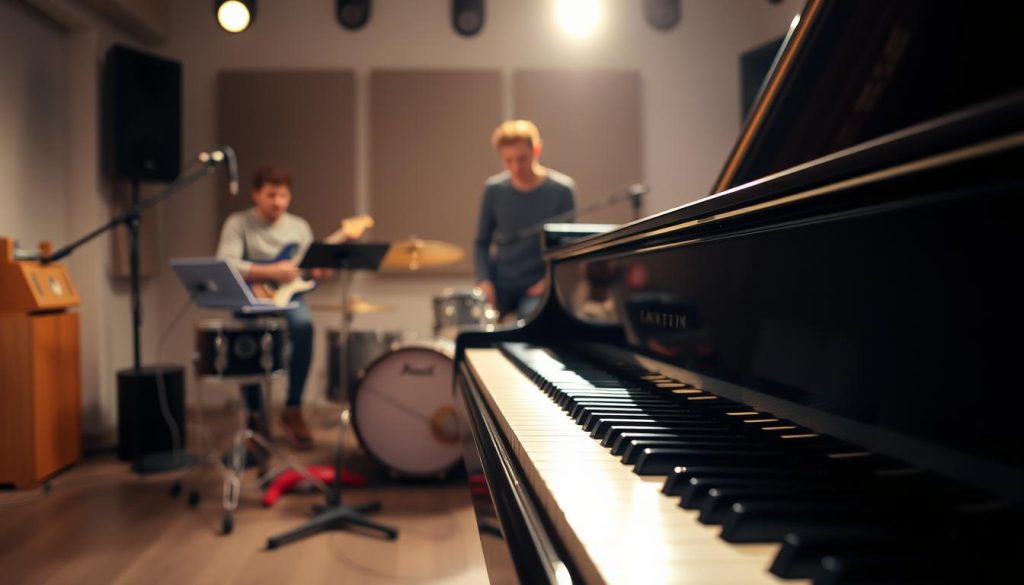
How to choose: check polyphony, connections (line/DI), and ease of setup. The balance of price and features also depends on accessories you need to add, such as a DI box, case, or flight case.
- Practical reminder: portable digital pianos offer the most flexibility for moving between rehearsals and gigs.
- Match the sounds to the band’s style (acoustic piano, electric piano, organ) and prepare presets for each song.
- Stage checklist: power supply, pedals, cables, DI box, stand, bench.
Try the three recommended models in each scenario to confirm your preferences for key action and controls. For a compact option with a built-in amplifier, see this offering too: Korg XE20 / SP option.
Which digital piano is best for playing in a band?
The quickest method: define your main use (rehearsals, small gigs, living room), then focus on three essentials: line outputs/DI compatibility, polyphony, and key action.
Portability and a moderate budget: consider reliable choices such as the FP-30X, ES120, or PX-S1100. These models balance feel, connections, and weight for frequent rehearsals.
Small venue with a PA system: consider the ES920, P-225 with a DI box, or SP-280. They offer quality stereo outputs and enough power to sit in the mix without placing excessive demands on the mixing desk.
Home use and a console piano: the YDP-145/S35, CLP-825, and CA-701 range from practical to high-end and offer an acoustic-piano-like feel and a virtual grand piano sound.
- Sounds: choose your main tone (Yamaha CFX, Kawai SK-EX, Roland SuperNATURAL): it will help define the band’s sound.
- Test the key action: rhythmic precision depends on it; try several models in realistic conditions.
- Total budget: add the stand, case, pedals, and cables to the purchase price so your setup is ready to use.
“If you are unsure, start with a midrange model; upgrade when you are playing on stage regularly.”
Final tip: if you want to learn more before buying, consult this complete guide to refine your choice according to your budget and intended use.
Conclusion
The essentials: prioritize reliable line outputs, an expressive action (PHA‑4, GHC, RHC/RHIII), and 192- to 256-voice polyphony to prevent notes dropping out.
Be careful with Bluetooth: it is useful in rehearsal, but choose wired connections on stage. Test the reference models (FP‑30X, ES120, ES920, P‑225, PX‑S1100, SP‑280, YDP/CLP, CA‑701, Nord Stage 4) in conditions close to those of your gigs.
Accessories: a case, stand, bench, and pedals make your setup more reliable and protect your investment. Match your choice to your budget and use: a suitable, properly connected instrument is more useful than an oversized model whose capabilities you do not use.
The ultimate goal is inspiring sound, dependable controls, and smooth group playing in service of the music.