

Goal: help you make your choice between two major approaches to sound and touch. This article by Sophie Duval (August 23, 2024) compares the CLP and P families with the FP and LX ranges.
We compare the use of CFX and Bösendorfer samples with SuperNATURAL and modeling technologies. The focus is on key feel (GrandTouch, PHA‑50), polyphony, Bluetooth connectivity and portability.
Concrete examples will guide you: P‑145 and P‑225, FP‑30X and FP‑60X, CLP‑845 and LX‑5. Each section will cover weight, speaker power and keyboard action.
What to expect: clear points of comparison to help you narrow your shortlist before trying the instruments in a store. The practical goal is to find the best fit for your needs, budget and quality expectations.
Understanding your purchase: which digital piano suits your needs in 2025?
The right instrument depends above all on how you plan to use it and what you expect from it in 2025.
First, define your main use: learning at home, returning to classical studies, creating modern music, accompanying pop songs or practicing quietly with headphones.
Then consider your level. Beginners appreciate a simple interface and a forgiving keyboard action. Intermediate and advanced pianists will look for greater precision and dynamic control.
Match your budget to the range: entry level (P‑145, FP‑10) for a serious start; portable midrange (P‑225, FP‑60X) for versatility; premium furniture-style models (CLP‑845, LX‑5) for a high-end living-room experience.
Consider your surroundings (apartment or living room) and the connectivity you will use: a learning app such as Smart Pianist or Stream Lights, or Bluetooth Audio/MIDI and Piano Designer for creative work.
| Profile | Use | Recommended model |
|---|---|---|
| Beginner | Simple learning | P‑145 / FP‑10 (approximately €400–€500) |
| Intermediate | Versatility, computer-based music production | P‑225 / FP‑60X |
| Living room / concert | Premium furniture-style experience | CLP‑845 / LX‑5 |
Yamaha vs Roland digital piano comparison
The two brands generate piano tone in different ways. One approach relies on samples recorded from concert pianos (CFX, Bösendorfer). These carefully made recordings provide a sound that is ready to play and faithful to the tone of a reference grand piano.
Real-time modeling
The other approach uses modeling to recreate mechanical and acoustic interactions in real time. SuperNATURAL and Piano Reality engines provide a lively response and highly responsive nuances.
Headphones or room sound
Through headphones, sample-based binaural technology aims to create a natural sense of sound around the head. Meanwhile, 3D processing and multichannel projection offer more adjustable spatial immersion.
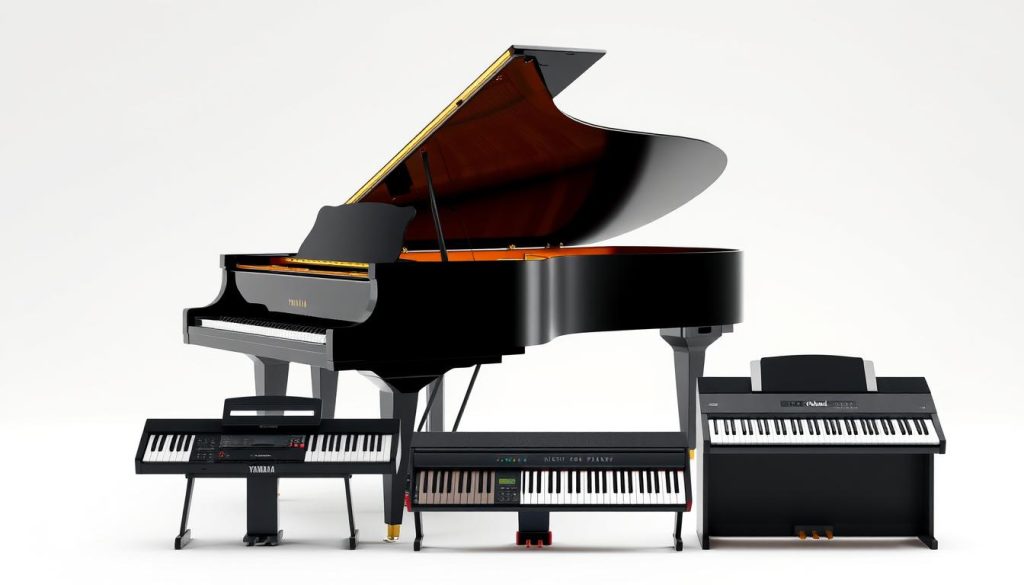
| Strength | Sample-based approach | Modeling-based approach |
|---|---|---|
| Sound quality | Faithfulness to the recorded tone | Dynamic, adjustable response |
| Customization | Limited (consistent studio-recorded sound) | Parameters: resonances, noises, projection |
| Example models | CLP‑845 / CLP‑835 / CLP‑735 (clear sound) | FP‑90X / LX‑5 (warmth, wide dynamic range) |
| Sound output | Two-way stereo, well-defined sound | Multichannel 3D projection (four speakers on the LX‑5) |
Tip: try the instruments side by side. Choose sampling if you want a convincing tone straight away. Choose modeling if you want to shape the sound and explore detailed settings.
Touch, action and keyboard quality: how the keys feel
Touch remains the deciding factor when choosing a keyboard that feels close to an acoustic instrument. The feel under your fingers guides your playing and technical progress.
GrandTouch‑S / GHS‑GHC and PHA‑50 / PHA‑4
GrandTouch‑S actions reproduce behavior close to that of a grand piano: longer key travel and noticeably weighted keys, as on the CLP‑745.
The portable GHS/GHC series offer a graded, lighter feel that is ideal for beginners (P‑145).
For its part, the hybrid PHA‑50 combines wood and plastic for durability and responsiveness (LX‑5).
The PHA‑4 includes escapement and a triple sensor: detection is more precise and dynamics more nuanced (FP‑10).
- Heavier touch: better control in classical repertoire.
- Responsive action: supports articulation in jazz and pop.
- Try an instrument yourself to judge how closely it feels like an acoustic piano according to your preferences.
| Model | Action | Characteristic | Recommended use |
|---|---|---|---|
| CLP‑745 | GrandTouch‑S | Weighted keys, long travel | Classical music, expressiveness |
| LX‑5 | PHA‑50 | Wood/plastic, responsive | Jazz, pop, precise attack |
| P‑145 | GHC | Light, graded touch | Beginners, portability |
| FP‑10 | PHA‑4 | Escapement, triple sensor | Technical development |
Polyphony and note control: play without sounds cutting out
Available polyphony determines whether sounds cut out when you use the pedal or layer tones. It is a technical specification that affects real-world performance.
128, 192, 256 voices or more: when should you prioritize a higher limit?
Polyphony is the maximum number of notes that can sound at once, including resonances and effects.
Practical guidelines: 128 voices are often enough for everyday playing. Polyphony of 256 voices, as on the CLP‑735 and FP‑90X, provides comfortable headroom for rich pieces and layered sounds.
- Entry level: P‑145 = 64 notes; FP‑10 = 96 notes — figures suited to learning.
- With the sustain pedal, held chords accumulate virtual voices; in dense pieces, limited polyphony can cause notes to cut out.
- Modeling sometimes adds voices to simulate resonances, increasing the demand on available polyphony.
“Aim for 192 to 256 voices for Romantic repertoire or advanced studies; 64 to 96 voices remain sufficient for beginners.”
Tip: choose polyphony according to your level and intended repertoire. It preserves musical expression when you use multiple pedal effects and tones.
Sound palette and modeling: beyond the piano
An instrument’s sound palette extends far beyond piano tone alone. It determines what you can play and produce in the studio or on stage.
Acoustic character or modern versatility
Yamaha emphasizes carefully crafted, consistent acoustic tones. The P‑525 offers approximately 542 sounds, ideal for an organic result (pianos, strings, organs).
Roland emphasizes variety. The FP‑60X offers more than 358 sounds, including synthesized textures and useful layers for live arrangements.
Modeling and creative uses
Here, modeling helps refine the responsiveness of Roland’s electric pianos and enrich their interactive effects. At Yamaha, the quality of the sound libraries strengthens acoustic realism.
| Feature | P‑525 | FP‑60X |
|---|---|---|
| Number of sounds | Approximately 542 | More than 358 |
| Focus | Acoustic tones | Modern / synthesized textures |
| Ideal for | Classical music, jazz, studio | Stage, production, mixed styles |
“Choose according to your musical approach: realism or sound exploration.”
Features and apps: learning, practice and creativity
Software tools change how you learn, rehearse and create. They often determine whether an instrument serves as a learning tool or a production station.
Smart Pianist, Stream Lights and chord analysis
Smart Pianist is an app that analyzes chords, offers lessons and displays scrolling scores. It makes practicing from a smartphone or tablet easier.
The Stream Lights system (CSP‑275) adds visual learning with LEDs above the keys. It suits beginners who want to improve step by step.
Bluetooth Audio/MIDI, Piano Designer and Twin Piano
Bluetooth Audio/MIDI connectivity enables wireless playback and app control. Piano Designer provides detailed tone customization.
Twin Piano divides the keyboard into two identical zones. This feature makes teacher–student lessons and immediate hands-on practice easier.
Recording, songs and metronome
Built-in features — metronome, songs and recording — are essential for tracking progress. Some models offer a USB recorder; others have an internal recorder (around 10 songs on the FP‑90X).
“For integrated teaching tools and straightforward use, choose the learning-focused ecosystem; for creativity and wireless connections, look to performance-focused tools.”
Tip: choose according to your priorities: teaching tools (Yamaha, Smart Pianist, Stream Lights) or connected creativity (Roland, Bluetooth and Piano Designer) to support your progress over time.
Connectivity and integration: USB, Bluetooth, Wi‑Fi, smartphones and home studios
Connectivity often determines how easily an instrument fits into your studio or living room.
In practical terms, some models prioritize a stable wired connection. For example, the CLP‑735 offers USB Host/Device ports and an AUX jack, useful for wired recording and using Smart Pianist.
USB Audio/MIDI or Bluetooth: what is the difference?
USB Audio/MIDI provides reliable transmission and low latency. The P‑145 offers a USB Audio connection useful in a home studio.
Bluetooth eliminates cables when playing backing tracks and quickly connecting to an app. The FP‑60X adds Bluetooth Audio/MIDI and even a microphone input for the stage.
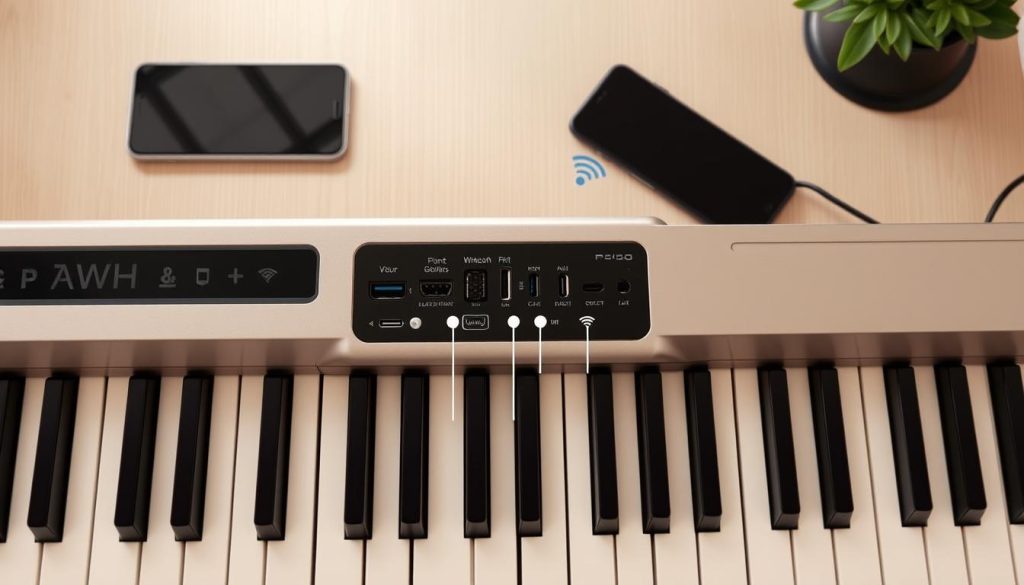
From home practice to the stage
For the stage, prioritize dedicated jack outputs and a microphone input. Wireless connectivity makes playback from a smartphone easier, but check the connection’s stability.
| Feature | CLP‑735 | FP‑60X | P‑145 / FP‑10 |
|---|---|---|---|
| USB Audio/MIDI | Yes (Host/Device) | Yes (Host/Device) | P‑145: yes / FP‑10: no (Bluetooth MIDI) |
| Bluetooth Audio/MIDI | Often via an adapter | Built in | FP‑10: built in / P‑145: no |
| Microphone input | No | Yes | No |
| Recommended use | Wired home studio, apps | Wireless stage & studio | Beginners / simple recording |
“At home, USB remains the most reliable connection; at rehearsals, Bluetooth offers freedom.”
Design, furniture and portability: appearance, weight and size
Design and size sometimes shape everyday use more than technical specifications do.
A classic cabinet fits into a living room and blends with the décor. Clavinova models offer this elegant upright silhouette, designed to last.
The FP range offers a contemporary shape and portable models. LX models return to a cabinet design with modern lines.
Appearance and shape
Classic cabinet: understated, suited to living rooms and a permanent setup.
Modern style: compact and uncluttered, ideal for the stage and contemporary spaces.
Weight and mobility
The P‑225 weighs approximately 17 kg; the FP‑60X weighs approximately 15 kg. The FP‑60X is therefore about 2 kg lighter, an advantage when transporting it.
For a traveling musician, every kilogram counts: choosing a lighter instrument makes journeys and quick setups easier.
Size and setup
The P‑145 measures 132.6 × 26.8 × 12.9 cm (approximately 11.1 kg); the FP‑10 is less deep (128.4 × 25.8 × 14 cm, approximately 12.3 kg). Choose according to the space available.
Dedicated stands (L‑100B, KSCFP10) improve stability and integration. They also affect posture and everyday practice.
| Criterion | Appearance | Weight (kg) | Recommended use |
|---|---|---|---|
| Cabinet-style piano | Classic, understated cabinet | Varies (cabinet models are heavier) | Living room, permanent setup |
| Portable models | Modern, streamlined shape | P‑225: approximately 17 / FP‑60X: approximately 15 | Stage, traveling musicians |
| Compact entry level | Minimalist design, small footprint | P‑145: approximately 11.1 / FP‑10: approximately 12.3 | Small spaces, home practice |
| Accessories | L‑100B, KSCFP10 stands | Negligible additional weight | Stability, posture, integration with furniture |
“For mobility, prioritize low weight and compact size; for the living room, choose a cabinet that complements your interior.”
Durability, reliability and pedals: a long-term investment
Investing also means choosing an action that will withstand years of practice. Materials and design affect durability and how consistent the touch remains over time.
Robust actions and wear
PHA‑50 combines wood and synthetic materials: this pairing offers strong responsiveness and notable longevity. Reports indicate that it holds up very well, even with intensive use.
GrandTouch‑S favors greater key mass for stability close to that of a grand piano. Synthetic ivory surfaces improve grip and limit surface wear.
Sustain pedal and half-pedaling
The pedal and its sensitivity are essential for nuance. Continuous-detection systems offer precise half-pedal control, useful for Romantic and Impressionist repertoire.
Damper Modeling simulates the complex interaction of strings and enriches resonance. The GP Response Damper adjusts the action curve for a more natural release according to how firmly you press.
“Good care — regular dusting and protection from moisture — extends the instrument’s life without demanding extensive maintenance.”
- Durability: PHA‑50 and GrandTouch‑S are designed for sustained use.
- Wear: synthetic surfaces help maintain grip and consistency over time.
- Pedal: prioritize continuous detection and half-pedaling for greater nuance.
- Minimal maintenance: dusting the instrument and keeping it away from moisture are generally enough.
| Element | PHA‑50 | GrandTouch‑S |
|---|---|---|
| Materials | Wood and synthetic materials (hybrid) | Weighted keys, stable construction |
| Responsiveness | High and durable | Very good, with dynamic control |
| Wear | Good resistance, occasional slight mechanical click (PHA‑4) | Synthetic ivory surface, limited wear |
| Pedal system | Damper Modeling (continuous detection) | GP Response Damper (adjusted curve) |
For practical advice and detailed comparisons, see our dedicated page: complete guide to the models.
Value by range: which model fits your profile?
At each budget level, some options offer a better balance of features and ease of use. This guide compares three ranges to help you choose according to your needs.
Entry level
P‑145 focuses on simplicity: 64 voices, 10 sounds and USB Audio for recording. Its uncluttered interface will appeal to families and beginners seeking good entry-level quality for approximately €400–€500.
FP‑10 stands out with 96 voices, Bluetooth MIDI and a more advanced PHA‑4 keyboard. It is a good choice if you want to progress quickly and use mobile connectivity.
Portable midrange
The P‑225 emphasizes the CFX sound signature and a sturdy body (approximately 17 kg). The FP‑60X reduces the weight (approximately 15 kg) while offering more sounds and Bluetooth Audio/MIDI. Both models have strong features for stage and studio use.
Premium cabinet models
The CLP‑845 aims for faithful reproduction with GrandTouch‑S, VRM and binaural sound; its headphone performance is remarkable. The LX‑5 emphasizes immersion through PHA‑50, Piano Reality modeling and multichannel projection. The main differences lie in customization and soundstage.
Which choice suits which player?
- Beginner / family: prioritize a simple interface and reliability.
- Intermediate player / technology enthusiast: focus on connectivity and the sound library.
- Teacher: Twin Piano or Smart Pianist makes lessons easier.
- Traveling musician: choose the lightest instrument with connections suited to mobile use.
“Choose according to how you will actually use it: the best range is not always the most expensive, but the one that meets your priorities.”
Conclusion
Ultimately, your investment should reflect your practical needs and musical interests.
In summary: one brand emphasizes immediately accessible authenticity (CFX/Bösendorfer samples, GrandTouch‑S, binaural sound, Smart Pianist), while the other offers extensive sonic flexibility (SuperNATURAL / Piano Reality, PHA‑50/PHA‑4, multichannel projection, Bluetooth Audio/MIDI).
Your listening preferences, desired key feel and place of use (headphones, living room, stage) determine the best choice.
Try the P‑145 / FP‑10, P‑225 / FP‑60X and CLP‑845 / LX‑5 side by side to confirm your preferences.
Use a shortlist of models to assess weight, connectivity and budget more easily and make a lasting, satisfying purchase.