
Choosing the right instrument is essential to expressing your playing fully. A demanding musician expects a realistic touch, responsive pedals, and a rich sound.
Key criteria: keyboard sensitivity, polyphony, amplification, and modern connectivity. Consider portability if you perform live, or a cabinet model if the instrument will stay in your living room.
Established brands—Yamaha, Roland, Kawai, Casio, and Korg—offer distinct sound signatures. The aim of a buying guide is to narrow the choice to one or two models to try in a store.
Prioritize value for money: the price should reflect the quality of the keyboard, speaker power, and sound technology, rather than design alone.
For more information on models and price ranges, see our selection of the best digital pianos.
Buying guide for advanced pianists in France
Before buying, a structured approach helps you narrow the selection quickly and save time in the store.
Define your needs. Consider your repertoire, available space, and how often you travel with the instrument. These factors will guide your choice of format and price range.
Budget and price: look at typical price ranges in France to set a realistic budget. Compare sound quality, amplification, and finish before considering the price tag.
Prioritize keyboard feel and the sensation under your fingers over lists of technical specifications. Test the dynamic range and pedal response through headphones.
Useful features: look for a metronome, recorder, split and dual modes, and USB, MIDI, and Bluetooth connectivity if you record or use apps.
Whether based on sampling or modeling, the sound engine affects perceived quality and dynamic nuance. Check how easy the controls are to use, too.
Make a shortlist of one or two models to test without rushing. Finally, check return policies and warranties in France before completing your purchase.
Digital Piano for Advanced Pianists: Our Advice
What distinguishes an advanced musician from an intermediate one is the refinement of their control and their technical demands.
What sets an advanced pianist apart
An advanced performer needs high polyphony and a highly responsive keyboard. They expect fine control over dynamics, rapid note repetition, and sustained notes that remain stable.
Pedal response must be precise enough to manage resonance and nuance. The sound engine must support the complexity of the repertoire, rather than merely produce a pleasant sound.
Refining your choice before testing in a store
“Limiting your selection to one or two models lets you spend more time trying each one and assessing it thoroughly.”
Prepare representative passages (Chopin, Debussy, jazz voicings) to test dynamics and harmonic detail. Check that the sound remains consistent through headphones and speakers at a volume suitable for home use.
- Check the feel and action; avoid compromising on the keyboard.
- Assess amplification: projection and clarity of individual notes.
- Test velocity and reverb settings to refine the feel.
Record your impressions of no more than two models and base your decision on objective criteria: feel, pedal response, polyphony, and sound quality.
Choosing the right format: portable, compact, cabinet, or stage piano
The format determines where and how you play: in the living room, at rehearsals, in the studio, or on stage.
Portable models and stage pianos
When to choose a portable or stage instrument
A portable model suits musicians who move between home, the studio, rehearsals, and small venues.
Examples: Roland FP-10 and FP-30X, Kawai ES120/ES920, and Yamaha P145/P525. These models are easy to set up on a stand, and some are sold in bundles with dedicated stands.
Stage models may have no built-in speakers. They need external amplification but provide outputs and controls suited to live performance.
Compact and cabinet pianos for the living room
Advantages of compact and cabinet models
Compact pianos fit neatly into a room and take up less space. They often provide even amplification and a rich sound at low volume.
Cabinet pianos come closest to an acoustic instrument in appearance and ergonomics. Common examples include the Yamaha YDP-145, YDP-S35, YDP-165, and CLP-825, as well as the Casio PX-870.
| Format | Portability | Amplification | Ideal use |
|---|---|---|---|
| Portable | High (lightweight; can be placed on a stand) | Built in; varies by model range | Rehearsals, studio, small venues |
| Stage | Medium to high (usually without a cabinet) | Often absent or limited; external amplification needed | Concerts, professional performances |
| Compact | Low (light cabinet) | Good for home use | Apartment, living room |
| Cabinet | Very low (fixed installation) | Excellent and even | Demanding home use |
- Check the weight and durability if you travel frequently.
- Bundles with dedicated stands improve stability and playing comfort.
- Your choice of format affects the total cost (stand, three-pedal unit, bench) and longevity.
Essential advanced criteria to assess before buying
Before buying, first assess the technical features that directly affect musical expression.
Touch and hammer actions
The hammer action determines precision, repetition, and control over dynamics. GHS and GH3 actions offer good progression; GH3 allows more precise note repetition.
PHA-4 and PHA-50 actions use sensors to provide stability and consistency. Kawai’s Grand Feel action has longer keys and a pivot point close to that of an acoustic piano.
Key surfaces and feel
Synthetic ivory and ebony key surfaces improve grip and consistency, which is useful in humid conditions. The pressure point and adjustable velocity curve let you adapt the keyboard’s response to your touch.
Sound quality and technology
Samples of CFX and Bösendorfer pianos provide rich tones. Roland uses SuperNATURAL and modeling; Kawai develops its own sound engines. Hybrid approaches combine realism and expressiveness.
Effective polyphony and complex playing
Polyphony prevents notes from cutting out when you layer notes played with both hands while using the pedal. A 128-note polyphony limit is sometimes enough, but 192 or 256 notes are recommended for dense repertoire and orchestral textures.
Amplification and speakers
Power affects projection at home: it often ranges from 2 × 8 W to 2 × 20 W or more. Speaker size and placement affect clarity. Also test whether the sound is consistent through headphones and speakers, as well as the pedal response (half-pedaling, repetition).
| Criterion | Musical impact | Practical benchmarks |
|---|---|---|
| Action | Precision, repetition | GHS/GH3, PHA-4/PHA-50, Grand Feel |
| Key surface | Grip, comfort | Synthetic ivory and ebony, pressure point |
| Sound | Tone, dynamics | CFX/Bösendorfer, SuperNATURAL, modeling |
| Polyphony | Sustained notes | 128 notes (minimum); 192 to 256 recommended |
| Amplification | Projection and clarity | From 2 × 8 W to 2 × 20 W or more; speaker placement |
Assess the price in light of the keyboard, sound engine, and amplification rather than secondary features.
Polyphony and demanding repertoire
The ability to manage simultaneous notes directly affects the sustain and clarity of a dense passage. In Romantic, Impressionist, or jazz works, the sustain pedal lets sounds accumulate. Without enough capacity, some notes cut out and the music becomes less clear.
Why 192 or 256 notes make a difference
Instruments such as the Roland FP-30X offer 256-note polyphony, while many compact and cabinet models offer 192 notes. This headroom prevents left-hand arpeggios, the melody, and simultaneous resonances from causing notes to cut out.
MIDI triggering increases the number of notes required still further: multitrack recording and layers in split and dual modes demand more resources than playing a single part.
- “Effective polyphony” varies with the sound engine, effects, and simulated reverb.
- Consistency between headphone and speaker sound depends on how the instrument manages simultaneous notes.
- Some brands optimize note allocation to reduce cutoffs.
Practical advice: allow extra polyphony if your repertoire is ambitious. Test long notes held with the pedal, rapid trills, and layered sounds: these situations reveal the quality of the response and touch. In the long run, spending a little more on polyphony may be better value than replacing the instrument.
Extra features that really matter
Useful features turn an instrument into a practical tool for practice.
A metronome, MIDI/audio recorder, and file playback support structured practice and self-assessment. A built-in recorder makes it easier to rehearse and analyze mistakes without external equipment.
Split/dual mode lets you layer strings with piano or separate bass and melody to work on them independently.
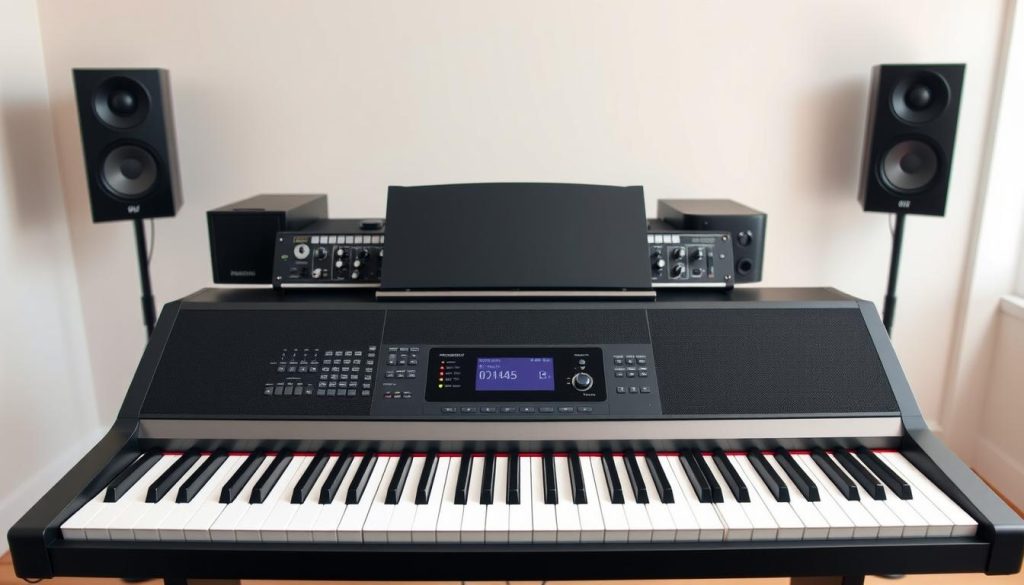
“A well-balanced effects system improves presence without obscuring the character of the sound.”
Reverb and chorus add depth when used sparingly. Test the settings through headphones to judge their real effect on sound quality.
Pedal response, especially half-pedaling, lets you shape resonance. The traditional three pedals (sustain, sostenuto, una corda) remain essential for nuanced expression.
| Feature | Benefit | What to check |
|---|---|---|
| Metronome | Rhythmic precision | Subdivisions and accents |
| Recorder | Self-assessment, saving performances | Audio/MIDI formats, export quality |
| Split/Dual | Practicing hand parts and textures | Layer quality, latency |
| Effects (reverb/chorus) | Sense of space | Realism and precision of settings |
| Pedals | Control of resonance | Travel, comfort, half-pedaling |
- Check pedal travel and stability, especially with portable stands.
- Prioritize direct access to features while playing over complicated key combinations.
- Avoid accumulating features at the expense of keyboard and sound quality.
Tip: use good headphones to hear the subtleties of the effects and pedal response before comparing prices and other specifications.
Modern connectivity for the studio and learning
USB and Bluetooth connections make studio and home use easier. They let you record, use learning apps, and control virtual instruments.
USB, MIDI, and Bluetooth: integration with DAWs and apps
USB audio/MIDI allows direct recording into a digital audio workstation (DAW) with less latency than an external interface.
Bluetooth MIDI/Audio makes it easier to use apps such as Smart Pianist and play backing tracks from a tablet or smartphone.
Workflows and practical uses
A simple example: send MIDI data to a computer, record it, then record the internal sound engine to produce a clean final result.
Controlling virtual instruments adds more sound textures without changing instruments.
“Connectivity must be stable and compatible with Windows, macOS, iOS, and Android.”
| Connection | Main use | What to check |
|---|---|---|
| USB audio/MIDI | Direct recording into a DAW | Port type (B/C), drivers |
| Bluetooth | Learning apps, backing tracks | Stability and latency |
| Line and headphone outputs | Monitoring and live output | Stereo quality, output level |
- Save velocity curves and presets via USB.
- Check for firmware updates from the manufacturer.
- Remember: good connectivity expands what you can do, but cannot make up for a poor keyboard.
Recommended brands and sound signatures
Each brand develops a sound identity that can guide your choice according to repertoire and use.
Yamaha balances realism and reliability. The Arius, Clavinova, and P Series ranges feature CFX and Bösendorfer samples. These instruments suit both living rooms and studios.
Roland emphasizes the expressiveness of its SuperNATURAL engines and PHA actions. The FP and RP series suit uses ranging from stage to studio, often with a highly precise dynamic response.
Casio stands out for its value for money. The Privia and Celviano ranges offer compact designs and useful features without stretching the budget.
Kawai prioritizes its Grand Feel action and a sensation close to an acoustic piano. Longer keys and a distinctive tone allow warm nuances.
Korg offers reliable instruments for rehearsal and performance. Their clarity and ease of use appeal to musicians who travel.
“Listen to the sound signatures: Yamaha’s brightness, Roland’s character, Kawai’s softness, Korg’s clarity, and Casio’s value for money.”
Try several models in the same range and compare them with good headphones. To refine your choice, read our brand guide and check build quality and after-sales service in France.
Leading models for advanced pianists
Here is a selection of models appreciated for their touch, sound, and amplification. It can help you target a store visit based on your intended use.
Cabinet and compact pianos
- Yamaha YDP-165: 192-note polyphony, GH3, 2 × 20 W amplification; excellent for the living room.
- YDP-145: 192-note polyphony, GHS, CFX tone; good value for money.
- YDP-S35: compact Arius model with a discreet design.
- CLP-825: Clavinova GrandTouch-S, 2 × 20 W speakers; premium cabinet piano.
Portable and stage pianos
- Roland FP-30X: 256-note polyphony, 2 × 11 W, Bluetooth. Ideal for portability and DAW use (around €599).
- FP-90X: PHA-50, advanced sound engine, acoustic-space simulations.
- Yamaha P525: wooden keys, CFX and Bösendorfer, 2 × 20 W + 2 × 6 W; premium portable model.
- Kawai ES120 / ES920: 192 to 256-note polyphony, actions close to an acoustic piano.
Controlled budget, high expectations
- Roland RP107: SuperNATURAL, PHA-4; solid entry-level model.
- Casio PX-870: 256-note polyphony, 2 × 20 W, Tri-Sensor; good value for money.
Practical advice: prioritize touch, sound quality, and amplification over secondary features. To refine your choice and compare models and prices, see which instrument to choose.
Comparing uses: living room, apartment, rehearsal, and stage
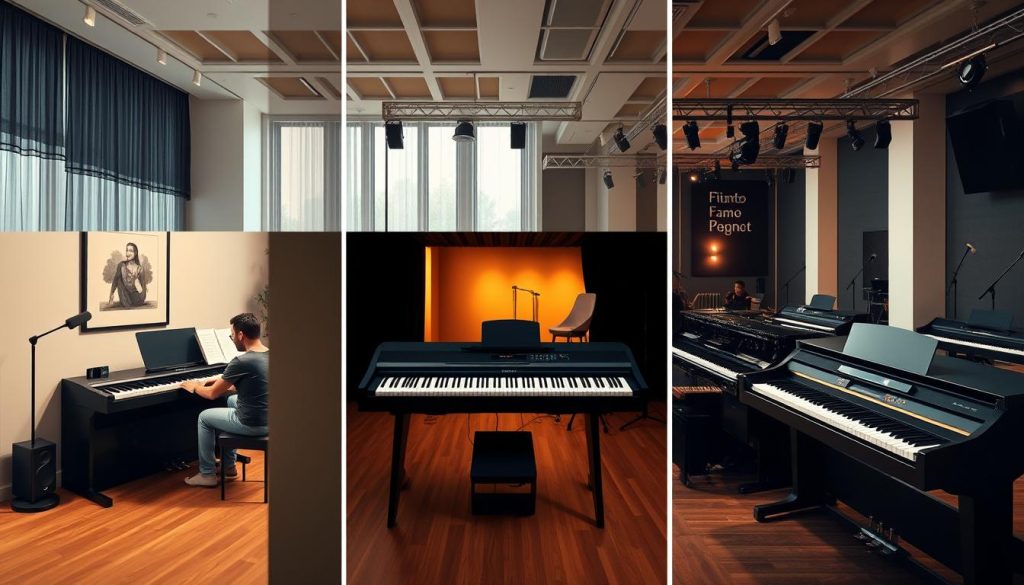
An instrument must be assessed in light of its use: the living room, apartment, rehearsal room, and stage each call for different priorities.
Headphone playing, volume control, and apartment constraints
In an apartment, headphone playing is essential. Choose good quality closed-back headphones to reduce listening fatigue and avoid disturbing others.
Look for a model with precise volume control and a reliable headphone output. Home amplification (from 2 × 8 W to 2 × 20 W) is enough for a living room, while headphones provide another way to listen.
Portability and durability: stands, bundles, weight, and transport
Portable pianos need a suitable stand. Manufacturers often offer bundles with a stand and padded case.
Consider the weight: above 20 kg, plan on two people or a trolley. The FP-90X (around 23.6 kg) illustrates this constraint.
- Living room: balanced amplification and a stable cabinet with an integrated three-pedal unit.
- Apartment: headphone output, precise volume control, and gentle equalization.
- Rehearsal: sturdy portable piano, stereo outputs, and a rigid stand that keeps the keys stable.
- Stage: line outputs, quick sound selection, and durability during transport.
“Choosing the right balance between size and performance helps you make the most of your space without sacrificing quality.”
Budget, value for money, and current price ranges
To assess the true cost of a purchase, add accessories, transport, and warranties to the advertised price.
2025 price benchmarks: Roland FP-30X, around €599; Yamaha YDP-145, around €833; Kawai ES-920, around €1,222; CLP-825, around €1,329; P525, around €1,695.
Practical ranges: entry-level and mid-range portable models, around €400 to €700; compact and cabinet models, around €800 to €1,500; premium models, over €1,500.
The price mainly reflects the quality of the keyboard, sound engine, amplification, and finish. A well-equipped portable model with a stand may offer better value than an entry-level cabinet model if portability matters most.
Consider accessory bundles (stand, three-pedal unit, bench, headphones): they can reduce the overall cost. Remember extra expenses such as transport, cables, a case, and possibly installation.
Tip: prioritize a better keyboard over secondary features. Check the warranty and after-sales service in France, then compare seasonal offers and rebates.
To learn more about your options and read our piano comparison, look at guides and promotions before making your final choice.
Testing and adjusting a piano before deciding
The best purchase comes from a methodical trial. Play familiar passages, compare two models, and adjust their settings to get closer to the feel of your ideal instrument.
In-store checklist
- Repetition speed: repeat the same note quickly and check that the response stays consistent.
- Dynamic range: play from pianissimo to fortissimo to assess response and nuance.
- Pedal: check half-pedaling and whether resonance continues smoothly with the sustain pedal.
- Listen for consistency between headphones and speakers, as well as simulated mechanical noise.
- Note how easy the controls and features are to access while playing.
Useful settings to try
Adjust the velocity curve to obtain a natural response to both light and strong attacks.
Use reverb and chorus sparingly when testing: they should enrich the sound without masking it.
If the instrument offers keyboard calibration, run it to make the feel consistent from key to key.
“Comparing two models with the same settings and headphones makes the decision much easier.”

To make your trials more thorough and prepare an objective shortlist, read our practical guide on which instrument to choose.
Common mistakes advanced pianists should avoid
A poor choice on essential features quickly takes its toll: frustration, limits on expression, and an early replacement.
Do not confuse style with musical quality. Choosing design or secondary features over the keyboard and sound engine is a common mistake.
Underestimating polyphony and amplification
Polyphony should exceed 128 notes if you play Romantic repertoire or dense jazz. Test long notes held with the sustain pedal and layered sounds.
Assess amplification under realistic conditions: 2 × 8 W may suffice in a small living room but limit the sound in a larger space.
Neglecting the action and playing feel
Check the action (GHS, GH3, PHA-4, Grand Feel) and the consistency of the keys across the keyboard.
Check the response of the pedals and the consistency of the touch; an unsatisfying feel often leads to replacing the instrument sooner than planned.
| Mistake | Consequence | Recommended action |
|---|---|---|
| Prioritizing appearance | Unsuitable keyboard | Test the feel before buying |
| Insufficient polyphony | Notes cut out | Test with the sustain pedal and sound layers |
| Insufficient amplification | Loss of dynamics | Listen under realistic conditions |
| Cutting costs on pedals and stand | Instability, poor response | Invest in a reliable three-pedal unit |
- Do not rely solely on in-store demonstrations: listen through headphones, too.
- Write down your criteria and check them during the trial.
- Allow room in your budget for essential accessories.
Alternatives to consider: acoustic and hybrid
When choosing an instrument, acoustic and hybrid pianos remain important alternatives.
Strengths and limitations of an acoustic piano
The acoustic piano remains the benchmark for expressiveness and natural resonance. Its mechanical action and projection create a distinctive interaction with the sound.
On the other hand, it is large and needs regular tuning and technical maintenance. Both its purchase price and its upkeep over several years are costly.
What hybrid pianos offer
Hybrid pianos combine a real action, a silent playing option, and high-quality electronics. They offer a strong compromise for musicians seeking an acoustic piano’s feel without all its sound-related constraints.
However, they remain expensive and require careful installation.
“Try acoustic, hybrid, and digital pianos side by side to assess differences in expressiveness and projection.”
- Practical advantage: electronic options offer adjustable volume, headphone playing, and useful connectivity for practice.
- Selection criteria: space, neighbors, budget, and time available for maintenance.
- Recommendation: consider an electronic instrument as a complement for practicing late without disturbing anyone.
Essential accessories for advanced playing
Well-chosen accessories immediately improve comfort and playing precision. They extend the instrument’s life and simplify recording at home.
Bench, headphones, pedals, and stands
Adjustable bench: align your wrist and forearm to reduce tension and improve precision.
Quality closed-back headphones: they reveal the subtleties of sound engines and prevent noise disturbances in an apartment.
Stable three-pedal unit: essential if you use half-pedaling to shape resonance.
Dedicated stand: it provides rigidity and a consistent height. Often included in bundles, it offers a good balance of cost and convenience.
Protection, interfaces, and monitoring
Padded cases: they protect portable instruments in transit. Regular keyboard care preserves the feel of the keys.
Audio/MIDI interface: it reduces latency and captures high-fidelity sound. Reliable cables and adapters help avoid interruptions.
Nearfield monitors: chosen to suit the room’s size, they reproduce sound more faithfully than built-in speakers.
| Accessory | Advantage | What to check |
|---|---|---|
“Put together a coherent set of accessories: comfort, reliability, and efficiency all benefit compared with improvised purchases.”
Conclusion
At the end of this guide, prioritize a convincing keyboard (GHS/GH3, PHA-4/50, Grand Feel), an expressive sound engine, and generous polyphony (192 or 256 notes). These factors determine the instrument’s quality and how well it supports your playing over time.
Narrow your selection to one or two models and test them through headphones, then through speakers, using your own repertoire. Check pedal response and whether notes remain sustained in dense passages.
Match your budget to your intended use and how long you plan to keep the instrument. Established brands reduce risk; consider accessory bundles and 2025 offers to optimize the price and value for money.
Keep a checklist and test the settings (velocity, reverb, chorus). This practical approach helps you choose a suitable, durable piano.