
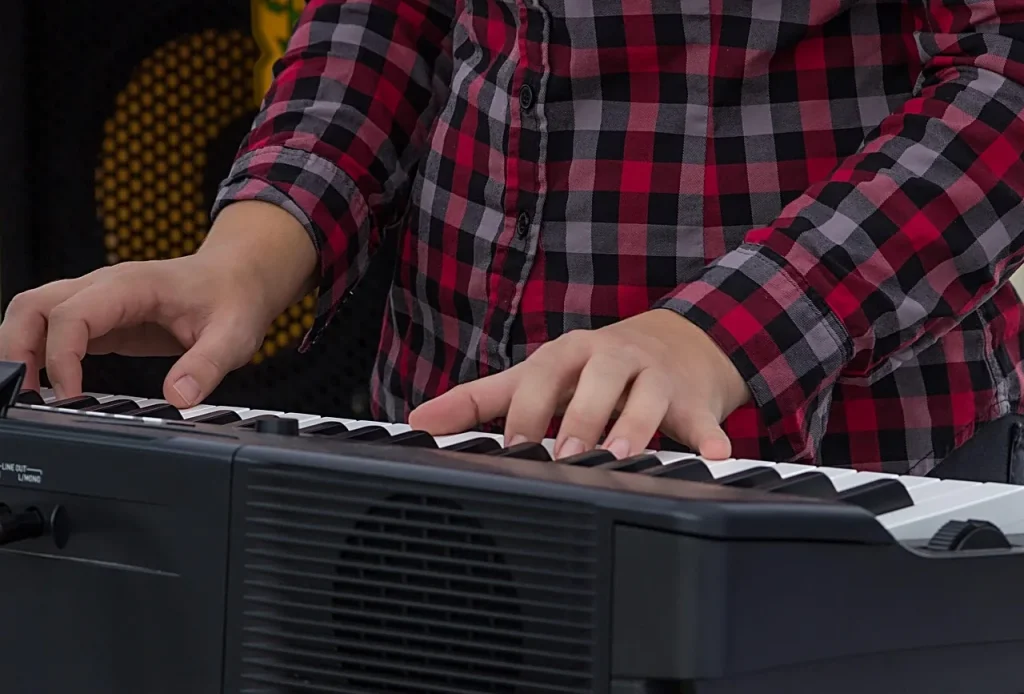
The electronic piano market in France attracts musicians looking for a capable instrument at an affordable price. New prices are rising, while buying second-hand often gives you access to good models without exceeding your budget.
Before buying, inspect the overall condition, keyboard, pedals, screen and controls. Test the sound quality by playing every note at different volumes to detect any buzzing or crackling.
Check the polyphony (at least 64 notes, ideally 128 or 256), sounds, metronome, recording features and USB/MIDI/Bluetooth connectivity for working with a DAW.
Favor established brands such as Yamaha, Roland, Kawai and Casio. Compare new and second-hand prices, then factor in transport and other expenses to calculate the true cost.
This guide gives you a clear method for buying with confidence. For a detailed checklist, see our page on how to buy an instrument second-hand.
Used digital pianos: pitfalls and good deals
A thorough inspection in person helps prevent unpleasant surprises after purchase. In a private sale, the instrument is often sold as is, without a warranty or an easy way to return it.
Common pitfalls in private sales
Beware of offers that look too good to be true: an unusually low price with no opportunity to try the piano is a warning sign. Be wary if the seller refuses a demonstration, insists on a remote sale or will not let you test the USB/MIDI ports.
Check for typical faults: sticking or squeaking keys, a sustain pedal that does not work, crackling speakers, dead pixels on the screen or unresponsive buttons. Play every key across all octaves and test the pedals.
Positive signs that inspire confidence
Evidence of good care builds confidence: the original receipt, manual, complete accessories (power supply, pedal and music rest) and a history of light use.
Test every connection: a working headphone jack, audio outputs free of interference and USB/MIDI ports recognized by a computer or app. The recommended minimum polyphony is 64 notes; 128 or 256 notes are preferable for advanced playing.
Compare several listings to gauge the market price. If you have doubts, do not buy without trying the piano in person.
Quick check: appearance, operation of every key and pedal, consistent sound quality, working ports, and the presence of documentation and accessories.
Understand the market in France and define your needs
Start by clearly defining what you need: home practice, music production, support for your studies or a return to playing after a break.
Your goals, budget and skill level
Identify your level (beginner or amateur) to determine the keyboard feel and sounds you need.
Set a realistic budget that includes the purchase price, transport and any missing accessories. A clear budget helps prevent unpleasant surprises.
Where to find reliable offers
Le Bon Coin remains a major source of listings, alongside specialist shops that sell inspected instruments.
Compare several listings and check with the manufacturer (Yamaha, Roland, Casio or Kawai) whether replacement parts are available.

Discounted new model or recent second-hand one
Depreciation is steep in the first few years; after that, the value stabilizes. Sometimes a discounted new model from a dealer is a better choice than a used one without a warranty.
If you cannot try the instrument in person, consider a discounted new model. For practical buying advice, see buying a used piano.
- Clarify how you will use it (at home, for music production or for study).
- Set a complete budget (purchase and transport).
- Compare several listings to gauge the price of the piano you want.
Inspect the overall condition: case, keyboard and pedals
A close look at the case and cabinet quickly shows whether the instrument has been treated well. Start with the exterior before testing the sound.
Case, scratches and cracks: what is acceptable
Examine the case in good light. Superficial scratches are acceptable. Cracks, crushed corners or broken plastic indicate a risk of structural damage.
Test every key and pedal
Check the keyboard alignment and play every key, from low to high, with varying force.
Listen for squeaks and clicks, and look for silent notes: these signs may indicate worn sensors or connections that need attention.
Operate each pedal: the sustain pedal should respond smoothly and quietly. Unusual resistance needs investigating.
Portability, stability and vulnerable parts
Check the legs and screws, and make sure there is no sideways movement. An unstable stand affects comfort and safety.
Ask whether the instrument has been well maintained, identify any hard-to-find parts and take photos to document its condition before negotiating.
Test sound quality and polyphony before buying
A systematic sound check can reveal faults that may affect your decision. Play every key slowly, then quickly. Listen for silent or inconsistent notes, buzzing and crackling.
Assess the polyphony: 64 notes is a minimum. Choose 128 or 256 notes for broad chords, sustained notes and clear sound layering.

Test the speakers at low, medium and high volume. Distortion or muddy bass may point to a worn amplifier or speakers. Try headphones too: if the sound is clear through them but the speakers distort, the problem often lies with the internal amplification.
- Play wide chords and arpeggios with sustain to check the polyphony.
- Layer two sounds (piano and strings) to check their balance.
- Turn on reverb and chorus: well-adjusted reverb enriches the sound without muddying it.
Then weigh the price against the performance: genuine sound quality is judged by listening, not just by reading a listing. For more practical advice, see our buying guide.
Key features and connectivity to check
Built-in features affect everyday use: check them before negotiating.
Quick check: operate the volume control (it should not crackle), try the sounds — piano, organ, harpsichord and electric piano — and check the metronome, transpose function and recorder.
Try reverb and chorus with several presets. Test sound layering and keyboard splitting to judge the balance between two tones.
Connect the instrument by USB/MIDI to a computer or tablet to check that a DAW (GarageBand or Logic Pro) recognizes it. Test the headphone and audio outputs for hiss or intermittent connections.
If it has Bluetooth, check pairing and connection stability with a learning app.
| Category | Essential tests | Practical notes |
|---|---|---|
| Entry level | Volume control without crackling, metronome, working headphones | Ideal for beginners, limited effects |
| Mid-range | Sound layering and keyboard splitting, reverb and chorus, USB/MIDI | A good balance for study and music production |
| Professional | Advanced recorder, stable Bluetooth, XLR outputs | Suitable for rehearsals and recording |
Buying tip: prioritize features you will actually use. To estimate your budget, see our page on the price of an electric piano.
Instrument age and storage history
The year of manufacture offers clues about the technology inside and the risk of wear. A recent model (five years old or less) often has more features and less worn components.

Year of manufacture: value, electronic wear and parts availability
Sensors, speakers and sockets wear over time. An instrument less than five years old reduces these risks.
Check parts availability for the brand and model. A lack of parts lowers the value and makes repairs harder.
Storage conditions and questions for the seller
Ask where the instrument was used: in a living room, cellar or garage? Humidity and temperature changes can damage components.
Ask how often it was transported and how it was maintained, then request the exact year of manufacture or the original receipt.
A well-maintained instrument kept in a dry place is more likely to retain its condition, value and repairability. By contrast, crackling when controls are operated or oxidation on connectors suggests poor storage conditions.
Conclusion: the price should reflect the age, history and ease of finding parts. A piano in good condition can last for several years if it has been stored properly.
Prices, negotiation and additional costs in France
First, define your true budget. The advertised price is only part of it: add transport, any repairs and missing accessories.

Compare new and second-hand prices and model values
Rule of thumb: a second-hand instrument often sells for 50% to 70% of its new price, depending on its age, condition and brand.
Brands such as Yamaha, Roland and Kawai tend to retain their value better. Check the model’s current new price to establish a realistic range.
Useful points for negotiation
Prepare a checklist: cosmetic wear, keys or pedals that need adjustment, speakers that distort or a screen with defects.
- Missing accessories (stand, pedal or power supply) may justify a lower price.
- Estimated repair costs can be deducted from the asking price.
- The absence of a warranty in a private sale may justify a lower offer.
Transport, delivery and other costs to include
Calculate transport costs based on distance and weight. Stairs, disassembling a cabinet or hiring professionals can raise the bill considerably.
Do the math: purchase price + additional costs + any necessary work = final budget. If the total exceeds your limit, broaden your search to other models or specialist sellers.
Recommended brands and models for a confident second-hand purchase
Favor proven models: they offer consistent sound and accessible technical support in France. Choosing a major brand reduces the risk of being unable to find parts after a few years.
Yamaha: the P-125 remains a popular model. Sturdy and portable, it offers balanced sound quality and holds its resale value well.
Roland: the FP-30 appeals to buyers with its modern connectivity and generous polyphony. Test Bluetooth and sound responsiveness when you try it.
Casio: models in the Privia series (PX-160 and PX-770) offer excellent value for money. The PX-160 suits portable use, while the PX-770 has a more substantial cabinet style for the home.
Kawai: the ES110 offers realistic key action and a rich sound close to that of an acoustic piano. It suits players seeking expressiveness and playing comfort.
Practical tips: check that the keys feel consistent, test the headphone output and polyphony, then compare the asking price with listings for models from the same year.
Conclusion
To sum up, follow a simple, thorough method. Define your needs and budget, focus on reliable brands and test the instrument in person. Check the keyboard feel, sound consistency, polyphony and USB/MIDI/Bluetooth connectivity.
Inspect the case, keys, pedals and screen. Consider its age and storage conditions: an older instrument that has been well cared for is often a better buy than a newer one that has been treated poorly.
When buying a piano, document every fault to support your negotiation; in a shop, the added security and services may justify a higher price. Remember transport costs and accessories: they count toward the final budget too.
In short: buying second-hand can give you a better-quality instrument for less than a new model, provided you compare offers, try the instrument and take your time. Beginners will appreciate a reliable model that retains its value over the years.