

Guide objective: help you decide whether pairing an electronic instrument with a wireless device suits the way you play in France.
All models have a PHONE/OUTPUT jack, making quiet practice easier and often letting you hear the sound more clearly than you would in the room.
Good, comfortable headphones with a neutral sound improve immersion and precision. Professional models such as the Beyerdynamic DT 770 Pro 80 Ω and the Sony MDR-7506 show the value of faithful sound reproduction.
Wireless headphones offer freedom of movement, but latency can interfere with playing in real time. This article explains when latency is acceptable and when a wired connection is preferable.
We offer a buying guide covering technical criteria, headphone types (closed-back or open-back), impedance, comfort, mistakes to avoid and hearing safety advice (the 60/60 rule).
Our aim is to give you a clear, practical answer, step by step, so you can get the most out of playing your piano with headphones.
Digital pianos, quiet practice and the freedom to play in France today
Headphones make practicing an electronic instrument discreet and flexible. In shared housing, they let you practice at any time without disturbing neighbors or family.
Using a dedicated output (usually 6.35 mm, sometimes 3.5 mm) provides clear, distortion-free listening. Check whether the instrument has an independent volume control so you can maintain a steady level during practice.
Modern digital pianos offer powerful sound engines and high polyphony. These improvements are easier to hear through headphones, where every detail and resonance comes through.
Some binaural technologies, such as Yamaha CFX Binaural Sampling, simulate the space around a grand piano to create a realistic soundstage through headphones. Closed-back headphones remain a good choice in noisy surroundings because they improve isolation and concentration.
“The freedom to play also includes using accompaniments and learning apps without adding noise to the room.”
Key point: the quality of the output directly affects the sound. This provides a starting point for choosing headphones and understanding the cautions about wireless use.
Digital piano and Bluetooth headphones: a good idea?
A wireless connection is appealing for the freedom it offers, but it has practical limitations when you play in real time.
The short verdict
For playing in real time, standard Bluetooth headphones are generally a poor choice. Latency, often several dozen milliseconds and sometimes around 100 ms, affects timing, playing feel and rhythmic accuracy.
Many instruments also cannot send the piano’s sound to Bluetooth headphones. A wired connection remains the dependable choice for immediate response at the keyboard.
When wireless may be acceptable
Wireless may be acceptable for less demanding uses:
- passive listening to music or accompaniments;
- reviewing sheet music while listening to audio;
- fingering exercises at a slow tempo or introductory sessions.
Dedicated wireless systems with ultra-low latency are available (see the models discussed below). If you want to go wireless, test latency while actually playing and compare the feel with a wired connection.
“A delay of a few dozen milliseconds is enough to disrupt rhythmic playing.”
Connection stability and codec compression also have a substantial effect on perceived sound quality. For more detail, see the sections on choosing your headphones, latency and codecs, and wired versus wireless connections.
Latency: the real wireless problem when you want to play without delay
Latency immediately changes how playing feels: even a small delay can break your rhythm.
Understanding latency and its impact
Definition: latency is the time between pressing a key and hearing its sound.
Even a delay of around 100 ms, common with consumer headphones, makes rhythmic playing less precise. Coordination between your hands suffers, and controlling the sustain pedal becomes more difficult.
Codecs and “low latency”: limits and realities
So-called “low-latency” codecs sometimes improve response, but they do not match the responsiveness of a wired connection. Implementation varies, and a “low-latency” label does not guarantee that you will notice no delay at the keyboard.
Wireless latency also adds to the piano’s internal delays and those of its effects, such as reverb and modeling. The total delay may then exceed what is tolerable for learning or recording.
- Rhythm exercises, fast staccato notes and virtuosic passages are affected most.
- Avoid areas with crowded radio frequencies: interference can undermine stability and make the delay more noticeable.
- A few proprietary “ultra-low-latency” systems exist, but they are uncommon.
“For playing without delay, choose a direct connection.”
Recommendation: choose a wired connection for rehearsal, learning and recording, where precision matters. Its immediate response removes the main wireless obstacle.
Sound quality and frequency response: what a piano needs
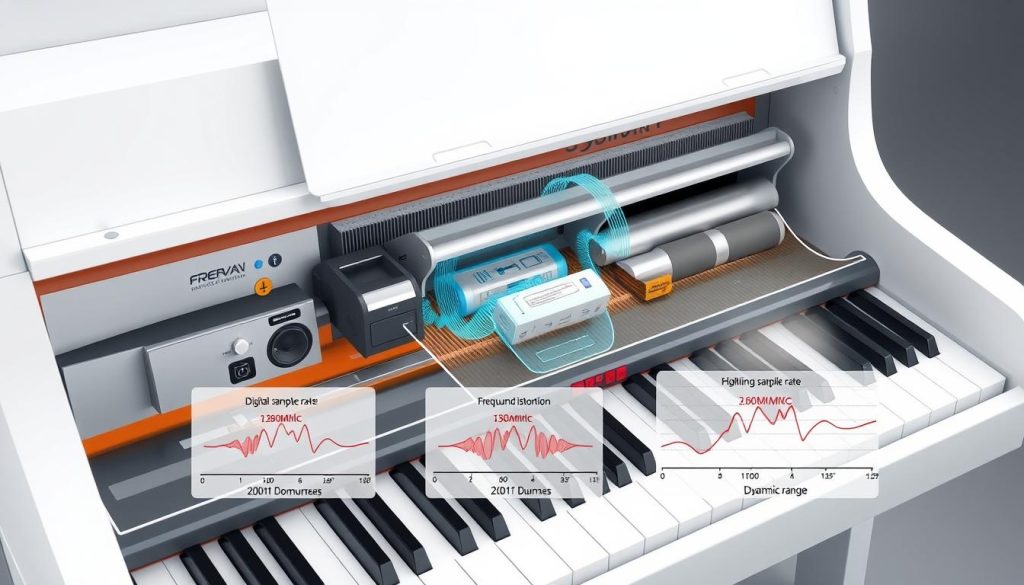
Faithful sound reproduction determines how well you hear every nuance at the keyboard. A piano spans a wide range; your headphones need to reproduce both the weight of low notes and the fine detail of high harmonics.
Wide bandwidth, precise highs and deep bass
Suitable headphones have an extended frequency response, ideally from 20 Hz to 20 kHz or wider. This helps you hear the attack, resonance and decay of every note.
Precise highs reveal resonances and natural spatial detail. Well-controlled bass supports the sound without overwhelming the midrange.
Neutral sound or boosted bass: why avoid typical consumer headphones
Consumer “V-shaped” sound profiles exaggerate the bass and soften the highs. They can make pop music enjoyable, but they conceal the nuances you need for practice.
To improve your playing, favor high-quality, neutral reproduction. Monitoring headphones such as the Beyerdynamic DT 770 Pro, Sony MDR-7506 or Audio‑Technica ATH‑M50x support balanced sound and detailed listening.
“Controlled bass is better than inflated bass: it preserves midrange clarity.”
- Listen to slow, harmonically rich passages to assess how well headphones reproduce fine detail.
- Check that the response is consistent across the full range of frequencies.
- If needed, adjust the keyboard’s EQ to compensate without distorting the sound.
| Model | Type | Strength | Best for |
|---|---|---|---|
| Beyerdynamic DT 770 Pro | Closed-back | Neutrality, controlled bass | Home practice, monitoring |
| Sony MDR-7506 | Closed-back | Precise highs | Detailed listening, rehearsal |
| Audio‑Technica ATH‑M50x | Closed-back | Balanced response | Studio work, learning |
| AKG K240 MKII | Semi-open | Natural soundstage, clear midrange | Critical listening, light mixing |
Closed-back, open-back or semi-open headphones: isolation, soundstage and comfort
Isolation
, ventilation and comfort guide your choice according to where and how you play.
Closed-back: isolation for practice at homeAdvantages:
excellent isolation, tighter bass and less disturbance to others. Ideal in an apartment or studio for limiting sound leakage.Limitations:
heat and pressure on the ears after several hours. Take regular breaks and adjust the headband to reduce fatigue.
Open-back: ventilation and a natural soundstageAn open-back model offers a wide soundstage and a natural feel. The reproduction
of harmonics seems airier, and reverb sounds more natural.
On the other hand, isolation is poor and sound escapes, which may disturb people nearby.
Semi-open: a compromise to consider
Semi-open headphones can provide a useful balance depending on ambient noise. They allow some airflow while retaining moderate isolation.
Test headphones with dynamic and pianissimo passages to assess how much isolation you need. For detailed comparisons, see a practical guide to closed-back models.
Impedance, sensitivity and headphone output: finding the right match for your instrument
The match between headphone impedance and the instrument’s output often determines sound quality and volume. A suitable pairing provides appropriate volume, dynamics and frequency control without overtaxing the output stage.
32 to 80 Ω: the ideal range for most digital pianos
For most digital pianos, an impedance of 32 to 80 ohms offers an excellent balance. The built-in output generally supplies a comfortable listening level with reasonable headroom.
Headphone sensitivity matters too: a more sensitive model needs less gain to reach a safe listening volume.
High impedance: when to consider a headphone amplifier
Headphones rated at 250 Ω or more often need a dedicated amplifier to deliver good dynamics and deep bass. Without amplification, volume may be insufficient and bass may sound weak, or distortion may appear early.
- Signs of a poor match: insufficient volume, thin bass and distortion at high levels.
- Check the headphone output (usually 6.35 mm, sometimes 3.5 mm) and the quality of the keyboard’s headphone stage.
- Practical example: some monitoring headphones come in several impedances (DT 770 Pro 80 Ω and 250 Ω).
Tip: match the impedance to your use. For practice at home, 32 to 80 Ω makes it easier to use the same headphones with a piano, audio interface and portable players.
“The aim is to balance available power, headroom and fidelity.”
Comfort: weight, ear pads and pressure for hours of playing
Comfort affects both the length and quality of your keyboard sessions.
Light, well-balanced headphones reduce neck fatigue. Poorly distributed weight causes strain after a few hours; look for a well-padded headband.
Ear pads affect pressure and heat dissipation. Velour or soft synthetic leather can reduce sweating during long sessions.
Adjust the headband carefully and vary its position to avoid pressure points. Glasses wearers may appreciate moderate clamping force and softer ear pads.
Closed-back models isolate better but retain heat and moisture: plan regular breaks, roughly once an hour.
- Choose replaceable ear pads to maintain comfort over time.
- Try different sizes and padding when you can.
- Good comfort helps concentration and makes piano practice more productive.
“Comfortable equipment lets you practice effectively for longer.”
Wired or wireless: virtually no latency or freedom of movement
Choosing between wired and wireless often means weighing precision against mobility. A cable offers a simple, robust solution for serious practice.
Why wired remains the standard for studio work and practice
A cable provides virtually no latency and a stable connection. That helps with rhythmic exercises, expressive playing and studio recording.
Just plug in the headphones and play, without worrying about interference, batteries or dropouts. For daily practice, this is an excellent combination of reliability and sound quality.
“Ultra-low-latency” wireless: the few suitable options
A few dedicated systems genuinely reduce perceptible delay. The Yamaha YH-WL500 is an example designed for instruments. These systems differ considerably from standard consumer models.
Even so, battery life, charging and compatibility remain real constraints. Always test responsiveness during actual use before choosing wireless.
“For most players, wired is still the best choice for precision and reliability.”
Connections and adapters: 6.35 mm outputs, mini-jacks, cables and lengths
Jack size and cable quality directly affect how clearly you hear the sound.
Always plug your headphones into the jack labeled PHONE or OUTPUT. It may be at the front left or at the back of the piano cabinet. This output provides a signal suitable for personal listening.
Do not confuse this jack with MIDI or USB ports or pedal inputs. An incorrect connection can cause intermittent contact or unwanted noise.
Choosing an adapter and cable
Most headphones have a 3.5 mm plug. Use a good-quality 3.5-to-6.35 mm adapter to avoid interruptions. Screw-on or plated adapters can help reduce intermittent contact.
Choose a durable cable, ideally detachable and at least 2 m long, so you can move comfortably. Keep it away from the pedals and the wheels of your seat.
- Choose a sturdy cable to limit handling noise.
- A coiled cable can reduce clutter while still allowing movement.
- Check the connector and adapter regularly for wear.
Useful piano settings: EQ, reverb and binaural sound
Careful EQ adjustment lets you tailor the output to your headphones and hear detail without artificial coloration.
EQ: slightly reduce overly bright highs or excessive bass. For neutral sound, aim for a balance among bass, midrange and treble. On models such as the Yamaha P-525, save a preset for each pair of headphones.
Reverb and binaural sound: reverb simulates different spaces, such as a studio or concert hall. Binaural sounds (for example, Yamaha CFX Binaural and Casio GP-310) offer natural positioning and a more realistic soundstage through headphones.
Compare short and long reverb settings for the style you play. Experiment gradually, then return to your reference settings to judge the result fairly.
Safe volume and the 60/60 rule
Apply the 60/60 rule: listen at no more than 60% of maximum volume for 60 minutes, then take a break. Raise the volume gradually at the start of a session to acclimate your ears without overwhelming them.
“An active limiter and saved EQ presets help protect your hearing while keeping the sound consistent.”
| Setting | Recommended action | Benefit |
|---|---|---|
| EQ | Reduce highs or bass according to the sound profile | More neutral response and clearer detail |
| Reverb | Compare short and long reverb | A soundstage that suits the style |
| Binaural sound | Enable the option if available | Natural positioning and immersion |
| Safety | 60/60 rule and limiter | Helps prevent listening fatigue |
Use cases: apartment, studio, recording and learning
Each setting calls for a straightforward choice. In an apartment, prioritize isolation to avoid disturbing neighbors. In a studio, look for accuracy so you can produce clean tracks.
Playing without disturbing others while remaining aware of your surroundings
To play without disturbing others, choose a closed-back model. It limits sound leakage and helps keep your home quiet.
If you need to hear what is happening in the room, a semi-open or open-back model lets in surrounding sounds while remaining comfortable.
Monitoring and accuracy while recording
For recording, choose neutral monitoring headphones, such as the DT 770 Pro or MDR-7506. Isolation reduces sound bleeding into microphones and makes it easier to follow a click track.
- Apartment: closed-back to avoid disturbing others; open-back if awareness matters more.
- Studio: isolation and neutral headphones for accuracy and mixing.
- Learning: lasting comfort, restrained EQ for recorded takes, and room-like reverb for practice.
- A semi-open model can be useful for face-to-face teaching.
- For recording, choose a suitable cable length and check compatibility with your interface.
“Recording your practice sessions helps you improve and correct your playing.”
Budgets and ranges: from essentials to premium models
Setting a clear budget makes it easier to choose a model suited to your needs.
To start, allow around €80 to €100 for a reliable entry-level model. Headphones such as the Roland RH-5 or the t.bone HD 815 offer a reasonable option for practice and occasional sessions.
As you move up the range, expect greater durability, a more neutral sound and better comfort. Models such as the DT 770 Pro, MDR-7506 and ATH‑M50x offer excellent value for frequent use.
Premium models suit demanding production work: the Neumann NDH‑20 and comparable headphones offer precision, soundstage and professional replacement parts.
- Criteria to prioritize: type (open-back or closed-back), impedance, replaceable ear pads and cable length.
- Spending more can reduce how often you need a replacement and improve your experience over time.
“A good investment brings out your instrument’s sound without requiring you to replace the instrument.”
Match your budget to how often you play and your goal, whether practice, recording or performance. Set aside a little for good-quality adapters and cables.
Recommended models and uses: wired and low-latency wireless
Here is a practical selection of models tested for different uses, from the living room to the studio.
Neutral, precise wired headphones
Beyerdynamic DT 770 Pro (80 Ω): wide bandwidth (5 to 35 kHz), closed-back design and comfortable velour ear pads. Ideal for home practice and monitoring.
Sony MDR-7506: durable, 63 Ω, with precise highs. Excellent for recording and detailed listening.
Open-back or semi-open headphones for natural sound
Yamaha HPH-150 (48 Ω) and AKG K240 MKII (55 Ω) offer a more spacious soundstage. Use them in quiet surroundings or for teaching.
On a budget
the t.bone HD 815 (32 Ω), Roland RH-5 and ATH-M30x offer good value for getting started.
Versatility and studio use
ATH-M50x, Sennheiser HD 25 and Neumann NDH-20 suit studio needs, depending on the isolation and precision required.
Low-latency wireless
Yamaha YH-WL500: a wireless solution designed for instruments, with reduced latency. Useful if you need both mobility and responsiveness.
- Match each model to your use: apartment, studio, lessons or production.
- Check impedance and comfort to ensure a good match with your piano.
- Favor models with a replaceable cable and an included adapter.
- Test them with scales, low chords and trills to assess precision.
“Choose according to your priorities: isolation, neutral sound, budget or mobility.”
Common mistakes to avoid before buying
Before buying, look out for common mistakes that can spoil the listening experience.
Choosing an “extra-bass” or gaming model
Caution: multimedia headphones with boosted bass alter the piano’s sound. They hide harmonics, distort dynamics and create a real problem when you are trying to judge your playing during practice.
Ignoring wireless latency and impedance
A standard wireless connection may introduce a delay of around 100 ms. This harms timing, especially during rhythm exercises.
Check impedance and sensitivity so the listening level suits the instrument’s output. A poor match may produce weak bass or distortion.
Overlooking isolation, comfort and cable length
Poor isolation makes concentration harder and may disturb others. Check weight, clamping force and ear pads with long sessions in mind.
Choose a cable at least 2 m long and a reliable 3.5-to-6.35 mm adapter. Do not plug headphones into MIDI ports or pedal jacks.
- Turn off default sound-enhancement effects that color the sound.
- Check whether replacement parts, including ear pads and cables, are available.
- Make a short checklist before buying to avoid disappointment.
“Checking settings and compatibility carefully prevents most regrets.”
Care and durability: ear pads, cables, updates and hygiene
Simple care preserves isolation, frequency response and comfort. After each session, gently wipe the ear pads and headband with a slightly damp microfiber cloth to remove sweat and dust.
Replace ear pads when they crack: pads in good condition preserve isolation and sound quality. Store the headphones in a dedicated case away from moisture and dust.
Inspect the cable and connectors regularly to prevent intermittent contact. Always unplug the headphones by holding the plug, never the cable, and keep a spare cable for important sessions.
- Simple routine: wipe after use, take a break every 60 minutes and store the headphones in a case.
- Coil the cable carefully without twisting it, and secure it with a soft hook-and-loop tie.
- Choose models with available replacement parts to extend their useful life.
Updates: remember to update the piano’s firmware when an update is available. Fixes often improve stability and the effects you hear through headphones.
“A small care kit—a microfiber cloth, an adapter and a spare cable—prevents many interruptions.”
Conclusion
In short: favor a wired connection and neutral sound to preserve precision and fidelity.
Verdict: standard consumer Bluetooth headphones are generally unsuitable for playing in real time. A wired connection provides virtually no latency and a stable signal for practice and recording.
Choose your headphones carefully. An extended, balanced response provides faithful sound quality. Look for an impedance of 32 to 80 Ω, and use a reliable cable and adapter.
Ultra-low-latency wireless solutions exist for specific needs, such as the Yamaha YH-WL500. Finally, follow the 60/60 rule, care for your equipment and choose a model suited to your surroundings for a better experience using headphones with your piano.