

This short guide helps you choose an instrument suited to city living.
Prioritize keyboard feel and sound quality: the key action and sampling determine comfort and expressiveness. Polyphony and the option to use headphones are essential for playing without disturbing your neighbors.
Your choice depends on your skill level, available space, and the constraints of apartment living in France. Portable models suit small spaces; cabinet pianos offer a more polished appearance and greater stability.
Next, we will cover keyboard feel, sounds, connectivity (USB/MIDI, Bluetooth), useful features, and budget. Try the instrument in a store with your own headphones, and check its connections and included accessories.
Goal: combine the pleasure of playing with consideration for your neighbors and a quality keyboard.
For a complete guide and model recommendations, read our detailed article.
The apartment setting: space, volume, and neighbors
City living calls for practical choices about where to put your instrument and how loudly to play it.
Volume and headphones are decisive: playing through headphones prevents you from disturbing your neighbors. Many models have two headphone outputs, making it easier to practice together or give remote lessons.
Cabinet pianos take up more space (approximately 40–45 cm deep and 80–100 cm high). Portable models, such as the Roland FP-30X (about 14.1 kg), are easy to move and can sit on a folding stand.
Measure the available space along the wall and check the number of electrical outlets. Secure the cables and leave room for air to circulate around the instrument to protect its electronic components.
- Use pads or a rug to reduce vibrations transmitted through the floor.
- Choose a spot that does not obstruct movement around the room.
- Plan for changing needs: a compact model may be a temporary solution before you buy a cabinet piano.
In practice, the right choice balances design, footprint, and sound performance. Consider independent headphone outputs for playing at night.
Digital piano for an apartment: key criteria
Before buying, clarify how and when you play. This simple step guides the rest of your decision.
Define your needs: skill level, styles, schedule, and space
Identify your skill level (beginner, intermediate, or advanced) and the styles you play. Note how much time you have and when you practice.
- Goals: learning, recreation, or occasional performances.
- Practice time and schedule: daytime sessions or late-night rehearsals.
- Size and stand: a cabinet piano or portable model, depending on your space.
- Connectivity: USB/MIDI or Bluetooth for apps and lessons.
Prioritize what matters in an apartment
Give priority to headphones, key quality, and size over unnecessary effects.
Always test the instrument through headphones: it can sound very different from its speakers. Choose a model with a sustain pedal, at least two headphone outputs, and a USB/MIDI connection if you need one.
Quick checklist: list your non-negotiable criteria, budget for accessories (stand, bench, and headphones), and play your own pieces in the store before making your final choice.
Touch and keyboard quality: the heart of the decision
The keyboard’s feel often determines whether an instrument inspires progress or holds it back.
Types of keys: keys may be unweighted, semi-weighted, or fully weighted. Unweighted models suit an introduction to keyboards (for example, the Casio CT-S1). Semi-weighted keys offer more resistance (Yamaha P-45). To develop your playing, favor a hammer-action keyboard such as the Roland FP-30X or Kawai ES920.
Graded hammer action reproduces the varying weight of an acoustic piano’s hammers. This supports technique and expressiveness. Some hybrid actions (Yamaha NU1X) go further and approach the feel of a grand piano.
Velocity sensitivity and dynamic response curves affect expression. Some models offer several curves (Yamaha P-525) so you can tailor the response to your playing.
Finally, key texture affects grip and realism: smooth plastic, textured plastic (Casio PX-S1100), synthetic ivory (Kawai CA99), or wood (Yamaha AvantGrand N3X). In a store, test key repetition and stability, and listen for unwanted mechanical noise.
To compare models and refine your choice, see our piano comparison.
Sound quality and realism in digital pianos
Sound fidelity often shapes listening pleasure and progress at the keyboard.
Sampling: a simple sample reproduces one note. Multisampling captures several dynamic levels. Binaural sound, available on some models such as the Roland FP-90X, simulates three-dimensional listening through headphones and creates a more immersive experience.
Simple sampling, multisampling, and binaural sound
Multisampling adds more nuance between pianissimo and fortissimo. Binaural sound is an ideal option if you play through headphones at night: it recreates the position and depth of a grand piano.
Physical modeling and headphone sound
Physical modeling, used by the Nord range, goes beyond samples. It calculates the interaction of strings and resonances. The result often sounds more lifelike during long listening sessions.
Practical polyphony (with the sustain pedal)
As a guide, 32–64 notes are enough for beginners. Aim for 128 notes to play denser textures. Beyond that, 256 notes or more (for example, the Kawai ES920) help prevent notes from cutting off while the sustain pedal is down.
Built-in effects and equalization for playing at home
Simple effects—reverb, chorus, and a four-band equalizer (as on the FP-90X)—help balance the sound at low volume. Adjust the equalizer to compensate for a small room’s acoustics.
Try several grand and upright piano presets, then compare how they sound through headphones. Consistent tone across the keyboard is a sign of quality and affects long-term listening enjoyment.
For more on choosing models and features, read our complete guide.
Connectivity and features for home use
Connections and built-in features make an instrument easier to use at home.
Headphones and outputs: favor a model with two headphone outputs so two people can play or have a lesson without disturbing anyone. An auxiliary input makes it easy to connect a player or smartphone.
Line outputs: jack or XLR sockets connect the piano to home speakers or an audio interface for recording. They can provide better sound reproduction than the built-in speakers.
USB/MIDI and Bluetooth
MIDI over USB (or DIN on some models) makes it easy to use learning software and sound libraries. Bluetooth Audio lets you play along with favorite tracks, while Bluetooth MIDI connects mobile apps.
Check Bluetooth latency and stability on each model. Plan for any cables and adapters you need (6.35 mm jack and mini-jack).
Practical features
Layer and Split modes add variety to practice and creative work. A multitrack recorder and built-in metronome make it easier to assess your progress. Look for a simple interface, clear menus, and the ability to update the firmware.
| Connection | Home use | Example | Tip |
|---|---|---|---|
| Two headphone outputs | Lessons for two, quiet practice | Kawai ES920 | Test with two pairs of headphones |
| Line output (jack/XLR) | Recording, speakers | High-end models | Use an interface if needed |
| USB/MIDI & DIN | Software, virtual instruments | Standard USB MIDI | Check compatibility with your music production software |
| Bluetooth Audio/MIDI | Backing tracks, apps | Roland FP-90X | Test latency before buying |
Portable or cabinet piano: which type suits your home?
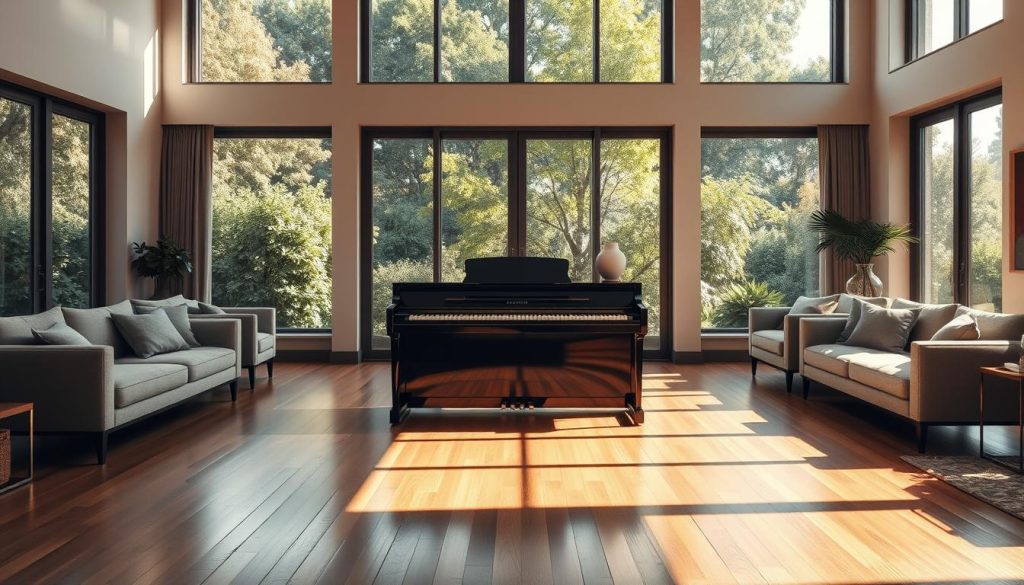
Depending on how you use the instrument and decorate your home, a cabinet piano and a portable model fit into a living room differently.
Design and fit: a cabinet piano offers a finish (wood or lacquer) that complements furniture. Its appearance can enhance the room and justify a higher price, which sometimes includes delivery and installation.
Weight and size: portable models are lighter (for example, the Roland FP-30X weighs approximately 14.1 kg) and easier to store. Cabinet pianos need more room and suitable access to avoid damage during delivery.
Speakers and sound at low volume: the built-in systems of a cabinet piano such as the Yamaha CLP-735 distribute sound better at low volume. Whether the speakers face forward or upward affects how the sound is heard in the living room.
Consider the stand: a portable instrument needs a sturdy stand and possibly a three-pedal unit. Check its rigidity to avoid bouncing and unwanted noise.
| Advantage | Portable model | Cabinet piano |
|---|---|---|
| Mobility | Very good (FP-30X) | Limited |
| Sound at low volume | Moderate (headphones recommended) | Better (built-in systems) |
| Total cost | Budget for a stand and pedals | Cabinet, delivery, installation |
| Appearance | Understated, compact | Refined, decorative finish |
Number of keys and keyboard type
The number of keys and the type of keyboard often determine what you can play and learn. They affect your repertoire, technique, and the space the instrument occupies.
88 keys: a complete foundation
If space allows (about 1.50 m of wall space), choose 88 keys. They cover the full repertoire and help you develop solid technique.
Models with 88 keys offer weighted keys that encourage accuracy, legato, and trills. Even at a low price, entry-level 88-note instruments are available. But key feel remains the priority: test how the keys repeat and how much resistance they offer.
61 or 49 keys: a practical compromise
Models with 61 or 49 keys are more compact and lighter. They suit travel or a limited budget.
However, they restrict the classical repertoire and often frustrate advanced students eventually.
- Check the total width and the position of the music rest before buying.
- Play pieces with demanding dynamics to assess the keyboard.
- Consider your available space, musical goals, and budget before choosing.
Headphones, sustain pedal, and essential accessories
Suitable headphones and sturdy accessories prevent many everyday frustrations.
Choose headphones suited to a digital piano
Criteria: comfort, suitable impedance, and neutral sound reproduction. These reduce fatigue and reveal nuances.
Bring your headphones when trying instruments. The sound through headphones is often better than that of the built-in speakers.
Pedal, stand, bench, and cover: budget for the full cost
The difference: a single pedal provides basic sustain; a three-pedal unit adds sustain, sostenuto, and una corda for greater expressiveness. Check half-pedaling compatibility if you want more subtle control.
- Stand: choose a rigid Z-style model, especially for a weighted keyboard, rather than an unstable X-style stand.
- Essential accessories: an adjustable bench, dust cover, audio cables, a 6.35 mm to 3.5 mm adapter, and possibly a small amplifier.
- Plan storage for sheet music and headphones, as well as a non-slip mat beneath the stand to reduce vibrations transmitted through the floor.
Estimated additional cost: often €100–€300 if these items are not included. Check exactly what comes with the offer.
In short, invest in accessory quality: good headphones and a stable pedal improve piano practice at home.
Budget and price ranges in France
Understanding price ranges in France helps you identify models suited to your skill level.
Entry level: learn without overspending
€200–€500: an ideal range for beginners. Affordable options include the Yamaha P-145 (about €450).
Allow another €100–€300 for headphones, a stand, and a bench. These models offer a reasonable keyboard feel, but polyphony and sound fidelity are more limited.
Mid-range: the best choice for progress
€500–€1,000: a good compromise. The Roland FP-30X (about €650), for example, offers better key feel and richer sounds.
If possible, start in this range: the improvement in quality supports long-term learning.
High-end and premium: touch and sound closer to an acoustic piano
€1,000–€3,000: instruments such as the Yamaha P-525 (about €1,750) offer a real step forward technically.
Above €3,000, premium models (Kawai NV5S, about €6,000) aim for an acoustic-like sound and long service life.
Practical tips: allow for extra costs (delivery, installation, extended warranty). Prioritize the keyboard and sound quality over gadgets. Look for promotions and bundles (stand and pedal) to make the most of your purchase and make a future resale easier.
Reliable brands and models for an apartment
Major brands now cover every need, from compact models to instruments intended for the studio.
Yamaha, Roland, Kawai: dependable choices
Yamaha offers a broad range combining realism and reliability (P-145, P-525, CLP-735). These models are dependable and have good after-sales support in France.
Roland emphasizes sound innovation and connectivity (FP-30X, FP-90X). Its SuperNATURAL technology and Bluetooth appeal to people who practice through headphones.
Kawai stands out for a touch very close to that of an acoustic piano (ES920, CA701). Its actions appeal to pianists seeking the feel of hammers.
Casio and Korg: compact size and value for money
Casio offers compact, affordable models (PX-S1100, PX-S3100). They suit small spaces without sacrificing sound quality.
Korg offers light, capable models (B2, D1, G1 Air), ideal for a living room or office.
Nord and hybrids: professional requirements
Nord models (Nord Piano 5, Stage 4) are aimed at demanding musicians. They excel at reproducing grand piano sound and offer sound expansion options.
“Choose a model by testing its sounds through headphones and comparing the keyboard feel across brands.”
Practical tips:
- Compare models through headphones so you assess them under the same conditions.
- Check the manufacturers’ apps (Yamaha Smart Pianist, Roland Piano App) to make practice at home easier.
- Read user reviews and tests before buying.
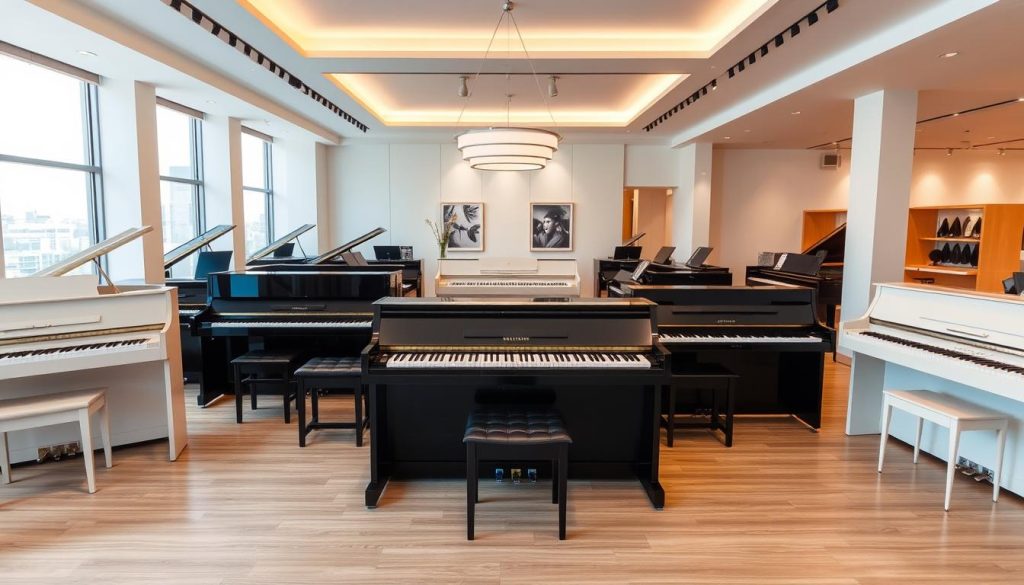
| Brand | Main advantage | Examples | Buying tip |
|---|---|---|---|
| Yamaha | Reliability and realism | P-145, P-525, CLP-735 | Test several presets through headphones |
| Roland | Sound innovation and connectivity | FP-30X, FP-90X | Check Bluetooth latency |
| Kawai | Feel close to an acoustic piano | ES920, CA701 | Test key repetition and half-pedaling |
| Casio / Korg | Compact size and value for money | PX-S1100, B2 | Consider stand bundles for compact models |
| Nord | Professional quality and grand piano sound | Nord Piano 5 | Intended for stage and studio |
Recommended models by use and available space
When choosing, think first about everyday use and the space you have.
Small spaces and tight budgets
Compact options: Casio PX-S1100, Korg B2, and Yamaha P-45, with a Z-style stand.
These models take up little room and are easy to move. Prioritize quality headphones and a stable sustain pedal to keep noise down.
Versatility at home and room to progress
To keep progressing without feeling restricted, consider the Roland FP-30X, Yamaha P-125/P-225, or Kawai ES120.
They balance keyboard feel, sounds, and features (USB/MIDI, two headphone outputs). Choose a bundle with a stand, bench, and pedal for a stable setup.
Excellent headphone sound and advanced features
If headphone sound matters most, consider the Yamaha P-515, Roland FP-90X, or Kawai ES920/ES8.
These models offer Bluetooth Audio/MIDI, an advanced equalizer, and high polyphony (192–256 voices), useful with the sustain pedal and dense textures.
- Ease of use: favor quick access to features (buttons and apps) for smooth everyday use.
- Try several velocity curves in the store to match the response to your playing.
- Check model availability and local after-sales support in France before buying.
| Use | Recommended models | Advantage |
|---|---|---|
| Small space / limited budget | Casio PX-S1100, Korg B2, Yamaha P-45 | Compact, economical |
| Versatility & progress | Roland FP-30X, Yamaha P-125, Kawai ES120 | Good key feel and useful features |
| Demanding headphone use | Yamaha P-515, Roland FP-90X, Kawai ES920/ES8 | High-quality sound, equalizer, and Bluetooth |
Final tip: plan your purchase, test instruments through headphones, and compare several models in a store to assess their sound and ease of use. This will help you make a lasting choice suited to your needs.
Digital and acoustic pianos for an apartment
Choosing between an organic sound and the ability to play quietly calls for a realistic assessment.
Practical advantages: an electronic instrument offers simple volume control, faithful headphone sound, and connectivity for apps and recording.
Stringed models produce natural resonance and harmonic richness that synthesis does not always reproduce.
Maintenance and costs: a digital piano does not need regular tuning. An acoustic piano, by contrast, needs periodic maintenance and adjustment.
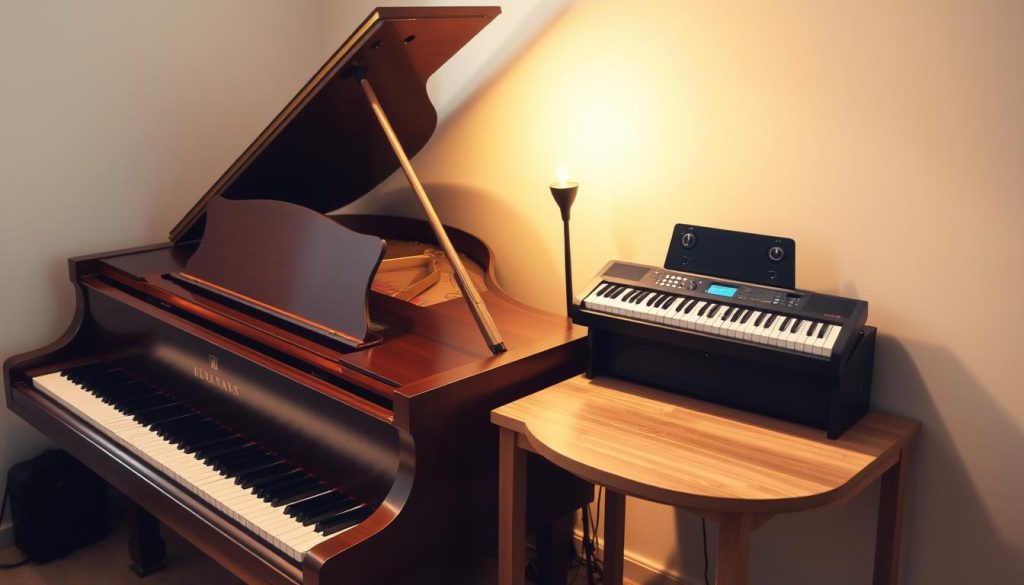
When to consider an upright piano with a silent system
An acoustic piano equipped with a silent system (for example, Yamaha SILENT B/U series or a Genio kit installed later) lets you play through headphones. The mechanism stops the hammers from striking the strings and uses sensors to capture your playing. The headphone sound reproduces the piano’s tone while limiting disturbance.
Note: even in silent mode, the mechanical noise of the keys (a faint “tap-tap”) may still be audible to sensitive neighbors.
Practical points to check before buying:
- space and weight: an acoustic piano is heavier and takes up more room, complicating delivery to an apartment building;
- overall budget: compare purchase, transport, and maintenance with the initial cost and accessories of an electronic model;
- resale: a well-regarded acoustic piano often retains its value better, but moving it adds expense.
In short, if quiet playing and minimal maintenance matter most, choose a good digital piano. If your priority is organic sound and your space, neighbors, and budget allow it, try an acoustic piano with a silent system and compare it through headphones.
“Silent piano” options and hybrid pianos
Silent and hybrid solutions pursue the same goal: playing without disturbing neighbors while retaining a realistic feel.
Silent acoustic piano: system, maintenance, and limits
Definition: a silent system stops the hammers before they strike the strings and uses sensors to capture your playing. The headphone sound is often very convincing.
Maintenance is still essential: tuning, mechanical adjustments, and cabinet care are needed even when you use silent mode.
Limitations: the feel may change slightly, and the mechanical noise of the keys can still be audible.
Yamaha SILENT (B/U series) and Genio kits illustrate these installation options for an acoustic piano.
Hybrid piano: acoustic action, digital sound, and headphone playing
Hybrids retain a real action and replace the soundboard with a digital sound engine.
Leading models include Yamaha AvantGrand, Casio Celviano Grand Hybrid, and Kawai Novus. They aim to deliver a grand piano feel through headphones.
Cost and logistics: these instruments often cost €6,000–€8,000, are heavy, and require careful delivery to an apartment building.
| Type | Advantage | Examples | Tip |
|---|---|---|---|
| Silent (retrofitted) | Retains the acoustic piano, allows headphone listening | Yamaha SILENT, Genio | Check for changes in key feel |
| Hybrid | Acoustic feel and headphone sound | AvantGrand, Celviano Grand Hybrid, Novus | Try it for an extended period to feel the escapement |
| High-end electronic piano | Less maintenance, lighter weight | Recent high-end models | Compare its headphone sound with a hybrid’s |
Durability, warranty, and minimal maintenance
Durability begins with a sturdy action and quality materials.
Build quality, keyboard action, and components
Durability depends on the action: a hammer action withstands wear better than a spring mechanism. Weighted keys and metal supports help extend its life.
Major brands such as Yamaha, Roland, and Kawai tend to last longer thanks to factory-tested components.
Protect the electronics from moisture: some internal systems may be sensitive to impacts or changes in climate.
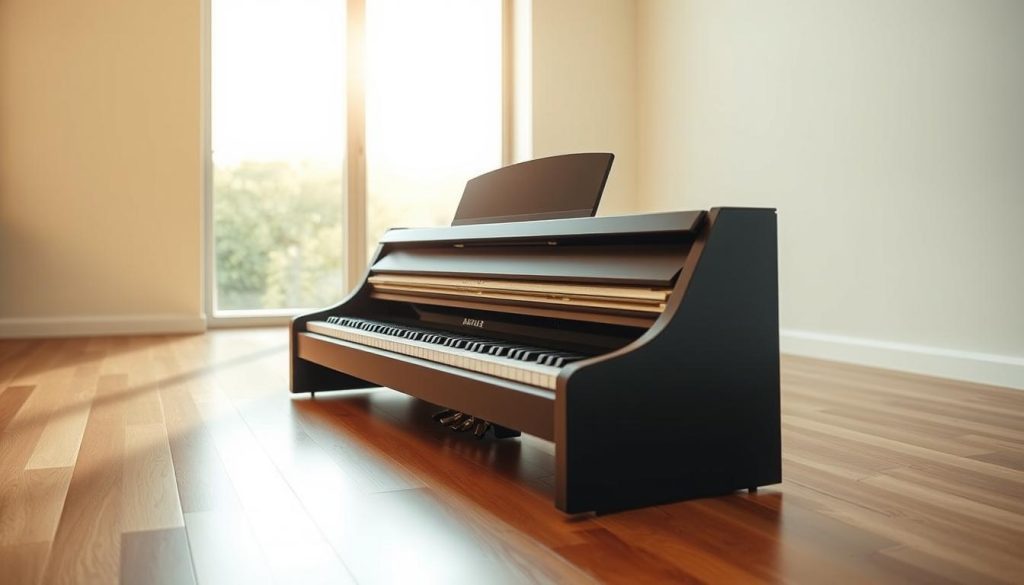
Everyday care and resale value
Clean the instrument with a soft cloth, keep it covered, and avoid direct sunlight and nearby radiators.
Test the pedals and sockets regularly to catch intermittent connections. Keep receipts and packaging: they make warranty claims easier and can increase resale value.
Warranty and purchase: check the manufacturer’s warranty period and any extensions offered by the retailer. Well-maintained pianos can fetch a good resale price, depending on demand and the market price.
A step-by-step buying plan
Organize your purchase into simple steps to avoid mistakes and stay within budget.
First step: draw up a shortlist based on your budget and available space, then arrange in-store trials.
In-store trials with your own headphones
Bring your headphones and pieces to play. Try several presets and check the dynamics and consistency of the sound.
Check connections, features, and included items
Check USB/MIDI, Bluetooth Audio/MIDI, line outputs, and two headphone outputs. Confirm what is included: pedal (single or triple), stand, bench, music rest, and cables.
Compare offers, delivery, installation, and after-sales support in France
Compare prices, bundles, and delivery terms. Check assembly conditions, packaging removal, delivery times, and the quality of local after-sales support.
| Step | Action | Practical tip |
|---|---|---|
| Shortlist | Select 3–5 models | Prioritize key feel and headphone sound |
| Trial | Play pieces through headphones | Note your impressions and favorite presets |
| Technical checks | Test USB/MIDI, Bluetooth, and outputs | Bring adapters if needed |
| Final offer | Compare prices, delivery, and after-sales support | Negotiate accessories or an extended warranty |
Conclusion
When buying, prioritize a convincing key feel, faithful headphone sound, and useful connectivity. These three points determine everyday comfort and the long-term quality of your playing.
Digital pianos offer volume control, require less maintenance, and provide great flexibility. They remain a practical solution when neighbors or space limit your options.
Consider your space, budget, and musical goals. Test instruments under realistic conditions with your own headphones, and check which accessories are included to avoid extra costs.
If touch matters most, explore premium models, silent systems, or hybrids. Plan delivery and installation too, so you can start playing with peace of mind.
Taking the time to choose well will make you want to play more often and keep improving.