
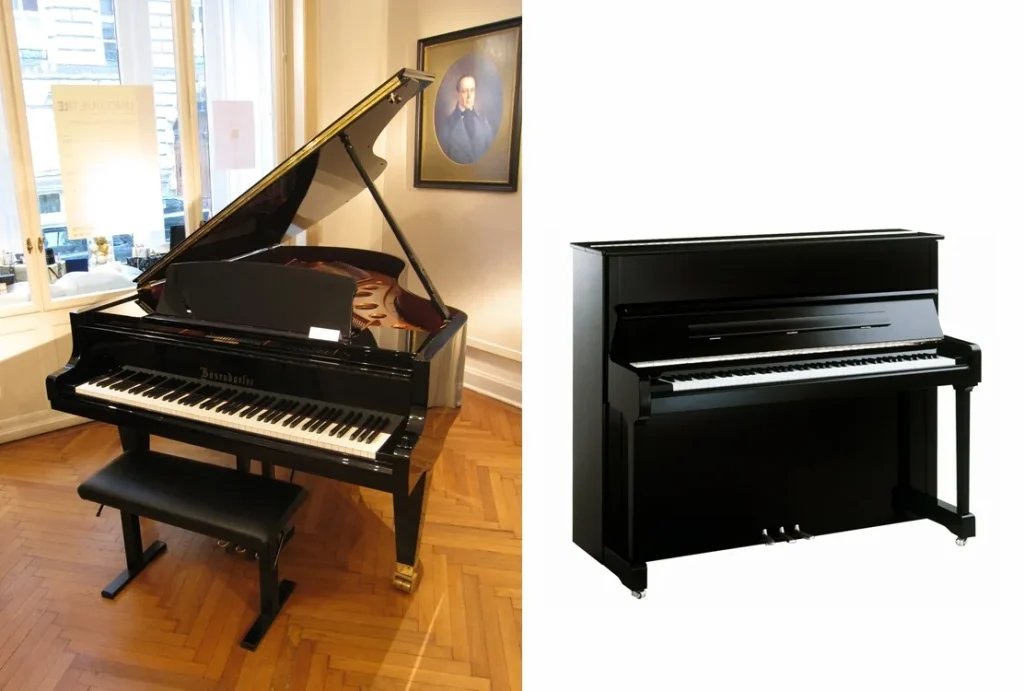
The digital piano market has changed considerably in recent years, and 2025 marks an important technological turning point. With instruments becoming increasingly realistic, compact and connected, manufacturers are finding ingenious ways to appeal to beginners and advanced musicians alike.
In this article, we present the best digital piano models in 2025, grouped by experience level, with practical advice to help you choose.
🎵 Beginner level: simplicity, good key action and an affordable price
🎹 Roland FP-10 : a budget benchmark
Roland’s FP-10 remains a reliable choice for beginners. It features a PHA-4 Standard keyboard with hammer action and escapement, giving it a feel close to an acoustic piano from the first notes. It also includes Bluetooth MIDI, making it easy to connect to apps such as Flowkey or Simply Piano.
✔ Why we recommend it:
- Realistic keyboard
- SuperNATURAL sound
- Under €600
- Lightweight and easy to transport
Ideal for discerning beginners, students or anyone looking for a simple, high-quality piano.
🎹 Yamaha P-145 : compact, expressive and practical
The successor to the P-45, the Yamaha P-145 introduces the GHC (Graded Hammer Compact) keyboard, which reproduces the graduated resistance of an acoustic piano’s keys. It is also slimmer than its predecessor and includes carefully sampled sounds from the CFIIIS concert grand piano.
✔ Advantages:
- Expressive Yamaha sound
- Very easy to use
- Perfect for home use
- Compatible with the Smart Pianist app
🎼 Intermediate level: more control and possibilities
🎹 Casio PX-S3100 : ultra-slim and versatile
With its modern look and exceptionally slim design, the PX-S3100 stands out as one of the most elegant pianos on the market. It offers 700 sounds, 200 rhythms, 192-note polyphony, a built-in sequencer and extensive connectivity (Bluetooth audio and MIDI, USB).
✔ Why we like it:
- Compact size and plenty of features
- Excellent electronic sounds and accompaniments
- Intuitive interface with a display
- Very good value for money
A smart choice for anyone who wants to learn, play and compose.
🎹 Kawai ES120 : key feel comes first
Kawai focuses on precision. The ES120 features the Responsive Hammer Compact II keyboard, with an action carefully adjusted to reproduce the dynamics of an acoustic piano. Its sounds are based on the Shigeru Kawai SK-EX grand piano, and it also offers a high-quality stereo headphone output.
✔ Key strengths:
- Warm sound
- Good dynamic response
- Bluetooth support for the PianoRemote app
- Careful construction
🎹 For experienced musicians: immersion and acoustic realism
🎹 Yamaha Clavinova CLP-885 : digital luxury
This premium piano features the GrandTouch keyboard with wooden keys, triple-sensor detection, a synthetic ivory texture and samples of the Yamaha CFX and Bösendorfer Imperial concert grand pianos. Its audio system is equally advanced: powerful speakers, binaural headphone sound and multitrack recording.
✔ Its main strengths:
- Highly realistic acoustic experience
- 256-note polyphony
- Many effects and settings
- Furniture-quality design for the living room
It is the quintessential living-room digital piano, intended for serious enthusiasts or teachers.
🎹 Kawai CA901 : a class act
The CA901 combines the Grand Feel III keyboard, with real counterweights, and an Onkyo audio system that delivers exceptional sound. Everything is housed in an elegant cabinet, with an OLED display for navigation.
✔ Standout features:
- Three-sensor keyboard with a wooden structure
- Harmonic Imaging XL samples
- Powerful, balanced speakers
- Very useful Virtual Technician feature
🤖 Innovation in 2025: connected and intelligent pianos
The emerging trend is for pianos with AI or connected learning tools.
🎹 Roli Airwave (one to watch)
Still in its launch phase, this Roli project combines a visual interface, artificial intelligence and motion sensors to guide students in real time. The idea is a teacher built into your instrument, watching you, correcting you and adapting exercises to your mistakes.
✅ Which model should you choose in 2025? Our final tips
Before buying, here are the key questions to ask yourself :
- What is your skill level? A beginner does not need 700 sounds, but does need good key action and a built-in metronome.
- Where will you play? For an apartment, choose a lightweight model with a headphone jack.
- Do you want to compose, record or simply play for pleasure? Your answer will point you toward either a simple or a feature-rich model.
- What is your budget? Expect to spend €400 to €700 to get started seriously, and more than €3,000 for a professional model.

c4ugbc4ugbEdit profile
🎯 Finally, for a complete analysis, feature comparisons, detailed reviews and regularly updated buying guides, we recommend visiting Pianup.com, a specialist platform run by enthusiasts.