
Goal of this guide: help every pianist find suitable headphones in 2025, with a focus on sound quality, comfort and compatibility with the instrument.
All digital pianos have a dedicated headphone jack. Playing with headphones lets you practise quietly and often hear more detail than through the built-in speakers.
Good headphones should have a neutral sound and a wide frequency response to reproduce the piano’s full range. Over-ear models are often preferred for their isolation and comfort during long sessions.
This guide explains how a considered choice can improve your musical experience through neutrality, frequency range and ergonomics. We will cover open- and closed-back headphones, wired and wireless models, impedance, plug types and a selection of the best headphones for piano by budget and use.
Why play a digital piano with headphones in 2025?
Listening directly through headphones can give you a more precise soundstage than entry-level speakers. The perceived sound quality is often richer and more detailed, especially in a reverberant room.
Headphones let you play at any time without disturbing others. They reduce the sound heard elsewhere in the home and make late-night practice possible, particularly in an apartment.
Repeating a passage fifty times becomes less stressful. The freedom to repeat speeds up learning and improves musicality without social pressure.
Immersion is another benefit: stereo separation is clearer and it is easier to concentrate. Headphones reduce distractions and make longer sessions more manageable.
| Situation | Benefit | Note |
|---|---|---|
| Apartment | Quiet for others | A simple, effective solution |
| Technical practice | Less pressure, faster progress | Ideal for difficult studies |
| Musical immersion | Precise stereo image | Often better than small speakers |
| Wireless or wired | Convenience or low latency | In 2025, wired remains the safer choice for playing in real time |
Headphones for a digital piano: how to choose the right pair
Neutral sound and a wide frequency range are essential for hearing all the keyboard’s harmonics and dynamics.
Choose a neutral sound signature over an exaggerated one. Avoid DJ or “extra-bass” models: they overstate the lows and obscure the midrange. An even response lets you work on nuance without being misled by artificial emphasis.
- Expected sound quality: a flat, balanced response.
- Comfort: a flexible headband and deep earcups for long sessions without fatigue.
- Isolation: closed-back over-ear headphones to limit sound leakage and background noise.
- Impedance: suitable for piano headphone outputs so you do not have to turn the volume up too far or lose dynamic range.
- Cable and plug: enough length, a durable cable jacket and a 3.5 → 6.35 mm adapter if needed.
“Neutral headphones reveal the instrument’s true sound, without a passing effect.”
Choosing by range and price: favour models that put neutrality and comfort first. A restrained but faithful pair is better than headphones with dramatic effects that soon become tiresome.
Open- or closed-back headphones for piano: which should you choose?
Choosing between isolation and openness affects how you hear dynamics and space. Consider where you practise, the background noise and the length of your sessions.
Closed-back headphones: isolation and controlled bass
Advantages: greater isolation and tighter bass. Ideal if you play in a noisy setting or an apartment.
Closed-back models limit sound leakage and retain the sound’s intensity. They help you focus when other people are nearby.
Limitations: they can become warm and trap moisture around your ears. Take regular breaks to stay comfortable.
Open-back headphones: natural soundstage and lasting comfort
Advantages: a more open soundstage and more natural timbres. Better ventilation makes long sessions more comfortable.
In a quiet room, open-back headphones produce a realistic sense of space and help you listen closely to harmonics.
Disadvantages: substantial sound leakage and little isolation. They are a poor fit when you need to keep your surroundings quiet.
Semi-open headphones: a middle ground
Semi-open models combine some ventilation with some isolation. They sound more spacious without giving up all protection from background noise.
For most home use, a closed-back model is often the default choice. If your room is isolated and quiet, however, an open-back model may improve the listening experience.
“A good balance between comfort and isolation turns every hour of practice into lasting progress.”
Wired or wireless headphones for playing piano
The connection directly affects the timing between your touch and the sound.
Bluetooth and latency: why is it a problem?
Bluetooth always introduces some latency, however small. The delay between pressing a key and hearing its sound interferes with rhythm and precision.
In addition, wireless transmission can compress audio and create artefacts. Interference in a home environment can make this worse.
Digital piano compatibility and wired alternatives
Most digital pianos do not have a dedicated Bluetooth headphone output. It is often simpler to plug wired headphones directly into the headphone jack.
Wireless solutions sometimes need a separate transmitter or adapter, adding complexity and cost.
Our recommendation: choose wired for reliability and quality
For study and performance, choose a wired connection. It avoids compression and interference and provides consistent sound quality.
- Choose a cable of suitable length with a sturdy connector.
- Route the cable unobtrusively or choose a coiled cable to keep it out of the way.
“For playing without delay, a wired connection remains the standard.”
To learn more about listening options and how to connect headphones correctly, read this dedicated guide.
Sound quality: neutral response, precision and dynamics
Sound fidelity determines whether you can really hear the nuances of your playing. Sound quality should remain transparent, without artificial emphasis that masks harmonics.
Look for an even response and a wide frequency range. These qualities reproduce the full span from low to high notes and keep resonances natural.
- Flat response: no boosted bass or artificial sound effects.
- Dynamics: reproduction from pianissimo to fortissimo without distortion.
- Frequency range: enough low- and high-frequency extension to hear pedal effects and harmonics.
- Stereo soundstage: stable positioning helps you balance your hands and refine precision.
Listening through headphones also exposes flaws. An overly flattering sound conceals performance errors. Choose precision: it sharpens your ear, touch and expressiveness at the piano.
“Neutrality reveals the instrument’s true sound; that is how you improve.”
Comfort, isolation and fit: earpads, weight and pressure
How headphones feel on your head determines how long you can comfortably play. A good balance between the earpads and headband prevents fatigue and helps you stay focused.
Velour or synthetic leather earpads
Velour breathes better and limits heat buildup. Models such as the DT 770 PRO show how soft fabric can improve comfort over several hours.
Synthetic leather provides better isolation and reduces background noise, but it retains more heat. Taking breaks reduces discomfort during long sessions.
Weight, headband and adjustments
A headband that distributes pressure well helps prevent headaches. Choose adjustable headbands and sliders for a precise fit.
- Adjusting side pressure affects both comfort and stability.
- Deep, soft earcups reduce pressure points if you wear glasses.
- Try the headphones for 30 to 60 minutes: how they feel after half an hour is revealing.
Summary: good comfort and reasonable isolation let you play longer without fatigue or loss of concentration.
To help you decide and discover options suited to modern pianos, consult this practical guide: listen and compare.
Impedance, sensitivity and power: matching headphones to your instrument
The match between the headphone drivers and the piano’s output affects dynamics and available volume.
Impedance is electrical resistance measured in ohms. It affects the level delivered by the output and the available dynamic headroom. Sensitivity (dB/mW) indicates the volume produced at a given power.
High or low impedance
High-impedance models (≥ 80 Ω) suit mains-powered devices such as many digital pianos. They offer better stability at high levels.
Low-impedance headphones.
- Recommendation: aim for 32 to 80 Ω for a good match with most keyboards.
- Check for a sensitivity of at least 95 dB so you do not need to turn the volume up too far.
Common mistakes with portable devices
Avoid using high-impedance headphones with a portable device: the sound may be quiet and flat. Conversely, very low impedance can overload a powerful output.
| Characteristic | Risk of a poor match | Solution |
|---|---|---|
| High impedance | Insufficient volume, reduced dynamics | Use an amplifier or a mains-powered device |
| Low impedance | Overload on powerful outputs | Reduce the gain or use an attenuator |
| Low sensitivity | Need to increase the volume | Choose suitable sensitivity of at least 95 dB |
A sound technical choice ensures consistent quality and comfortable use of your instrument. Effective isolation helps you listen at a moderate volume and protects your hearing.
“Matching headphone specifications to the output avoids compensating with extreme equalisation.”
Connections: how to plug headphones into a digital piano
Compatibility between the plug and socket affects everyday use and the reliability of your setup.
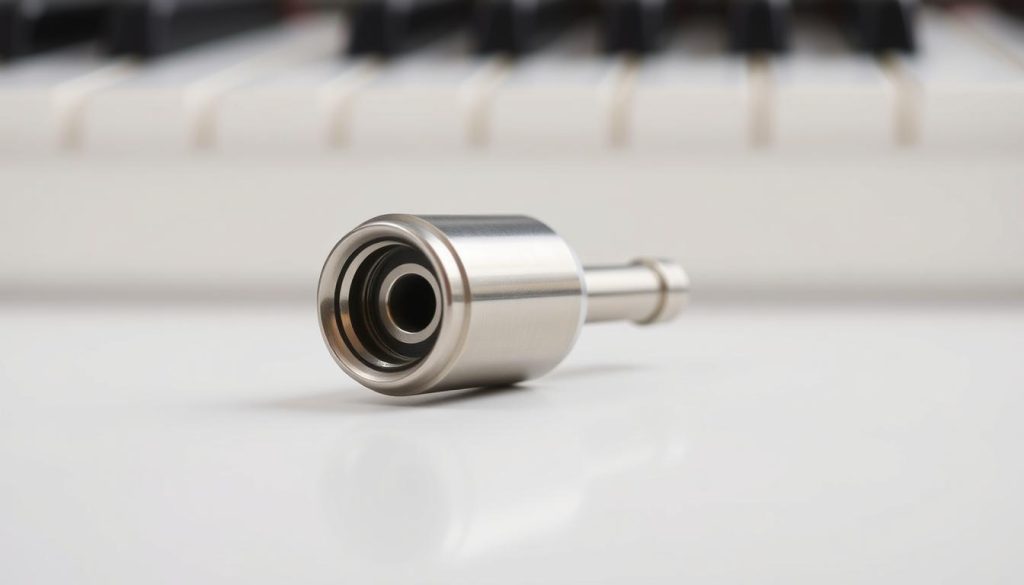
6.35 mm or 3.5 mm jack
Piano headphone outputs commonly use a 6.35 mm jack. Most consumer headphones have a 3.5 mm plug.
Solution: a 3.5 → 6.35 mm adapter is often included. Choose a screw-on model to avoid intermittent contact.
Adapters, cable length and jack location
Check where the PHONES jack is located: on the front for quick access or at the back near the other inputs, outputs and pedals.
Choose a cable long enough to avoid strain on the jack. A cable that is too short pulls on the connector and can damage the plug.
Good connection habits
- Turn down the volume before plugging in or unplugging headphones to protect your hearing and the electronics.
- Route the cable under the keyboard or through a cable guide so it cannot catch on anything.
- Choose sturdy connectors and a quality cable to preserve sound quality and the lifespan of your equipment.
“Well-chosen connections make the setup easier to use and more reliable every day.”
Our selection of the best piano headphones in 2025
This short list covers established models suited to pianists’ needs.
Beyerdynamic DT 770 PRO 80 Ω
A studio staple: closed-back headphones with velour earpads and a secure fit. Their 5 Hz to 35 kHz response offers a wide soundstage and controlled bass.
Use: ideal in noisy surroundings or for long sessions thanks to their comfort.
Sony MDR-7506
A sturdy, reliable model. Closed-back and analytical, it provides clarity in the midrange and treble, which helps when working on precision.
It offers good isolation and excellent value for anyone seeking a practical option.
AKG K240 MKII
Semi-open, light and comfortable. It offers a more open image and spacious sound, ideal in a quiet room.
A useful compromise if you value soundstage over isolation.
Quick comparison: the DT 770 PRO provides more isolation and more restrained bass; the MDR-7506 is analytical; the K240 sounds more spacious.
| Model | Type | Impedance | Strength |
|---|---|---|---|
| DT 770 PRO | Closed-back | 80 Ω | Comfort, controlled bass |
| Sony MDR-7506 | Closed-back | 63 Ω | Clarity, durability |
| AKG K240 MKII | Semi-open | 55 Ω | Open soundstage, light weight |
All three models cover the instrument’s range and convey the intent of your playing. Choose according to your room, isolation needs and budget. If possible, try them before buying and consult a detailed guide to the best headphones for piano.
“Trying headphones remains the best way to judge their comfort and sound.”
Best piano headphones by budget: from affordable to premium
Here is a breakdown by price range to help you choose according to your needs and budget.

Budget
the t.bone HD 815 and Numark HF125 are affordable options. They are light; the t.bone has an impedance of 32 Ω, and their sound is surprisingly balanced for the price.
They are ideal for getting started without spending too much. Avoid consumer models that emphasise bass too heavily.
Midrange
Roland RH-5 and Yamaha HPH-100 are designed for keyboard playing.
They provide better comfort, good dynamic handling and suitable ergonomics. If you own a Roland piano, the RH-5 fits naturally into the brand’s range.
Premium
Beyerdynamic DT770M and DT 770 PRO 80 Ω offer strong isolation, durability and comfort for long, demanding sessions.
These models suit musicians who practise often and need high precision.
- Choose your price range based on how often you play: budget for starting out, midrange for progressing and premium for intensive practice.
- Tip: base your purchase on your weekly practice hours and surroundings, whether an apartment or a dedicated room.
The best value is often in the midrange; premium models make sense when isolation and durability are priorities.
Dedicated headphones and popular piano brands
Some models are aimed specifically at pianists, with a tonal balance designed for study and practice.
Yamaha HPH-150: neutral sound and low weight
Yamaha HPH-150 is an open-back, 48 Ω model. It offers a neutral signature faithful to the harmonics and is very light.
Its low weight makes long sessions more comfortable without sacrificing clarity. Ideal for assessing the balance between your hands and your use of the pedal.
Universal compatibility: Yamaha, Roland and other brands
Most wired headphones plug into a piano’s dedicated output without difficulty, using a 3.5 → 6.35 mm adapter if needed.
- You do not need to choose the same brand: a neutral model often sounds better than headphones chosen for their logo.
- Wireless options remain poorly suited to playing because of latency.
- Headphones from piano manufacturers may offer features and sound tailored to their instruments.
“Good neutral headphones work easily with most piano setups.”
Connect, adjust, play: improve your listening experience
Before playing, a few simple adjustments can immediately improve the clarity and dynamics you hear through headphones.

Safe levels and hearing protection
Turn down the volume before inserting or removing the plug. Raise it gradually to avoid sound peaks that could harm your hearing.
Breaks and comfort
Take a 5- to 10-minute break every 45 minutes. This reduces heat and pressure, especially with a highly isolating closed-back model.
Adjusting the piano for headphones
Adjust reverb, equalisation and stereo width for a coherent soundstage when listening directly. Small EQ changes are enough; avoid excessive processing.
- Raise the volume gradually when you start.
- Reduce built-in effects if the sound seems too wide or reverberant.
- Position the plug and route the cable behind the music stand so it does not interfere with your playing position.
- Briefly compare the headphone sound with the speakers to check the balance of resonances.
| Action | Why | Quick tip |
|---|---|---|
| Lower the volume before connecting | Prevents sudden noises and protects hearing | Set the volume to minimum, then raise it |
| Reduce reverb | Improves clarity through headphones | Reduce it by 30 to 50% depending on the setting |
| Take breaks | Limits heat and fatigue | 5 to 10 minutes every 45 minutes |
Good habits when using and adjusting your equipment improve the experience and extend its lifespan.
Mistakes to avoid and smart buying habits in France
Before buying, identify the mistakes that can turn a purchase into a disappointment.
Do not choose a model based on price alone. Many disappointments come from buying without listening or trying it on. Testing the headphones lets you assess their real comfort and isolation.
Avoid “extra-bass” signatures that mask flaws and tire your ears. Overemphasised bass reduces piano precision and comfort during long sessions.
- Check plug compatibility, impedance, cable length and material quality.
- Make use of return rights available in France: try the headphones at home and compare several models.
- Choose a wired connection for study to avoid latency and audio compression.
Pay particular attention to musicians’ reviews, rather than relying only on general comments. Seek a good balance of precision, comfort and durability.
A considered purchase helps you choose headphones truly suited to everyday piano practice.
Conclusion
The best choice combines faithful sound, technical compatibility and lasting comfort. Aim for neutral, wired headphones with an impedance suited to your digital piano for precise reproduction.
Isolation: a closed-back model keeps your surroundings quiet and helps you focus; an open-back model offers a more natural soundstage in a quiet room.
Balance comfort, quality and budget. Try a few models, assess their value and keep a reliable jack adapter handy.
Pianos from brands such as Yamaha and Roland work with headphones from many manufacturers. To compare useful options, see this practical guide: digital piano headphones guide.
With these pointers, pianists can progress faster by hearing their instrument faithfully and playing longer without fatigue.