
Goal of this guide: to help you find the Arius model that suits your needs, space and budget. We keep things practical and avoid unnecessary jargon.
The Arius series comprises compact console digital pianos. They offer weighted keys and sound technologies that bring them closer to acoustic instruments. The YDP and YDP-S ranges favor the comfort of a traditional cabinet and a slimmer design, respectively.
In Yamaha’s lineup, Arius sits between the premium Clavinova range and portable models (the P Series and Portable Grand). In 2025, the range includes the YDP-145, YDP-165, YDP-S35 and YDP-S55, which differ in key action, power and cabinet design.
This guide covers the key technologies (CFX, VRM Lite, key actions and Smart Pianist), headphone sound, connectivity, pianist profiles and indicative prices in France. The prices are guides only: they vary by retailer and finish.
A buying guide to finding your Arius piano in France
Finding the right instrument means assessing your skill level, available space and budget; this guide will help you do that.
Start by identifying your profile: beginner, returning player or intermediate pianist. This makes the choice easier and quickly narrows your options.
Arius models are quality entry-level options among compact console digital pianos. They offer weighted keyboards and CFX-derived sounds for convincing realism at home.
In France, the YDP-145, YDP-165, YDP-S35 and YDP-S55 are regularly available. Delivery times vary by finish (black, white or white ash).
- Allow room in your budget for an adjustable bench, headphones and maintenance.
- Smart Pianist makes it easier to use the piano and manage its sounds from a smartphone.
- Compare offers: price, delivery and assembly affect their real value.
“Good value for money depends on longevity, key feel and support for learning.”
In short, define how you will use the piano, try the available models and choose the one with the best balance of touch, sound and price.
Understanding Yamaha’s ranges to make a better choice
Comparing product families helps you choose according to your needs and budget.
Clavinova and Arius: acoustic realism, features and budget
Clavinova targets the premium market with GrandTouch-type keyboards, Bluetooth and binaural sound options on certain models. Its sound and feel come very close to an acoustic piano, but it costs considerably more.
Arius combines a compact cabinet, weighted keys and CFX sounds with VRM Lite. It is a strong choice for beginners and families who want a stable instrument in the living room.
P Series and Portable Grand: portability, stage use and accompaniments
The P Series prioritizes mobility: its standalone keyboards, with optional stands, suit performances and rehearsals.
The Portable Grand (DGX-670) is a hybrid arranger. It includes accompaniments, a microphone input and USB recording, making it suitable for playing and singing.
Where does Arius fit for beginners and families?
For family use with a console piano, Arius is a logical choice. It combines simplicity, sound quality and a manageable price.
- If advanced key action and power matter to you: consider Clavinova.
- If mobility is your priority: choose the P Series.
- If you want a compact cabinet and good value for money: Arius fits the bill.
Yamaha Arius Digital Piano: How to Choose the Right Series
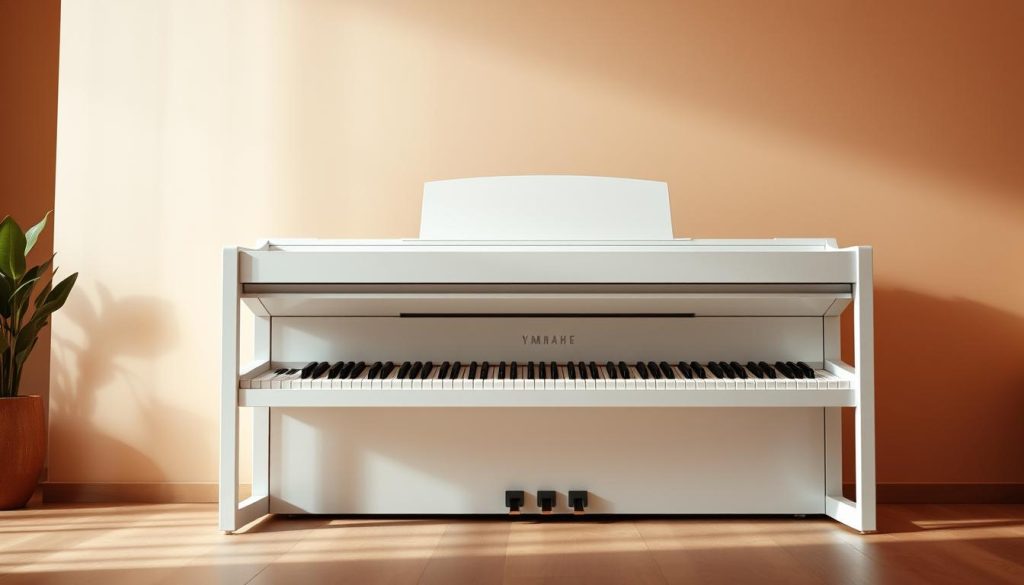
The console piano range has two families: one has a traditional appearance, while the other saves space.
YDP “Standard” — the spirit of an acoustic piano
A classic cabinet with a traditional front and music rest. It fits naturally into a living room and more closely evokes an acoustic piano through its appearance and sonic presence.
YDP‑S “Slim” — space-saving design
A slim profile and modern folding key cover help make the most of your space without compromising the playing experience. All three pedals remain integrated despite the shallower cabinet.
Shared features: both families offer 88 weighted keys, CFX sound, learning tools (metronome, two-track recorder and Duo mode) and USB to Host connectivity.
Choose according to your available space, interior style and aesthetic preferences: substantial and classic (YDP), or sleek and discreet (YDP‑S). Common finishes include black and white; the slim model also comes in white ash to suit contemporary interiors.
| Feature | YDP (Standard) | YDP‑S (Slim) |
|---|---|---|
| Footprint | Traditional depth, more substantial cabinet | Slim profile suited to small spaces |
| Design | Traditional front and music rest | Modern folding key cover |
| Keys and sound | 88 weighted keys, CFX sound | 88 weighted keys, CFX sound |
| Finishes | Black, white | Black, white, white ash |
Arius models to consider now
Here is an overview of models to try in a store or compare online. Each suits particular needs for key feel, power and learning features.
YDP-145 — an excellent entry-level instrument. CFX sound, a GHS keyboard and compatibility with Smart Pianist. Indicative price: around €868. Ideal for beginners who want a convincing practice instrument.
YDP-165 — a more expressive version with a GH3 keyboard (three sensors). It offers better note repetition and greater nuance for around €1,111. Consider it if you are progressing toward an intermediate level.
YDP-S35 and YDP-S55 — compact designs with VRM Lite and a stereophonic optimizer. The S35 (2 × 8 W) suits small living rooms (around €832). The S55 adds the GH3 keyboard and 2 × 20 W amplification for better sound projection (around €1,089).
- Try them: play the GHS and GH3 keyboards to feel the difference in repetition and control at pianissimo.
- All models include Duo and Layer modes, a two-track recorder and compatibility with Smart Pianist.
Explore these models and compare prices and options available in France.
Key technologies to understand before buying
Built-in technologies affect the playing experience far more than design or color. Understanding them helps you compare models using useful criteria: touch, response and acoustic sound.
Graded Hammer GHS and GH3: touch, repetition and nuance
GHS offers a graduated, weighted keyboard that is stable and ideal for beginners. It recreates a feel close to an acoustic model without excessive complexity.
GH3 adds a third sensor. This allows better note repetition and finer control of dynamics, useful for fast pieces or repeated notes.
CFX, Bösendorfer and VRM Lite: realistic sound and resonance
The CFX sound engine produces a bright, dynamic tone. Recent Arius models favor this sample to deliver a convincing sound.
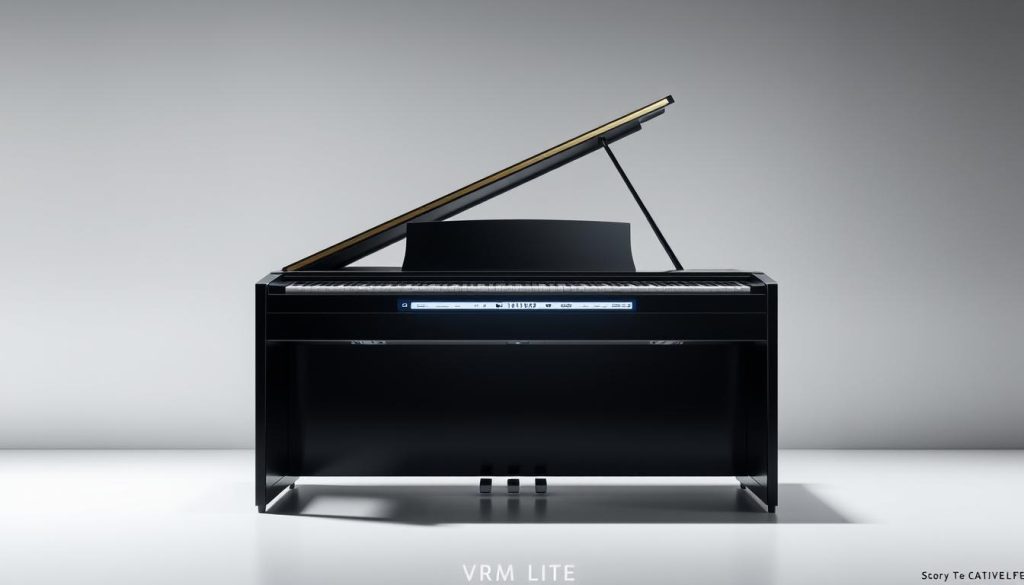
VRM Lite technology simulates string and soundboard resonance. It gives sustained chords and damper-pedal use a more natural character.
For even richer tones, higher-end ranges sometimes include Bösendorfer samples, known for their distinctive sound.
Smart Pianist: an app for learning and control
Smart Pianist is an iOS and Android app that makes settings easier to adjust, provides built-in scores and simplifies access to effects. It adds structure to practice and helps you get started faster.
IAC (Intelligent Acoustic Control) and the stereophonic optimizer improve listening at low volume and through headphones. The result is a balanced sound and a more natural sense of space during late-night sessions.
“Thoughtful technology turns daily practice into a real pleasure.”
For a complete overview of the features and models, see our complete guide.
Which Arius suits your pianist profile?
The right instrument depends as much on your motivation as on its technical specifications. For family use or a return to playing, favor a reliable model that is easy to play.
Beginners, children and players returning after a break: YDP‑145 and YDP‑S35
The YDP‑145, with its GHS keyboard and CFX sound, suits beginners and children. It offers a natural playing experience and access to Smart Pianist to support lessons.
The slim YDP‑S35 retains these advantages and adds VRM Lite for better resonance in a compact cabinet.
Intermediate or advanced pianists: YDP‑165 and YDP‑S55
To support your progress, choose the GH3 keyboard (three sensors): it offers better repetition and greater control over dynamics. The YDP‑165 suits students whose playing is advancing.
The YDP‑S55 combines GH3 key action with 2 × 20 W amplification, useful in larger rooms or for more comfortable listening.
- Practical tip: choose the YDP‑145 for a traditional cabinet and the YDP‑S35 to save space.
- Choose the YDP‑165 if you want a more refined key action.
- Choose the YDP‑S55 if you want a slim design and more power.
Read our YDP-145 review before buying to confirm your choice.
Sound, amplification and the headphone experience
Amplifier power and audio processing determine how much presence an instrument has in a living room.
The YDP‑S35 offers 2 × 8 W amplification: the treble stays clear and the bass remains present without distortion at higher volumes. This is sufficient for daily practice in a living room.
The YDP‑S55 goes further with 2 × 20 W and two headphone outputs. It therefore has enough sound headroom for larger rooms and offers greater listening comfort.
Built-in speakers, IAC and the stereophonic optimizer
IAC automatically adjusts bass and treble at low volume. The result is a balanced sound without turning up the volume, which is useful in the evening.
The stereophonic optimizer improves the headphone experience. It makes the sound seem to “breathe” around you instead of remaining confined inside your head.

- 2 × 8 W is enough for home use; 2 × 20 W provides more headroom and better projection.
- Two headphone jacks allow a student and teacher to listen simultaneously in Duo mode.
- Good studio headphones improve sound definition and help you concentrate.
| Feature | S‑35 | S‑55 |
|---|---|---|
| Power | 2 × 8 W | 2 × 20 W |
| Sound quality | Clear treble, pronounced bass | More dynamics and headroom |
| Headphones | 1 output | 2 outputs (can serve as line outputs) |
Connectivity and modern uses
Connecting your instrument to the digital world opens up new ways to practice. Built-in features make playing, recording and teaching at home easier.
USB to Host and app-based control
The USB to Host port lets you exchange MIDI data with a computer, tablet or smartphone. It lets you use music apps, send data to a sequencer and control Smart Pianist to access sounds and scores.
Two-track recorder, Duo and Layer
The two-track MIDI recorder helps you progress: listen back to your sessions, practice each hand separately and create your own accompaniments.
Duo mode divides the keyboard into two identical zones. It is ideal for lessons with a teacher or for two people playing side by side.
Layer mode combines two sounds (for example, piano and strings) to enrich expression and vary the sound of pieces you perform.
Practical tools for playing with other instruments
The metronome, transposition by ± 6 semitones and fine tuning in 0.2 Hz steps make it easier to adapt to singers or other instruments.
| Feature | Use | Example |
|---|---|---|
| USB to Host | MIDI exchange and app control | Smart Pianist, sequencers |
| Two-track recorder | Self-assessment and accompaniment | Practicing each hand separately |
| Duo and Layer modes | Shared learning and richer sound | Two students or piano and strings |
| Transposition & tuning | Adapting to voices and instruments | ± 6 semitones, 0.2 Hz |
Budget, indicative prices and value for money
Price benchmarks make it easier to compare models and retailers. Here are indicative prices in France to help set your budget and assess value for money for family use or learning.
Price benchmarks in France
YDP‑S35: around €832; YDP‑145: around €868; YDP‑S55: around €1,089; YDP‑165: around €1,111.
The DGX‑670 costs around €798 (around €979 as a bundle). Clavinova CLP models start at about €1,429 and can exceed €4,500 depending on the model and options.
Long-term value and choice
Investing in a GH3 keyboard means your instrument can continue to suit your needs as your playing improves. Better key action reduces the need to replace it soon.
| Range | Indicative price | Advantage |
|---|---|---|
| Compact format | About €832 to €1,089 | Saves space, good sound |
| Intermediate | About €868 to €1,111 | Improved key action (GH3) |
| Premium | > €1,429 | More power and realism |
Compare offers, look out for bundles (cabinet, pedal unit, bench and headphones) and account for delivery and assembly costs. Budgeting for accessories prevents surprises and provides good practice conditions from the start.
Considering other Yamaha series?
How and where you practice each day often determines the most suitable range.
P Series: portability and versatility
The P Series prioritizes mobility. The P-145 is compact and ideal for travel. The P-225 moves up the range with 192-note polyphony for denser textures.
The P-525 sits at the top of the portable range: a wooden keyboard, CFX and Bösendorfer samples, more than 500 sounds and 256-note polyphony. A dedicated stand can turn this stage instrument into a console-style piano for the living room.
Portable Grand (DGX-670): accompaniments and microphone
The DGX-670 suits players who want built-in accompaniments. It offers varied styles, a microphone input for singing and interactive recording features.
As a bundle (stand and pedal unit), it comes closer to a console piano experience while remaining portable.
- When to choose a console piano: if you prefer simplicity and a stable instrument in the living room.
- When to choose a portable model or DGX: if mobility, accompaniments or singing matter to you.
- Tip: a bundle with a stand and three-pedal unit makes a portable model feel more like a console piano.
Buying checklist and useful accessories
Good equipment makes daily sessions more productive and comfortable. Here are the essentials for protecting the instrument, improving comfort and making home practice easier.
Stand, adjustable bench and care
A height-adjustable bench is recommended: it lets you set the right height and arm angle. A stable position improves touch and posture.
Allow for a music stand light if you read scores, and soft cloths to dust the keys and cabinet regularly.
Avoid humidity and temperature fluctuations. Simple, regular care preserves the instrument’s quality and extends the life of its electronic components.
Headphones for undisturbed playing and better focus
Choose comfortable, neutral-sounding studio headphones for long sessions. Closed-back models provide better isolation and reduce sound leakage.
If you practice together, two headphone jacks are a real advantage: they let you use Duo mode and communicate as you play.
- Check the space around the cabinet and the clearance needed to open the lid on slim models.
- Check that the floor is stable; add protective pads if needed to protect its surface.
- Include the bench, light and headphones in your budget so you can play comfortably as soon as the piano is installed.
Conclusion
In short: Arius models are accessible, engaging console digital pianos with convincing sound and living-room-friendly design.
To get started with confidence, consider the YDP-145 or YDP-S35. To develop your playing, look at the YDP-165 or YDP-S55, which offer more refined key action and greater sound projection.
Compare GHS and GH3 keyboards, as well as 2 × 8 W and 2 × 20 W amplification, then try the Smart Pianist app to see how they suit you. Consider accessories (bench, headphones and light) and available space: choosing a standard or slim model affects both its sound and where you can place it.
If mobility or accompaniments matter to you, the P Series or DGX-670 remain relevant alternatives within Yamaha’s range. Ultimately, choose the instrument that makes you want to practice every day and explore music.